As with all Earthcaches it is the intent of the Earthcache creator to educate those that seek the Earthcache, please be respectful of the area in which these Springs are found, stay on the trails and viewing platforms, do not venture into the spring areas themselves.
Spring: A Spring is a component of the Hydrosphere, namely any natural occurrence where water flows to the surface of the earth from below the surface. This it is where the aquifer surface meets the ground surface.
Formation: A spring may be the result of karst topography where surface water has infiltrated the Earth's surface (recharge area), becoming part of the area groundwater. The groundwater then travels though a network of cracks and fissures - openings ranging from intergranular spaces to large caves. The water eventually emerges from below the surface, in the form of a spring.
The forcing of the spring to the surface can be the result of a confined aquifer in which the recharge area of the spring water table rests at a higher elevation than that of the outlet. Spring water forced to the surface by elevated sources are artesian wells. This is possible even if the outlet is in the form of a 300-foot deep cave. In this case the cave is used like a hose by the higher elevated recharge area of groundwater to exit through the lower elevation opening.
Non-artesian springs may simply flow from a higher elevation through the earth to a lower elevation and exit in the form of a spring, using the ground like a drainage pipe.
Still other springs are the result of pressure from an underground source in the earth, in the form of volcanic activity. The result can be water at elevated temperature such as a hot spring.
Types of spring outlets: Seepage or filtration springs: The term seep refers to springs with small flow rates in which the source water has filtered into permeable earth.
Fracture Springs: Discharge from faults, joints or fissures in the earth, in which springs have followed a natural course of voids or weaknesses in the bedrock.
Tubular Springs: Tubular springs are essentially water dissolved and create underground channels, basically cave systems.

Mineral Spring: Minerals become dissolved in the water as it moves through the underground rocks. This may give the water flavor and even carbon dioxide bubbles, depending on the nature of the geology through which it passes. This is why spring water is often bottled and sold as mineral water, although the term is often the subject of deceptive advertising. Springs that contain significant amounts of minerals are sometimes called "Mineral Springs". Springs that contain large amounts of dissolved sodium salts, mostly sodium carbonate, are called 'soda springs'.
As rain water and snowmelt percolates through glacial and river sediments on the hills above these springs various minerals are dissolved. The mineral-rich water then flows along the underlying lava until it eventually bubbles to the surface.
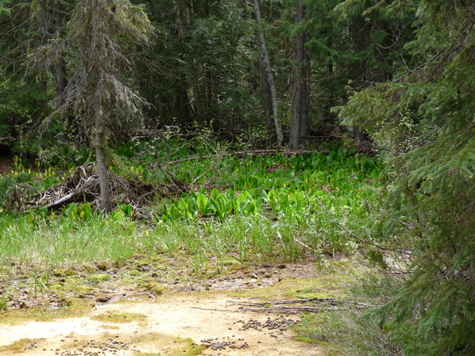
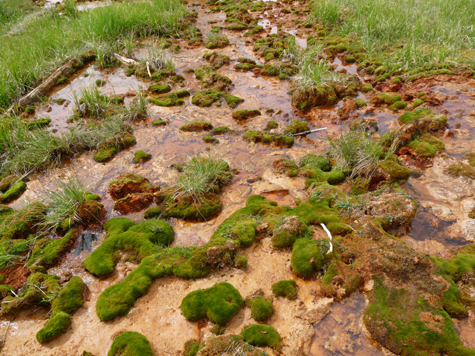
Mineral Springs have often been used for their therapeutic values and are a source of minerals for wildlife living in the area. The animals will seek out these locations and return on a regular basis to partake of the Mineral waters.
You can see in the bottom left picture the moose droppings where they have visited this site on a regular basis, the area around the picture to the lower right has been visited by Moose, Deer, Bear and Wolves as is evident by the footprints found here on a regular basis.
In order to log this Earthcache you will be required to do the following: Visit the spring at the posted co-ordinates and the nearby Ray Farm Springs at the co-ordinates below.
1) Visit the nearby Ray Farm Springs at N52 03.483 W120 09.343 and gather information at this location in order to answer some of the questions below.
2) Email the owner the answer to the following questions:
a) What has created the mound from which the cold Mineral Water flows at the posted co-ordinates, what is the name of that material.
b) Name at least 4 minerals that are present in the water of these springs.
c) Estimate the rate of flow of the water of the Spring at the posted co-ordinates.
Optional: Please post a picture of yourself with your GPS at the posted co-ordinates.
Please indicate what you might have seen that would be an indication that animals had visited the Springs, or tell us if you saw any animals while visiting.
Information for this Earthcache was gathered from the sites and some research on the Internet. You will be able to answer all questions by visiting the two sites.
Thank you to the Friends of Wells Gray and British Columbia Parks for building the viewing platforms and information panels.
| I have earned GSA's highest level: |
 |