Let’s
Visit Family
A McKee Clan
cache
Some McKee Clan history
is buried here
Located
in the Wirrabara cemetery is my grandfather
Albert
(Bert) Walter Noble
If you
have the time, the grave is east of the cache approx three rows of
graves (20m).
There is
some graves in the late 1800’s and early 1900’s near
GZ
As my family
visit regularly to this cemetery, they thought it was a great Idea
to place a cache here and help us maintain it. Mum thinks it is
great and gives her another excuse to visit her dad.
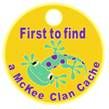
The cache contains a certificate and a
unique FTF path tag for the first to find. They are not swapped or
given out so the first to find pathtag is a unique item that no one
else will have. We have also put in some of our Gecko key rings.
Good luck Happy Geocaching.
FTF Wombat
Stew STF J & J TTF Unka Dave
Please
follow the: 
Wirrabara
The
Nearby town is Wirrabara, 235km north of Adelaide in an area first
known as Charlton. First proclaimed on 13th August 1874. Some of
the first settlers and landowners in the Wirrabara area were the
pastoralists. Thirty years before the town's proclamation, the
White brothers, Samuel and Frederick, had taken out occupational
licences and named it Charlton after their home in England. After
they had been established, their licences were converted to
leasehold in 1851. On 16 June 1853 Samuel White married Eliza
O'Halloran. When their daughter Eliza was one month old the family
left Charlton and settled at White Park. Charlton was bought by
C.B.Fisher in 1861 who named it Wirrabara.
After
farming sections were advertised during 1874, George Hollitt bought
sections 330 and 331 along the Rocky River. George, born in England
in 1830, married Mary Ann Asbury and they sailed on the Shackamaxon
for South Australia. After their arrival in Port Adelaide on 19
January 1853, George first farmed at Currency Creek before
travelling north and trying his luck at Wirrabara. His family
became well established in the area. His son Josiah, born on 12
July 1865 at Currency Creek later played a prominent role in
Wirrabara. He was secretary and Treasurer of the Bible Christian
School, secretary of the Band of Hope, trustee of the Wirrabara
Cemetery, appointed Justice of the Peace and a member of the School
Board of Advice.
When
laid out, Wirrabara was modelled on the Adelaide plan. It was
surrounded by North, East, South and West Terraces with the other
streets named First to Sixth Streets plus a Hillside Road and High
Street. The core was in turn surrounded by suburban blocks of up to
twenty acres. The first land sales were held on 24 September 1874.
The first stores to open were those owned by Andrew Clarke of Clare
and Thomas Marshall of Melrose. Others
who moved in to establish their businesses were Peter Farrely from
Saddleworth who bought lot number 64 and built a hotel. John Fry
and his wife Elizabeth opened a butcher and baker shop and William
Andrews, a saddler of Laura, opened up for business next door.
The
Wesleyans Methodists built their church in 1876, Daniel O'Leary
established a tannery in 1877 and that same year saw the start of
the Grand United Order of Oddfellows. Provisions for a cemetery
were also made and in 1878 Fanny Hollitt laid the foundation stone
for the Bible Christians' church. It was built by Yates of
Gladstone. Although private schooling had been available
on and off at Wirrabara, it was not until 1879 that the government
school was opened with Samuel Roberts in charge of 54 students.
Samuel, born in Penzance, Cornwall, had previously taught at
Moonta. During
his first year at Wirrabara he also opened a night school for those
unable to attend during the day. A post office and telegraph was
operating by 1880. On 12 August 1889 R.S. Hoar was appointed
Messenger for the Post and Telegraph Department.
In
1892 the town's population was 156 in 40 houses. It was big enough
to have three Resident Justices, who were T.J. Cockburn, James
Milne and H.M. Smith. The postal services were looked after by
J.Hoar while William Fletcher kept his customers happy at the
Wirrabara hotel.
Efforts were also made to have a railway and police station for the
town. Both took even longer to accomplice. The first police officer
did not arrive until 1909 when Mounted Constable H. Hannam was
appointed. During his first year he made more than forty arrests.
The railway was connected to Wirrabara in 1910 and opened on 27
April. The first station master was Arthur Middleton.