The Eastern Box Turtle (Terrapene carolina) is one of two species of box turtles found in the United States. It is the only "land turtle" found in North Carolina and is also the state reptile. Box turtles are extremely long lived, slow to mature, and have relatively few offspring per year. These characteristics, along with a propensity to get hit by cars, make the box turtle a species particularly susceptible to human-induced problems.
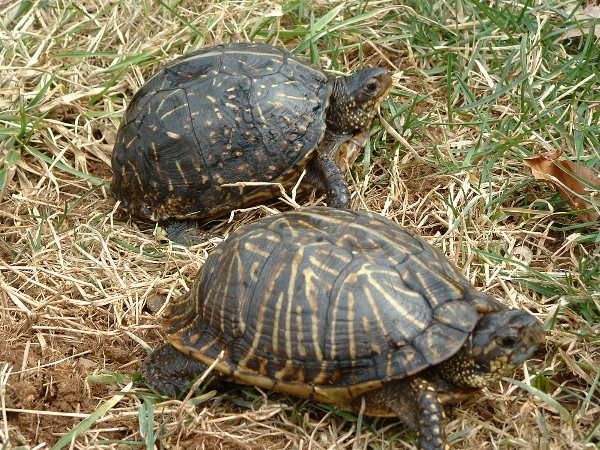
Box Turtles are the most common terrestrial turtle in the eastern United States. They are small to medium sized turtles, attaining a maximum length of about 8 inches and having a highly domed carapace. A key characteristic of box turtles is their hinged plastron (bottom of the shell) that can be shut completely to exclude predators. Although mud, musk, and blandings turtles also posses hinged shells, they cannot be closed completely. Superficially, box turtles resemble tortoises but they are actually more closely related to many aquatic turtles and belong to the same family as spotted, bog, chicken, map, and painted turtles, as well as sliders, cooters, and diamondback terrapins. Box turtles in the United States are divided into two species, the eastern box turtle (Terrapene carolina), which ranges from Texas throughout the southeast and north to Michigan and southern Massachusetts, and the western box turtle (Terrapene ornata), which ranges west of the Mississippi to Colorado and New Mexico. The western box turtle is superficially similar to the eastern box turtle but is typically smaller and has a shell marked with radiating yellow lines. There are an additional two species of box turtle that are endemic to restricted habitats in Mexico. One of these species (Terrapene coahuila) is almost totally aquatic.
Eastern box turtles are highly variable in shell shape, pattern, and coloration. Based on these differences, four subspecies of eastern box turtles have been designated. The most widespread subspecies is simply known as the eastern box turtle (T. carolina carolina). This turtle ranges along the entire east coast of the United States from Massachusetts to northern Florida, as far west as the Mississippi River, and north to the Great Lakes. Although this subspecies is highly variable in coloration, it is often more brightly colored than the other subspecies and almost always has four claws on the hind feet.
The florida box turtle (T. carolina bauri) is distributed throughout peninsular Florida. This subspecies typically has a highly domed shell marked with radiating yellow lines and three claws on each hind foot. The largest, and least widespread subspecies of eastern box turtle is the gulf coast box turtle (T. carolina major). This subspecies ranges along the coast of the Gulf of Mexico from the Florida panhandle to the Mississippi delta. Its coloration resembles T. carolina carolina but it is larger, reaching a length of over 8.5 inches, and has flared shell edges. It also usually has four hind claws. The final subspecies of the eastern box turtle is the three-toed box turtle (T. carolina triunguis). This subspecies often has an almost pattern less, brown shell with some red around the head, neck and forelegs, and three claws on the hind feet. The three-toed box turtle ranges extensively west of the Mississippi River through the southern Midwest and Texas. Although this range overlaps considerably with the western box turtle, the two species are usually separated by habitat preference. Three-toed box turtles prefer woodlands and damp brush while western box turtles inhabit more arid, open habitats.
Although box turtles are still fairly common over much of their range, their future is uncertain. Box turtles are slow growing, have few young, and have exhibited delayed sexual maturity. These qualities make them particularly susceptible to damage due to human activities. First and foremost among problems faced by box turtles is habitat destruction and fragmentation. Fragmentation is defined as the process by which natural or seminatural habitats are seperatated from similar habitats by land that is used by humans(2). As areas of suitable habitat become fewer and farther between, box turtle populations will decline and individual populations will become increasingly vulnerable to extinction. Confined to smaller areas, the turtles will have an increasingly difficult time finding food or mates. These small, isolated populations may suffer from inbreeding and other genetic problems. Box turtles may also wander out of their isolated habitats into the matrix (the land used by humans), where they are particularly susceptible to accidental death due to humans. Each year countless box turtles are hit by cars or trains when they attempt to cross roads or railroads. Others are accidentally killed by lawn mowers, tractors, and farm equipment.
Another concern is the capture of box turtles for the pet trade. The impact of taking turtles from the wild can be devastating to local populations. Over the span of their lifetime, female turtles will lay hundreds of eggs, but only 2-3 of these offspring will survive to adulthood. These offspring will eventually replace their elderly parents, allowing the population to remain at a stable size. But, if box turtles are taken from the wild to become pets, or are killed by human activities, they are removed from the overall breeding population, the number of offspring drops, and the overall population declines. Additionally, box turtles have a homing instinct that causes them to try to return to the place of their birth if they are moved. As a result, when box turtles that have been taken as pets are returned to the wild, they will head straight for their natal grounds. This journey causes the turtles to encounter many dangers, such as roads, predators, and humans. For these reasons, if you are looking for a pet, you should try to find a captive-bred animal or consider a different pet.
After learning a bit about this great reptiles now is time for the hunt, this cache is located in the Bird Drive Recharge Area hidden jewel in the middle of Miami, very fun and challenging short hike to the GZ so gear up as best as you can, and as always safety first watch your step.
Don’t be shy and jump into the wet muddy fun this cache will be well worth it once you see what Nature has to offer you, please leave this area as you found it or better ( I MEAN CLEAN ).
Highly recommended gear for this hike
*Water
*Hiking footwear
*Hat
*Bug repellent
*hiking pole or staff
*Lots of sun block
*Camera
*Be willing to get dirty while having fun ;)
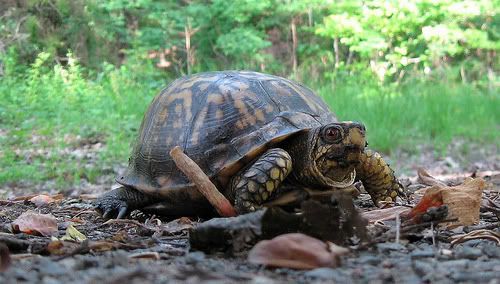


 FTF HONORS TO jeffgamer
Note to cachers on behalf of jeffgamer I would like to ask any cacher attempting to grab this cache if you have the time to search as well for jeffgamer’s car “key” since he dropped it somewhere in between the parking coordinates and the GZ, don’t worry it will be an easy find is just somewhere in swamp no biggie  LOL Thank you