Weathering of Limestone
Limestone is largely made up of calcium carbonate in the form of
the mineral calcite. Limestone weathers by the solution of this
calcite. This occurs along the joints and bedding planes which are
present due to the sedimentary nature of the rock.
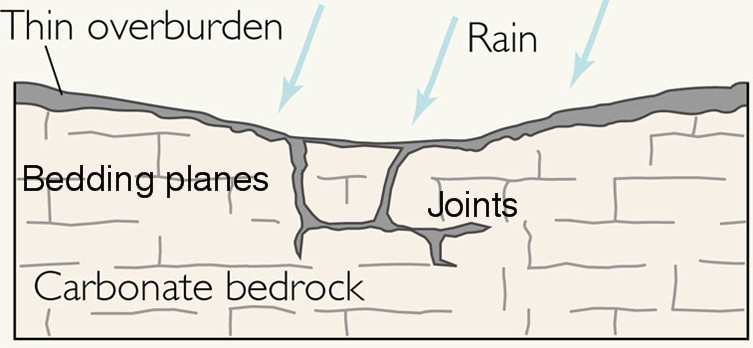
Diagram showing bedding planes and
joints
This causes the surface to become uneven, producing grooves
along the surface called lapies or karren. When these develop
further they are known as grykes (gaps), separating raised sections
called clints.
The area that you are directed to in this earth cache is
slightly unusual. You are not there to look at limestone pavement,
rather the differential effect of layers (strata) of rock that are
of a difference hardness or resistance to the elements of weather:
heat, cold and wet being three of the main ones.
What effects weathering?
A rock's composition has a great effect on its rate of
weathering. Rocks that are softer and less weather-resistant tend
to wear away quicker than those that are crystalline (igneous rock)
or have been subjected to more heat and pressure (metamorphic
rock). When the more weather-resistant rock is left behind, this
process is called differential weathering.
A rock's exposure to the weathering elements and its
surface area can affect its rate of weathering. Rocks that are
constantly bombarded by running water, wind, and other erosion
agents, will weather more quickly. Rocks that have a large surface
area exposed to these agents will also weather more quickly. As a
rock goes through chemical and mechanical weathering, it is broken
into smaller rocks. As you can imagine, every time the rock breaks
into smaller pieces its surface area or part exposed to weathering
is increased.
Think about a cube, which has both volume and surface area. To
find the surface area of a cube, you need to calculate the sum of
the areas for all six sides. Let this cube represent our rock that
is exposed to weathering. Already our cube has six sides that are
exposed to the elements. If we split our cube into eight smaller
cubes, then the total surface area would be doubled. Although the
surface area increases, the volume remains constant. Splitting the
eight smaller cubes in the same way would have the same effect; the
surface area would again be doubled. Increased surface area causes
rocks to weather more rapidly.
With thanks to edhelper
Education
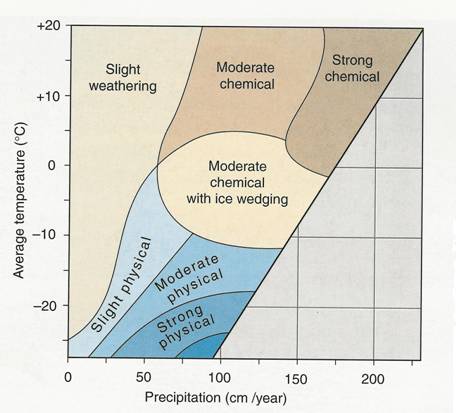
Graph showing differential weathering
rates
The above graph, a Peltier diagram, shows how weathering is
affected by temperature and rainfall (precipitation). Loius
Peltier, an American physicist in 1950 and climatologist in 1950,
predicted the rate and type of weathering that would occur from
mean annual temperatures and mean annual rainfall.
There are 3 major types of weathering, physical and
chemical.
1. Physical weathering is the breakdown of minerals, which
remain the same; there are 5 major subtypes:
a. Block or Granular disintegration results in blocks
of the parent material falling from the cliff and often increases
the surface area susceptible to attack.
b. Freeze-thaw action can effect water in the cracks in rocks,
freezing and expanding in volume by around 10% (in fact 9.05%)
where diurnal temperature variations include crossing freezing
point.
c. Exfoliation happens when there are changes in temperatures with
a diurnal range of 50 to 70 °C which is very possible in deserts.
Because rocks are relatively bad conductors of heat, only the
outside few millimetres are affected. Also known as ‘onion
skin’ weathering or differential expansion as different
colour minerals expand and contract at different rates.
d. Dilation is the expansion of rocks (doming) by removal of
overburden such as happens when ice sheets melt.
e. Salt weathering happens in the presence of saline solutions and
causes crystals to grow, particularly in shady conditions. This
causes flaking of surface or in small weathering pits and is faster
in marine locations.
2. Chemical weathering is most intense in warm, wet climates.
High temperatures promote chemical reactions and heavy rainfall
provides the necessary moisture. This results in the alteration of
the chemical composition of the weathered material due to a
reaction which alters:
a. the composition of rock minerals
b. the volume of the rock
c. the strength and coherence of the rock
It tends to be concentrated at the rock surface or along joints
and bedding planes. Block weathering and granular disintegration
can also be the result of chemical weathering.
There are 3 major products if chemical weathering:
a. secondary minerals
b. resistant minerals e.g quartz
c. soluble products
The result of weathering is often known as regolith and is often
composed mainly of unweathered and/or insoluble residues such as
quartz sand and pebbles.
Chemical weathering is capable of penetrating more deeply into
the rock than physical weathering and is particularly effective
where rock is alternately wetted then dried. An example of this can
be where there is seasonal fluctuation in the water table. Another
example is Carbonation. This particularly affects limestone as it
is altered to calcium bicarbonate which is taken into solution and
re-precipitated as tufa, or calcite to form stalactites,
stalagmites and helictites.
A key element in weathering is the presence of water.
Solution/dissolution obviously occur, also acts as a medium for
transporting acids etc.
Hydration affects rock minerals which have the capacity
to take up water. They increase in volume, which sets up stresses
within the rock e.g conversion of iron oxides to iron hydroxides.
This can cause surface flaking, similar to salt weathering.
Hydrolysis is a complex reaction affecting minerals in
igneous or metamorphic rocks e.g feldspar in granite – known
as rotting – and produces potassium hydroxide and
alumio-silicic acid. The former is carbonated and removed in
solution. The alumio-silicic acid breaks down into clay minerals,
notably kaolinite (china-clay) and is removed in solution. This is
also known as spheroidal weathering, as it rounds off corners and
affects statues, gargoyles etc.
Feldspar + hydrogen ions + water = clay + dissolved ions
4KAlSi3O8 + 4H+ + 2H2O = Al4Si4O10(OH)8 + 4K+ + 8SiO2
Oxidation is the reaction between rock minerals and
oxygen (usually dissolved in water) and changes the colour on
brickwork
4Fe + 3O2 = 2Fe2O3 (iron oxide or hematite) Reactions are
speeded up by warmth.
Chemist Jacobus Henricus van 't Hoff said that the speed of a
reaction increases by 2½ times when the temperature rises by 10°C,
so chemical weathering is greater in humid tropical climates in the
main.
3. Biological weathering is the effect of living things
such as tree roots: as a tree grows, its roots extend into the
ground. As they grow and thicken, rocks are prised apart. Ivy
growing on a building can loosen the bricks. It also occurs on a
slower, smaller scale where mosses and lichens overlay rock.
a. Decomposition produces humic acid and this
can result in the process of Chelation, the break down of
rock minerals by organic acids. Humic acid can also be produced by
excreta, especially where large areas rock are occupied by large
colonies of seabirds such as gannets
b. Respiration by plant roots increases carbon dioxide in
soil and assists the formation of weak acid as rainwater filters
through the soil. Trees extract water from soil which can lead to
shrinkage and ground subsides.
c. Burrowing animals such moles break up the rock and bring
material to the surface where it is exposed to chemical weathering.
Crustaceans on rocks at the coast bore holes in rocks and
secretions of shellfish increase rate of weathering
d. Trampling. Elephants trampling vegetation in game
reserves in Zambia and Namibia have led to soil erosion which
exposes bedrock which is then affected by weathering.
Other important factors
1. Rock Type
2. Rock strength and hardness
3. Minerals in the rock formed under high temperature and pressure
weather most quickly because they are ‘furthest’ from
the conditions in which they were formed. Some rocks are
‘harder’ than others.
4. Chemical composition - The presence of silicate minerals is
important. More stable minerals tend to be lighter in colour.
5. Rock texture - whether it is coarse grained or fine grained. In
finer grained rocks, the bonding is stronger, but the boundaries
between crystals form lines of potential weakness or cleavage. Fine
grained rocks often weather quicker.
6. Joints and bedding planes: these allow access to the
water.
7. Vegetation type.
8. Topography: slope angles, and aspect
With thanks to Peachnut
Education
For more information, click
here
To log this cache:
- Find out, using the Peltier diagram above, what type of
weathering is most likely to be affecting the cache area
- Take a photo of the small cliffs nearby the rock that you are
directed to with your GPS and/or you and post it to this page
- Count how many obvious layers there are in the rock you are
directed to
- Email me with the answers to log this cache
Please do not post images of the actual cache
on the website
Official EarthCache Banner