Plymbridge Woods
Lying to north-east of Plymouth at the edge of the city Plymbridge Woods comprises some 200 acres of woodland and meadows.
The area is a historic site which once bore the brunt of industrialisation. Noisy mines and quarries were once serviced by railway lines replaced now with the gentle noise of running water amongst the native trees. We regularly walk through the woods with our dogs and see mice, squirrels, deer, herons, the peregrine falcons and occasionally kingfisher and an owl.
Slate of sufficient grade to be used for roofing was worked at Cann and Rumple Quarries, although it appears that most of the slate was used for flooring and walls. The slate was originally a marine mud which, having been buried and turned into mud stone, was heated and compressed as a result of the tremendous forces at work during a collision of tectonic plates. This process altered the orientation of the minerals within the mud stone allowing it to split easily. That is, it had become slate Cann Quarry is also cut by a fine grained granite dyke (molten rock which intrudes into the local rocks). The quarries are recorded as being in use as far back as 1683. .
This earth cache is designed to lead you on a walk of just under two miles from the car park at Plymbridge, out along the cycle track to the Railway Cottages, on to Cann Quarry, The Rumple Quarry and Engine house, Rumple Wheel pit and finally a pleasant amble back along the track past the little Plymbridge 'beach' and to the car park. We recommend you start at waypoint 1 and follow the waypoints in order, this will lead you on the circular walk.
Railway Cottages - The small two storey building was originally home to three or even four quarry workers families. In the last century it housed only the family of the last man to control the workings of Cann Quarry.
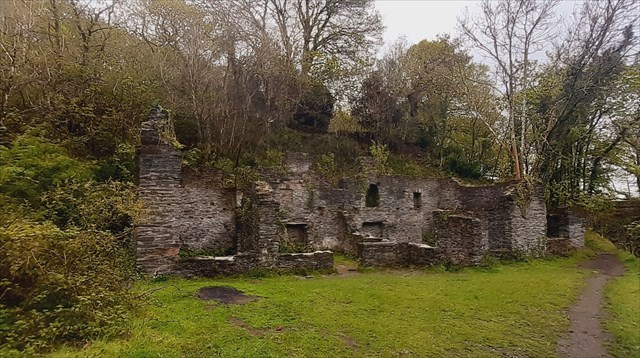
The Railway Cottages
Cann Quarry - Slate from this spectacular Quarry face was used in both building work at Plympton School and Devonport Dockyard. The wheel was powered by water brought her by a tributary of the Plym along the leats. These were lined with slate to make them waterproof. The waterwheel would have driven a variety of machinery for sawing, planing and hauling the slate.
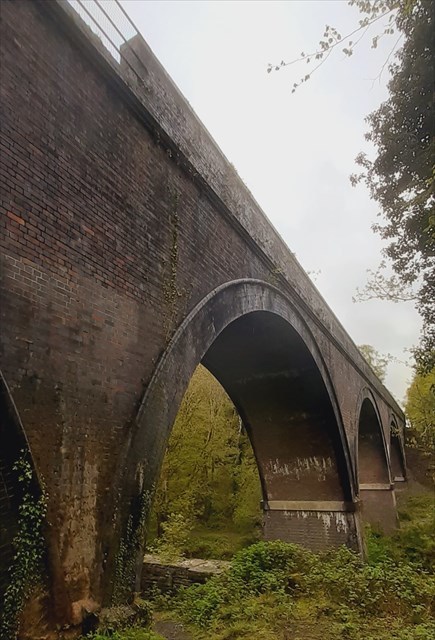
Viaduct
The Viaduct - The viaduct was built using Staffordshire blue blocks and carried the South Devon and Tavistock Railway until it's closure in 1962. It replaced the original wooded structure built by Isambard kingdom Brunel and Augustus Bampton in 1859.
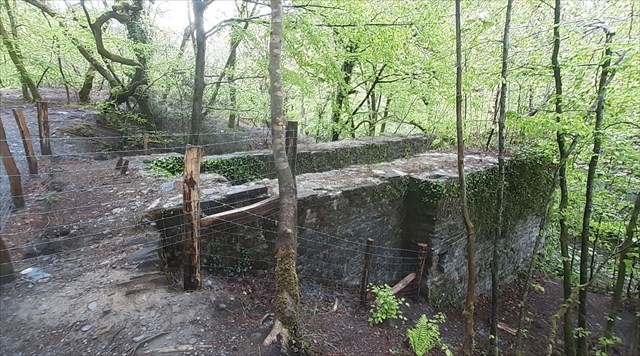
Rumple Quarry Wheel Pit
Rumple Quarry and Engine House - Slate was extracted from Rumple Quarry but it had an overhanging cliff and was therefore considered dangerous to work in. It was closed for two years after an accident, when two men died following the collapse of part of the working face. The building was constructed in the late 1860's, it was used to haul stone up from the Rumple Quarry to train on the Tavistock line.
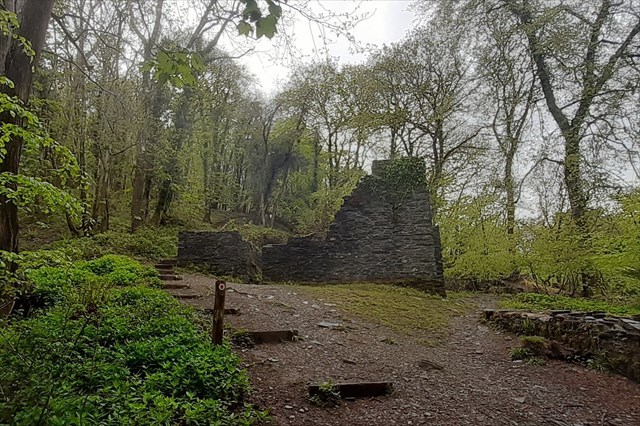
Rumple Quarry Engine House
Rumple Wheel Pit - The 50 foot diameter water wheel was opened in 1865 with a picnic for the mines shareholders. The wheel which was designed to replace a steam powered wheel nearby was an economic failure and steam was soon reintroduced as the main power for moving loads of slate.
There is nothing placed in the woods, in order to log the cache send us the answers to the following questions (Through our profile, nothing in the logs please) and upload a photo of yourself or your GPS'r by Rumple Wheel Pit.
Waypoint 2
1. What might the outbuildings at the back of the Railway Cottages have been used for? The information board has been removed so give us your best guess.
Waypoint 3
2. What was the date the present viaduct was built?
3. What material was the original viaduct built from?
Waypoint 5
4. Looking down into Rumple Quarry wheel pit, estimate the depth of the wheel pit
5. Upload a photo of yourself or your GPS'r by Rumple Wheel Pit
Waypoint 6
6. From the information board, walk through the gate and on the opposite side of the road is a man made cave. How tall is the cave?
Waypoint 7
7. What letter has been engraved onto the two roadside stones?
Many thanks to Stephanie, the National Trust Warden at Plymbridge for permission to have this earthcache sited in Plymbridge Woods..