THE ABOVE COORDINATES ARE NOT CORRECT.
About This Series
This series will provide lessons to assist you in building your puzzle-solving skills. Each will contain a lesson centering on a specific puzzle skill, examples of how to apply that skill, an exercise to test you on that skill, and a cache to find as a reward for your efforts. Study the lesson, complete the exercise, and you'll find the location of a cache.
Here are links to all the caches in this series for your reference.
There is an extra credit puzzle that will be needed to solve the Final Exam (it is found on the GeoCheck page). So you will need to solve this puzzle correctly, then use the Geochecker to get to the extra credit puzzle. Remember to save the answer to the puzzle for the Final Exam.
This series is based on a couple similar ones, one in the Fresno area, along with another one in Florida that were quite helpful. With permission from COs of those series I bring you this series as a teaching and learning experience, so shall we continue to our next lesson?
Lesson 8: Steganography
Introduction
This series of caches has discussed a number of different types of puzzles commonly used to hide geocaches. But some of the most difficult-to-solve puzzles are created using a method known as steganography.
Steganography means literally "hidden writing". It is similar to cryptography in that it is used to send a message so that only the intended receiver can make sense of it. Whereas the purpose of cryptography is to scramble a message into unintelligible gibberish, the purpose of steganography is to keep unintended recipients from discovering that a message even exists at all.
A steganographic message appears to be something else, typically something common and innocuous. A message can be a letter, an article, a shopping list, a photograph, an audio recording, or some other form. This apparent message is called the covertext.
To create a steganographic message, the plaintext is typically encrypted in some manner using a cipher to create the ciphertext. This ciphertext is then embedded into the covertext to create the stegotext. The stegotext is often surrounded with nulls, which are extra pieces of information not part of the hidden message but which are included to increase confusion and distraction for those seeking the message.
Examples
Probably the best way to understand this process is with some examples:
- One of the most well-known steganographic tools is invisible ink. A secret message may be written in invisible ink over top of the cover text; to read it, the recipient would hold the cover text up to a particular shade or intensity of light. (Remember the opening scenes of The DaVinci Code?)
- In ancient Greece, wooden tablets covered with layers of wax were often used as the medium for writing messages. A secret message could be hidden by writing the message directly on the wood before covering it with wax. The recipient would then simply melt the wax to read the message.
- Also in ancient Greece, Herodotus tells the story of a message tattooed on a slave's shaved head, hidden by the growth of his hair, and exposed by shaving his head again. The message allegedly carried a warning to Greece about Persian invasion plans.
- During World War II, a spy for the Japanese in New York City, Velvalee Dickinson, sent information to accommodation addresses in neutral South America. She was a dealer in dolls, and her letters discussed how many of this or that doll to ship. The stegotext in this case was the doll orders; the 'plaintext' being concealed was itself a codetext giving information about ship movements, etc.
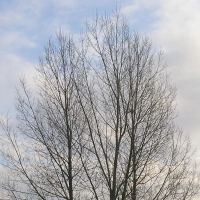
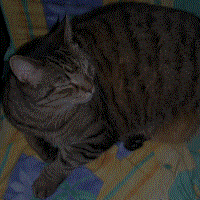
- Digital image files can be used to conceal information. For example, the image on the left is the stegotext; the image on the right is the hidden message. (The cleartext is in the two least-significant bits of the color level of each pixel in the stegotext. Don't worry if you don't know what that means ... just appreciate that the picture of the cat really is hidden inside the picture of the trees.)
Stegotext
 |
Plaintext
 |
Steganalysis
Unfortunately, due to the extremely wide variety of methods that can be used to encode information, there is no easily generalized method of performing steganalysis. This is why these categories of puzzles can be so infuriating. Here are some places to look for clues:
- Look in the body of the stegotext. It may have clues that indicate the type of information contained. Things in the stegotext that seem odd, inexplicable, or otherwise out of place (no matter how slightly) may also be indicators that they hold the key to the secret information.
- Look inside the digital message. Executable, image, and audio files often have methods of including information that describes the contents of the file that are not directly part of the content of the file. For instance, an MP3 file can contain the name of the song, artist, and album, although none of those things changes the audio playback of the file. A secret message could be hidden in any of the extra fields of such a file.
- Get to know the sender and the receiver. Knowing something about the individuals transmitting and receiving the message may uncover information about how to decrypt the message.
- Use the tactics described in C.S.U.Puzzles 102 of this series to find clues. Look for things that may hold patterns of coordinates or clues to container sizes or hints as to hiding spots. Especially watch for things that fit into some kind of overall repetitive pattern.
Here are some other helpful sites with good explanations of Stenography-
infosyssec.com has a good explanation, also check the example programs page for a how to on a couple programs.
unfiction.com has a quick explanation also along with tutorial on another program along with already covered by the previous link, but maybe a little better how to.
Exercise 8: ZIP it Buddy
|

Excerpt from the files of Stan Spud
It was a cold dreary morning, one that makes you want to sit back and enjoy your coffee. I didn't want to go out, but sometimes you gotta do what yous gotta do. There is only so much I could do from my desk.
I had been working on this case for awhile, running into all kinds of deadends. It seemed like no one wanted talk. But if you keep on pocking around someone is bound to slip up. Finally I had break, I had been tailing this goon for awhile. He was careful to cover his trail, but I was a better hound dog. I had caught up with him in Glen Spey, NY. It was a small little town north of my office in the big city. I had cornered the perp on a small farm, and with alittle persuasion he started talking, and I mean talking. I couldn't get the guy shut up. After I had got the info I needed I told him to zip it, but he kept on going. I got his whole life story, whether I wanted it or not. It made it hard to seperated the fact from the fiction, you know like the forest from the trees. Maybe that was his plan all along, spread so much muck about I wouldn't be able to pick out the clues.
If he thought that would work, he didn't know who he was up against. It wasn't long before I had sifted out the useless stuff and was on my way to another small town, on the trail of his cohort.
I felt out of place in this town, it was like going back in time. It was a perfect place to hide out from the law. Nobody would think to look here for a hardened criminal, I was in Amish country. The clues I had squeezed out of Buddy had lead me west to New Wilmington, PA. Fred had tried to blend in, but it was futile. To the trained eye of this detective he stuck out like a sore thumb. It only took me a couple days to track him down. The locals here were much more helpful, they didn't care much for his likes in their quiet little town. If they had wanted to big city problems, they would have moved to the big city.
Fred was tough, but not tough enough. This P.I. can take care of himself, I quickly had him subdued and in the car for the ride back. I took him back to the big city, and turned him over to the Law. He was going to pay for his crimes, and spend some time with his fellow goons in the big house.
Yet another case solved, now on to the next one, to find that illusive puzzle cache. It has had me stumped for awhile, but I was on to something, maybe Buddy was more help than he thought.
|

Congrats to Lookout4, ShaadowTech, and UnicornShaadow for the FTF
While working towards the solution, you may or may not
be required to download a file from a non-Groundspeak, Inc. site
in order to obtain further details needed to find this cache.
As the cache owner, I represent that this file is safe to download
although the file needed to complete this geocache has not been checked by
Groundspeak or by the Geocache Reviewer for possible malicious content.
As a result, you are downloading this file at your own risk.