The Tricolour:
The history of the Irish Tricolour is intended to symbolise the inclusion and hoped-for union of the people of different traditions on this island, which is now expressed in the Constitution as the entitlement of every person born in Ireland to be part of the Irish nation (regardless of ethnic origin, religion or political conviction).
A green flag with a harp was an older symbol of the nation, going back at least to Confederate Ireland and Owen Roe O’Neill in the 1640s, and was subsequently widely adopted by the Irish Volunteers and especially the United Irishmen. A rival organisation, the Orange Order, whose main strength was in the North, and which was exclusively Protestant, was founded in 1795 in memory of King William of Orange and the ‘glorious revolution’ of 1689.

Flag Of The United Irishmen
Following the 1798 Rebellion which pitted orange against green, the ideal of a later Nationalist generation in the mid-nineteenth century was to make peace between them and, if possible, to found a self-governing Ireland on such peace and union. Irish tricolours were mentioned in 1830 and 1844, but widespread recognition was not accorded the flag until 1848. From March of that year Irish tricolours appeared side by side with French ones at meetings held all over the country to celebrate the revolution that had just taken place in France. In April, Thomas Francis Meagher, the Young Ireland leader, brought a tricolour of orange, white and green from Paris and presented it to a Dublin meeting. John Mitchel, referring to it, said: ‘I hope to see that flag one day waving, as our national banner’. Although the tricolour was not forgotten as a symbol of hoped-for union and a banner associated with the Young Irelanders and revolution, it was little used between 1848 and 1916. Even up to the eve of the Rising in 1916, the green flag held undisputed sway.
Neither the colours nor the arrangement of these early tricolours were standardised. All of the 1848 tricolours showed green, white and orange, but orange was sometimes put next to the staff, and in at least one flag the order was orange, green and white. In 1850 a flag of green for the Catholics, orange for the Protestants of the Established Church and blue for the Presbyterians was proposed. In 1883 a Parnellite tricolour of yellow, white and green, arranged horizontally, is recorded. Down to modern times yellow has occasionally been used instead of orange, but by this substitution the fundamental symbolism is destroyed. Associated with separatism in the past, flown during the Rising of 1916 and capturing the national imagination as the banner of the new revolutionary Ireland, the tricolour came to be acclaimed throughout the country as the National Flag. It continued to be used officially during the period 1922- 1937, and in the latter year its position as the National Flag was formally confirmed by the new Constitution, Article 7 of which states: ‘The national flag is the tricolour of green, white and orange’.

The Irish Tricolour
Guidlines For The Use Of The National Flag:
The following guidelines are to assist persons in giving due respect to the National Flag. Observance of the guidelines is a matter for each individual because there are no statutory requirements. It is expected, however, that the National Flag will be treated at all times with appropriate respect by those who use it. The Department of the Taoiseach has general responsibility in relation to the National Flag.
The National Flag is rectangular in shape, the width being twice its depth. The three colours – green, white and orange – are of equal size, and vertically disposed. Often different shades of yellow, instead of orange, are seen at civilian functions. This misrepresentation of the National Flag should be actively discouraged. The Flag should normally be displayed on a staff, the green being next to the staff, the white in the middle and the orange farthest from the staff. Technical data: Pantone Matching System colours: Green 347, Orange 151. Provided that the correct proportions are observed, the Flag may be made to any convenient size.
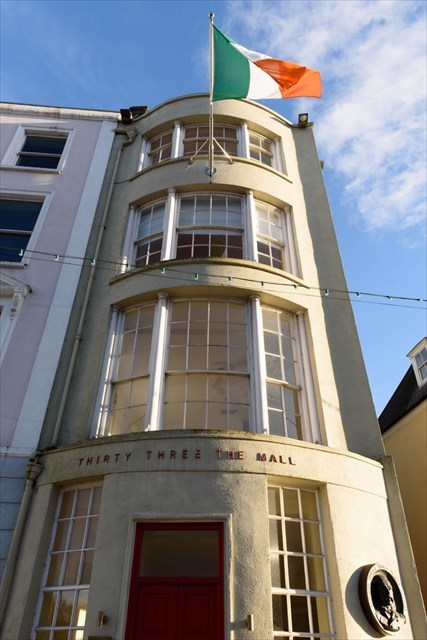
The Cache is a small magnetic tube container placed near 33 The Mall, Waterford. At this house, the first raising of the Irish Tricolour by Thomas Francis Meagher was carried out on March 7th March, 1848 (Some records state it was the 1st March). The building is currently a cafe. Up the street a little (towards the river) there is an impressive statue of the man himself on horseback. The information above with additional protocols and observances are available from the Department of the Taoiseach. Enjoy.