The Bighead River is a river in Grey County in southern Ontario,
Canada, that flows from the township of Chatsworth to empty into
Nottawasaga Bay at Meaford. The Bighead River thus flows for over
50km from the Niagara Escarpment to Georgian Bay on Lake Huron. It
has four main tributaries East Minniehill Creek, Minniehill Creek,
Rocklyn Creek and Walters Creek.
River Valley formation
River valleys can be broadly categorized according to their
shape. V shaped valleys are a result of fluvial erosion whilst a
valley carved by glaciers is normally U-shaped. The valley becomes
visible upon the recession of the glacier that forms it. When the
ice recedes or thaws, the valley remains, often littered with small
boulders that were transported within the ice. Floor gradient does
not affect the valley's shape, it is the glacier's size that does.
Continuously flowing glaciers – especially in the ice age
– and large-sized glaciers carve wide, deep incised valleys.
Examples of U-shaped valleys are found in every mountainous region
that has experienced glaciation, usually during the Pleistocene ice
ages. Most present U-shaped valleys started as V-shaped before
glaciation. The glaciers carved it out wider and deeper,
simultaneously changing the shape. This proceeds through the
glacial erosion processes of glaciation and abrasion, which results
in large rocky material (glacial till) being carried in the
glacier. A material called boulder clay is deposited on the floor
of the valley. As the ice melts and retreats, the valley is left
with very steep sides and a wide, flat floor. A river or stream may
remain in the valley. This replaces the original stream or river
and is known as a misfit stream because it is smaller than one
would expect given the size of its valley.
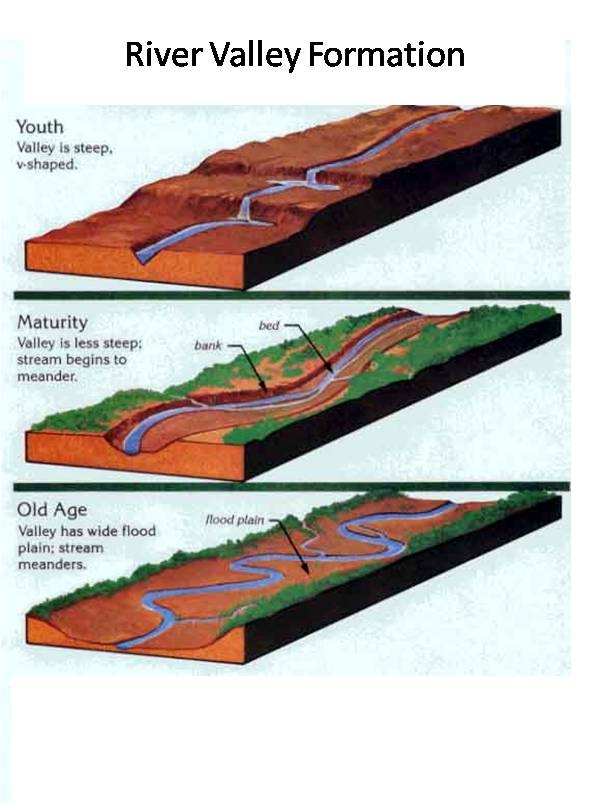
Evolution of the River Valley
River valleys can also be categorized into maturity stages based
upon their rate of water flow as well as the formation of certain
features within the valley. Youthful river valleys typically have
fast flowing rivers and steep valley walls which rapidly erode.
When a river valley reaches maturity, water velocity slows and the
river broadens out to meander from side to side within the valley.
Finally in old age the river valley has broadened out to form wide
flood plains with extensive meandering. Features such as secondary
flow channels and oxbow lakes can been seen in these valleys.
Logging Requirements
Please do not post the answers in your log, email them to me
directly. Feel free to log your find simultaneously, if for
whatever reason I don’t receive the emailed answers I will be
obliged in terms of the Earthcache rules to delete your log.
1. What geological feature is in the process of forming below
you.
2. Based on what you see, which maturity stage would you expect
the Bighead River Valley to be in ?
3. Do you think the Bighead valley was originally formed by
fluvial erosion or glaciation ?
4. Estimate the length of the geological feature from where you
are standing to the main river channel.
5. How high are you above the river at this point.
Note : The graphic on this page is copyright
of the University of North Carolina at Chapel Hill, and is being
used under license. The licence can be viewed at
http://creativecommons.org/licenses/by-nc-sa/2.5/legalcode