The posted waypoint is not for the location of this Earthcache.
It is for the office as everyone must check to see if the office is
open. If the office is open, it means that school children could be
present on site and a visitor pass is then required. Please enter
the office and ask for a visitors pass. If the office is closed, a
visitors pass is not require and you may proceed to the child
waypoint titled "Coal" to complete this Earthcache.
Things you will need to log this Earthcache:
- GPS
- Camera (optional)
The logging requirements for this Earthcache are:
Email me, via my profile, the answers
to the following questions:
- Near the child waypoint "COAL" you will find several good sized
(2' to 5') examples of the coal that was mined here. Tell me which
one of the four types of coal listed below does these pieces best
fit into. Please DO NOT remove any pieces of coal from these
examples.
- Tell me the color of these examples.
- From the State Historical sign labeled "Coal Mine #8", what
year was coal discovered here.
- Also from this sign, how deep was the shaft?
- A photo can not be required, but is always
appreciated.
Definition of Terms
|
Carboniferous
The name comes from the Latin word for coal, "carbo". Carboniferous
means "coal-bearing". Many coal beds were laid down globally during
this period, hence the name. The "Carboniferous" period of geologic
time occurred from 355 to 299 million years ago during the late
Paleozoic Era (540 to 250 Mya).
|
 |
Lignite
The lowest rank of coal with the lowest energy content. Lignite
coal deposits tend to be relatively young coal deposits that were
not subjected to extreme heat or pressure, containing 25%-35%
carbon. Lignite is crumbly and has high moisture content (up to
45%). Lignite is more like soil than a rock and tends to
disintegrate when exposed to the weather. Lignite is also called
brown coal.
Subbituminous Coal
Has a lower heating value than bituminous coal. Subbituminous coal
typically contains 35-45% carbon. Most subbituminous coal in the
United States is at least 100 million years old. Also called black
lignite.
Bituminous Coal
It's a soft, dense, black coal, often has bands of bright and dull
material in it. Has a moisture content less than 20%. Bituminous
coal in the United States is between 100 to 300 million years old.
It is the most abundant rank of coal found in the United States,
accounting for about half of U.S. coal production.
Anthracite Coal
Often referred to as hard coal, anthracite is hard, black and
lustrous. Anthracite is low in sulphur and high in carbon. It is
the highest rank of coal. moisture content generally is less than
15%. Contains 86-97% carbon, and generally has a heating value
slightly higher than bituminous coal.
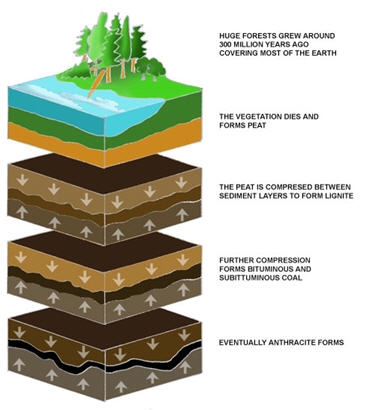
Stages of coal formation from Peat to Anthracite Coal. |
Coal is classified into four main types, or ranks
(lignite, subbituminous, bituminous, and anthracite), depending on
the amounts and types of carbon it contains and on the amount of
heat energy it can produce. The rank of a deposit of coal depends
on the pressure and heat acting on the plant debris as it sank
deeper and deeper over millions of years. For the most part, the
higher ranks of coal contain more heat-producing energy. |
Follow this Link to see an animation of the process of how
coals are formed. Then click either the "Step-through" or the
"Continuous Play" options.
Geological History
The coal that we mine today was formed in the Carboniferous Period,
which occurred from 355 to 299 million years ago during the late
Paleozoic Era (540 to 250 Mya). The land mass Laurussia (North
America, northern Europe, and Greenland) was just south of the
equator and was moving northward. This position meant that the
climate was humid and tropical.

The Earth 306 million years ago.
Vegetation during this time included giant club mosses, ferns,
seed ferns and fernlike trees, giant horsetails (calamites), club
mosses (lycopods) and primitive conifers. These plants grew in
large lowland swamp forests. Over millions of years, dead plant
debris built up thick layers of peat under the swamps they grew
in.

What a Carboniferous forest could have looked like.
For the peat to become coal, it must be buried by sediment.
Burial compacts the peat and, consequently, much of the water is
squeezed out during the first stages of burial. Continued burial
and the addition of heat and time cause the complex hydrocarbon
compounds in the peat to break down and alter in a variety of ways.
The gaseous alteration products (methane is one) are typically
expelled from the deposit, and the deposit becomes more and more
carbon-rich as the other elements disperse. The stages of this
trend proceed from plant debris through peat, lignite,
sub-bituminous coal, bituminous coal, anthracite coal, to graphite
(a pure carbon mineral). Scientists estimate that from 3 to 10 feet
of compacted plant matter was required to form 1 foot of bituminous
coal.
Deposits of coal occur throughout northern Europe, Asia, and
Midwestern and eastern North America. The term "Carboniferous" is
used throughout the world to describe this period, although this
period has been separated into the Mississippian (Lower
Carboniferous) and the Pennsylvanian (Upper Carboniferous) in the
United States. This system was adopted to distinguish the
coal-bearing layers of the Pennsylvanian from the mostly limestone
Mississippian, and is a result of differing stratigraphy on the
different continents.

Michigan coal basin and abandoned mines.
References used:
-
http://www.enchantedlearning.com/subjects/Geologictime.html
-
http://science.nationalgeographic.com/science/prehistoric-world/carboniferous/
- http://www.eia.gov/kids/energy.cfm?page=coal_home-basics
- http://www.michigan.gov/deq
- http://bcs.whfreeman.com