Most Drive-In Movie Theaters consist of a large outdoor screen (either a wall painted-white, or a complex steel-truss structure with a complex finish), a projection booth, a concession stand and a large parking area for automobiles. Within this enclosed area, customers can view movies from the privacy and comfort of their cars.

The original Patent Drawings.
The idea originated in the early 1930's in Camden, NJ. and was Patented by Richard M. Hollingshead. His idea began as an experiment in his driveway with a Kodak Projector, mounted on the hood of his car, aimed at a screen that was attached to some trees. He tried different techniques and finally worked-out the parking-arrangement and spacing to allow everyone that attended, an unobstructed view of the screen. Once he had this idea in- place, he was granted a Patent in 1933 and He opened his first Drive-In Theater soon thereafter. This facility only lasted a few years before closing, but the idea caught-on elsewhere to become part of the American Pop-Culture and Landscape to-this-day.

Typical-style of Drive-In Theater Speakers with the Volume Knob.
Sound was originally produced from Speakers in the main screen tower, but the quality wasn't that good and many attempts were made to improve it. In 1941, the RCA corporation found a solution and along-came the in-car speakers with built-in volume controls that most drive-in patrons would come to know. These were better than the original Sound, but still had a very "tinny" sound to them. Later-on, as the technology improved, this system was replaced with Radio Broadcast equipment to allow the sound to be transmitted directly to the vehicles. This was an improved process for sound and also kept damage to the wired Speakers and/or patrons cars that would happen when folks would leave, after a good show of their favorite film, and some people would "forget to remove the speaker" and damage both the speaker and/or their cars in the process (i.e. Windows, or scratches/dents, etc.).
The popularity of the Drive-In's soared after World War II and peaked in the 1950's and 1960's. The theaters would provide cheap, family entertainment including many having a Playground (or other things) for their youngest patrons. For colder-weather, in-car heaters were also offered at many Theaters, much like the Speakers had been.

This type of heater plugged in to 120vAC (not 12V car power)
to warm your car during cold nights at the drive in movie.

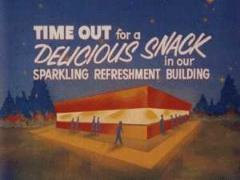
An "intermission cartoon" to entice patrons to the Concession Stand.
Another Intermission Ad
To this day, food revenue remains extremely important to exhibitors, especially with film rental rates going as high as 80% on opening weekends for some features. In order to promote the concessions, most locations used the now-famous drive-in intermission films, popularized by the Filmack Company, featuring dancing hot dogs and countdown clocks that were supposed to mesmerize the audience members, wet their pallets and open their wallets.
Many Theaters even had "car-hops" like their Drive-In Restaurant counterparts to make the experience even more appealing for their patrons.

A car-hop, taking an order (California)
The Drive-In owners would later allow other-uses for their large amounts of space which could only be used for the Theater after-sunset. This would usually generate more income for the theaters and some of these uses included Flea Markets, Swap Meets, and even Outdoor Church Services.
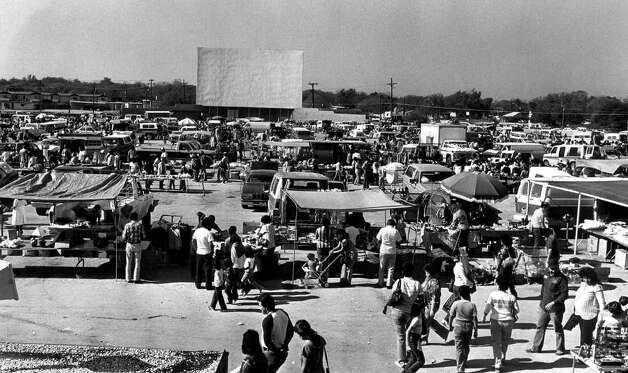
A typical Flea Market at the Mission Drive-In, San Antonio, Texas, 1984
Over time, with the advent of other sources of entertainment, as well as the rising cost of Real Estate and other economic factors, Cinematic Landmarks such as these have been slowly disappearing over the years, leaving less than 500 across the United States currently. Many of those which were closed were later demolished and the real-estate used for other things such as Office or Retail Space, with some being replaced on the exact same land with Mutli-Plex indoor Movie Theaters. Some properties have just been left vacant with nothing remaining there but an empty field. However, a very-select few that were closed have even re- opened to be given a new-life with new patrons looking for a very unique movie-going experience.
Many folks feel that these Gems of Americana are very much an endangered part of the landscape. Most, if not all of them, have very fond memories of their time spent there and would love to be able to revisit their favorite Drive-In Theater once again.
Michigan Cinema History:
The Silverdome Drive-In Theatre
Featherstone Road, Pontiac, Michigan
(updated June 9, 2013)
OPEN: October 10, 2003 | CLOSED: July 2011 | CAPACITY: 360

Close-up of the graphic below the "Marquee"
The Silverdome Drive-In Theater was one of the most recent additions to the Drive-Ins in the area and was also one of the most unusual because of it's location within the complex of the Pontiac Silverdome Stadium parking Lot. It was also unusual because of the fact that it was the only other Metro Detroit Drive-In Theater aside from the Ford-Wyoming, in Dearborn.

The "Marquee" from the Silverdome Drive-In.

The "concession stand", a typical type found at an Amusement Park or Carnival.
The pricing at the snack bar was typical for any theatre, maybe a tad higher (4 dollars for a hamburger). The selection was pretty good, burgers, dogs, sausage with the movie staples of popcorn and candy and pop. The much discussed restroom situation was better than expected. Although they are portable, they were heated trailers with hot water and regular stalls.

The "backside view" of the Screens from M-59
The screens themselves will be permanent (and are still along the M-59 property edge) with the projection booth, concession stand and ticket booth being moveable to allow for other events at the Silverdome. There was plenty of security and folks directing the cars to there spots. The vehicles were aligned by the use of white lines painted on the lot, the yellow lines being for regular parking. There was some confusion amongst some of the patrons as to the proper space and position for their vehicles.

The "Ticket Booth" for the Silverdome Drive-In
The picture quality was good, it was sharp and quite bright. There was a small amount of light pollution visible from the lighting on M-59, but overall did not adversely affect the image. The sound was broadcast through FM radio and was good although there was a small amount of interference at times. There was also a short vintage intermission reel between movies to provide a bit of nostalgia.

Inside the Projection "booth" with the Film Platters.
The original plan was to run 3 screens thru December and then close down until March, when there would be an additional 2 screens added. There was much interest in the concept from other arenas and stadiums around the country to do something similar.

A Classic car with the Patrons waiting for the show to begin.
The Theater did fairly well, but interest in it declined over the very few years it was open and as of July 2011, the heart-wrenching decision was made to close the Silverdome Drive-In after the complex was sold to another owner.

The Silverdome also held some Classic Car Shows to draw-in customers and add to the Classic-Feel of the Drive-In.
This one, like many of the Drive In Theaters that are no longer around, are a wonderful piece of Endangered Americana that are missed by all who treasured the times that they had there.
March 2012 update: There are currently plans from the group that created the Silverdome Drive-In to setup and create another Drive-In somewhere else in Metro Detroit with the equipment from here. There are no "finalized plans" as of this time, but the news will be welcomed if/when it ever happens by those that love this type of venue for moviegoing.
IF you have any good-memories or stories of the Silverdome Drive-In, please feel free to share in your logs.
Enjoy the Hunt...and beware of your surroundings, as always. :)