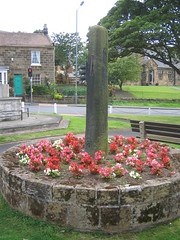
This green area at a busy crossroads of the A173 marks the original centre of the ancient manor of Skelton. The manor dates from at least the Anglo Saxon period, there being some evidence to suggest a settlement in the location from an even earlier time.
After a period of abandonment and devastation, the village appears to have been re-established as a ‘lordship centre’ by Robert de Brus in the 12th century along with the first fortified stronghold - the near-by Skelton Castle. At that time powerful Norman landlords were re-establishing settlements of this type throughout Northern England as a deliberate policy to realise the region’s economic potential by creating a planned infrastructure of villages and towns. De Brus, who also founded the nearby Gisborough Priory, was one of the most powerful landlords in the north.
Such Norman settlements generally took the form of two rows of properties, facing each other across an open green. Each property consisted of a narrow strip of land with a dwelling, agricultural buildings and garden. The dwellings collectively formed a continuous building frontage onto the green and there were agricultural buildings and gardens (garths, tofts or burgage strips) on the strips to the rear. All of the strips were about the same length and collectively ended in a straight line, frequently at a path or back lane. Well-defined track-ways, often sunken through use, crossed the green and provided access to the fields surrounding the settlement. Within or close by the village were the manor house and church.
Today, the space formed by North, South, East and West Terraces consists mostly of private gardens and small fields, with only a small area of public open space. This space is now accommodates the War Memorial and the remains of the market cross or ‘whipping post.’ Originally, this whole area would have been the village green or town square, which in Skelton has been variously known over the years as Town Gayte, Town Street, Cross Green and Town Green, of which the latter now tends to be used to refer to the public open space.

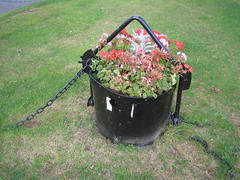
Skelton Cross Green was established by public enquiry in 1978 as common land, with no owner, under care of Langbaurgh Council (as it was then); it now forms the heart of the Skelton Conservation Area. Together with the aforementioned War Memorial and old Market Cross, the space was once home to the old town cistern (or covered well) but this is now filled in and replaced with a rose bed. A replica ironstone tub and kibble (ignominiously used as bedding plant containers) act as tributes to the town's mining past.
This can be a busy spot: please use extreme stealth and replace the cache carefully! To remove or replace the logbook, rotate the centre stick to roll it up tightly.
Congratulations to nobby_salter on another very rapid FTF!
NB: although the cache location is accessible by wheelchair, and the cache visible from one, you may need someone to reach it for you.