The Michigan Cinema History (MCH) caches are dedicated to the local creation, viewing, or enjoyment of movie and cinema-related items in the local area. This series is a companion to the Detroit Cinema History (DCH) series.
This can include, and is not limited to, people, places, and things of Cinema or both past-and-present.
Most Drive-In Movie Theaters consist of a large outdoor screen (either a wall painted-white, or a complex steel-truss structure with a complex finish), a projection booth, a concession stand and a large parking area for automobiles. Within this enclosed area, customers can view movies from the privacy and comfort of their cars.

The original Patent Drawings.
The idea originated in the early 1930's in Camden, NJ. and was Patented by Richard M. Hollingshead. His idea began as an experiment in his driveway with a Kodak Projector, mounted on the hood of his car, aimed at a screen that was attached to some trees. He tried different techniques and finally worked-out the parking-arrangement and spacing to allow everyone that attended, an unobstructed view of the screen. Once he had this idea in-place, he was granted a Patent in 1933 and He opened his first Drive-In Theater soon thereafter. This facility only lasted a few years, but the idea caught-on elsewhere to become part of the American Pop-Culture and Landscape to-this-day.

Typical-style of Drive-In Theater Speakers with the Volume Knob.
Sound was originally produced from Speakers in the main screen tower, but the quality wasn't that good and many attempts were made to improve it. In 1941, the RCA corporation found a solution and along-came the in-car speakers with built-in volume controls that most drive-in patrons would come to know. These were better than the original Sound, but still had a very "tinny" sound to them. Later-on, as the technology improved, this system was replaced with Radio Broadcast equipment to allow the sound to be transmitted directly to the vehicles. This was an improved process for sound and also kept damage to the wired Speakers and/or patrons cars that would happen when folks would leave, after a good show of their favorite film, and some people would "forget to remove the speaker" and damage both the speaker and/or their cars in the process (i.e. Windows, or scratches/dents, etc.).
The popularity of the Drive-In's soared after World War II and peaked in the 1950's and 1960's. The theaters would provide cheap, family entertainment including many having a Playground (or other things) for their youngest patrons. For colder-weather, in-car heaters were also offered at many Theaters, much like the Speakers had been.

An "intermission cartoon" to entice patrons to the Concession Stand.
The Concession Stand (or Snack Bar) would have food that could be served very quickly. Hot Dogs, Pizza, Cheeseburgers, Popcorn, Soft Drinks, and a host of other "food" could be found there to enjoy along with the show. This is usually where the Theater makes most of it's profits and much of the promotions are geared towards that area.
Many Theaters even had "car-hops" like their Drive-In Restaurant counterparts to make the experience even more appealing for their patrons.

A car-hop, taking an order (California)
The Drive-In owners would later allow other-uses for their large amounts of space which could only be used for the Theater after-sunset. This would usually generate more income for the theaters and some of these uses included Flea Markets, Swap Meets, and even Outdoor Church Services.
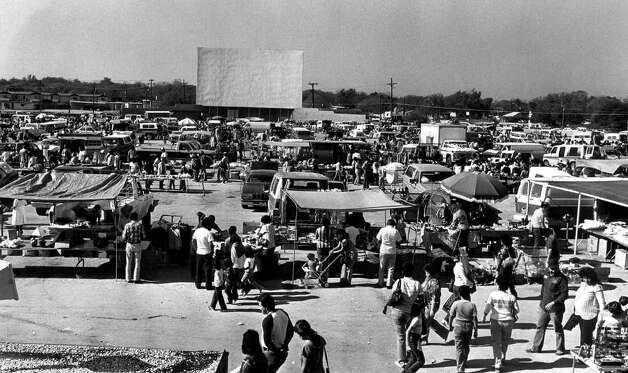
A typical Flea Market at the Mission Drive-In, San Antonio, Texas, 1984
Over time, with the advent of other sources of entertainment, as well as the rising cost of Real Estate and other economic factors, Cinematic Landmarks such as these have been slowly disappearing over the years, leaving less than 500 across the United States currently. Many of those which were closed were later demolished and the real-estate used for other things such as Office or Retail Space, with some being replaced on the exact same land with Mutli-Plex indoor Movie Theaters. Some properties have just been left vacant with nothing remaining there but an empty field. However, a very-select few that were closed have even re- opened to be given a new-life with new patrons looking for a very unique movie-going experience.
Many folks feel that these Gems of Americana are very much an endangered part of the landscape. Most, if not all of them, have very fond memories of their time spent there and would love to be able to revisit their favorite Drive-In Theater once again.
The Town Drive-In
Opened May 1949 | Closed 1963 | Car Capacity 1000
Street View of the Main Screen (Mid 1950's)
The Town Drive-In Theater in Redford Township meant more to the people living around it than to those who paid to drive inside. Up until 1962, the drive-in would open during Easter vacation and, if the spring twilights were exquisite, children straddled the cool, steel corner mailbox and watched Technicolor Woody Woodpecker cartoons.
Then the movies, with titles like "The Angry Red Planet", "Experiment in Terror" and "Love in a Goldfish Bowl" starring Fabian, would come on to entertain the neighbors that lived nearby.
Many of the kids, however, would not be allowed to watch the entire movie as their parents would call them inside because the features would run too-late into the evening.
There was a train that went around the playground. Kids would fill the cars and it would travel around the track to the delight of the children and parents - all for free!

Screen and Speakers.
To many, the movies would mean summer excitement for those folks along West Chicago Road, both young and old alike, even with the massive amounts of traffic along Telegraph Road and the noise that went with it. The neighbors knew one another well and many of the kids attended the same Catholic church (St. Hilary's), or public schools like Fisher Elementary and Thurston High.
Many of the children would grow up and reside on this block for the next 35 years. The families were tight-knit with others in the neighborhood and it was a very warm and welcome feeling to those who lived here.
There were many kids here and usually in the summer, after the first feature was shown at the drive-in, there often were fireworks shot into the night sky from the parking lot, like blessings over the big backyards where the neighbors sat, ate snacks and watched the dazzling explosions and brilliant hues.
Rare Night Photo of the main screen and Marquee
On the Fourth of July, 1961, so many people from Livonia, Dearborn Heights and Inkster parked their automobiles along the block-length of the green steel drive-in fence, and stood on the corners of Wormer and Woodbine as well as on the lawns along West Chicago Road, that the neighbors all thought the State Fair had opened. Of course, it wasn't the Fourth of July without this pyrotechnic brilliance up at the Town Drive-In.
Aerial Photo looking SouthWest towards the neighborhood circa 1960's.
In the summer the residents along W. Chicago would sit in lawn chairs or on their porches and watch movies for free. Every Friday night, there was a "cartoon festival" of sorts. No matter what movie was playing, there were at least 5 or 6 cartoons before the main feature.

a Souvenier from the Town.
After it closed it became a strip mall with a Super Market and Department Store. One last "pyrotechnics" display was purely on accident. The main screen of the Town caught fire while they were tearing it down for the new shopping center that held Korvette's (a now defunct discount department store). It was reported that a cutting torch ignited the building that held the screen tower. There are stories of folks who remember the Screen Tower after the fire and it having a "scorched" look to it that would be very "spooky" as they drove-by. After the fire was extinguished, they attached a cable to the tower and pulled it down to complete the demolition.

Grand Opening Ad from May 4, 1949
The owners had planned on moving the theater across the street to a larger location, the original theater holding only about 1000 cars. They sold the drive in site before getting all permits to build on the new site. Needless to say, those permits were not granted and the larger Town Drive-In was never built.
An Article in Boxoffice Magazine:
Detroit Drive-In Closed; Land Is Too Valuable - The permanent closing of the 1,000-car Town Drive-In, on Telegraph road just beyond the western city limits, has been confirmed by Community Theatres, which operates several drive-ins and a conventional house. This is the first drive-in in the Detroit area to go out of business since the opening of the East Side Drive-In which recently marked its silver anniversary. It is also the first major drive-in in Michigan to fold. While the Town has been considered a profitable operation, the location on about 23 acres at a major intersection proved too valuable for drive-in purposes and has been sold for the construction of a Korvette discount store. Ironically, various theatre interests have been seeking for a long time to overcome opposition to four projected drive-ins a few miles west of the Town. Irving Goldberg, the partner in Commmunity, said that while the circuit has no immediate plans for expansion to replace the Town, "We are looking". (Boxoffice Magazine 2/4/63)
The Drive-in Theater is a part of Endangered Americana that is missed by all who treasured the times that they had there.
Enjoy the Hunt...and beware of your surroundings, as always. :)