The Michigan Cinema History (MCH) caches are dedicated to the local creation, viewing, or enjoyment of movie and cinema-related items in the local area. This series is a companion to the Detroit Cinema History (DCH) series.
This can include, and is not limited to, people, places, and things of Cinema or both past-and-present.
Most Drive-In Movie Theaters consist of a large outdoor screen (either a wall painted-white, or a complex steel-truss structure with a complex finish), a projection booth, a concession stand and a large parking area for automobiles. Within this enclosed area, customers can view movies from the privacy and comfort of their cars.

The original Patent Drawings.
The idea originated in the early 1930's in Camden, NJ. and was Patented by Richard M. Hollingshead. His idea began as an experiment in his driveway with a Kodak Projector, mounted on the hood of his car, aimed at a screen that was attached to some trees. He tried different techniques and finally worked-out the parking-arrangement and spacing to allow everyone that attended, an unobstructed view of the screen. Once he had this idea in-place, he was granted a Patent in 1933 and He opened his first Drive-In Theater soon thereafter. This facility only lasted a few years, but the idea caught-on elsewhere to become part of the American Pop-Culture and Landscape to-this-day.

Typical-style of Drive-In Theater Speakers with the Volume Knob.
Sound was originally produced from Speakers in the main screen tower, but the quality wasn't that good and many attempts were made to improve it. In 1941, the RCA corporation found a solution and along-came the in-car speakers with built-in volume controls that most drive-in patrons would come to know. These were better than the original Sound, but still had a very "tinny" sound to them. Later-on, as the technology improved, this system was replaced with Radio Broadcast equipment to allow the sound to be transmitted directly to the vehicles. This was an improved process for sound and also kept damage to the wired Speakers and/or patrons cars that would happen when folks would leave, after a good show of their favorite film, and some people would "forget to remove the speaker" and damage both the speaker and/or their cars in the process (i.e. Windows, or scratches/dents, etc.).
The popularity of the Drive-In's soared after World War II and peaked in the 1950's and 1960's. The theaters would provide cheap, family entertainment including many having a Playground (or other things) for their youngest patrons. For colder-weather, in-car heaters were also offered at many Theaters, much like the Speakers had been.

An "intermission cartoon" to entice patrons to the Concession Stand.
The Concession Stand (or Snack Bar) would have food that could be served very quickly. Hot Dogs, Pizza, Cheeseburgers, Popcorn, Soft Drinks, and a host of other "food" could be found there to enjoy along with the show. This is usually where the Theater makes most of it's profits and much of the promotions are geared towards that area.
Many Theaters even had "car-hops" like their Drive-In Restaurant counterparts to make the experience even more appealing for their patrons.

A car-hop, taking an order (California)
The Drive-In owners would later allow other-uses for their large amounts of space which could only be used for the Theater after-sunset. This would usually generate more income for the theaters and some of these uses included Flea Markets, Swap Meets, and even Outdoor Church Services.
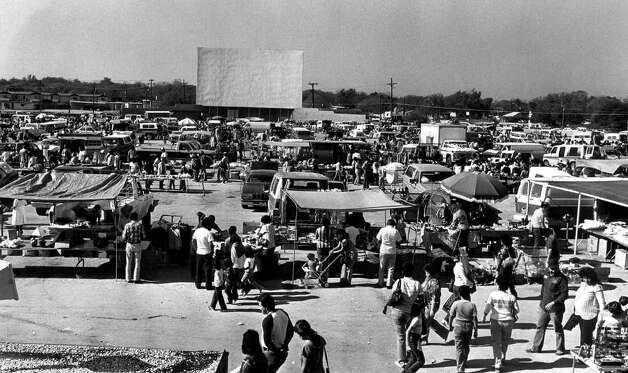
A typical Flea Market at the Mission Drive-In, San Antonio, Texas, 1984
Over time, with the advent of other sources of entertainment, as well as the rising cost of Real Estate and other economic factors, Cinematic Landmarks such as these have been slowly disappearing over the years, leaving less than 500 across the United States currently. Many of those which were closed were later demolished and the real-estate used for other things such as Office or Retail Space, with some being replaced on the exact same land with Mutli-Plex indoor Movie Theaters. Some properties have just been left vacant with nothing remaining there but an empty field. However, a very-select few that were closed have even re- opened to be given a new-life with new patrons looking for a very unique movie-going experience.
Many folks feel that these Gems of Americana are very much an endangered part of the landscape. Most, if not all of them, have very fond memories of their time spent there and would love to be able to revisit their favorite Drive-In Theater once again.
The Jolly Roger Drive-In
Open: Sept 15, 1954 | Closed: 1990
Capacity: 1000 (1957) - 1600 (1977)
Street View of the Main Screen
The Jolly Roger Drive-In opened in 1956. It had a pirate ship painting on the rear of its 122 feet wide screen. The Jolly Roger had two working amusement park rides that operated in that little play ground located in front of the movie screen. There was a merry go round and "another round and round ride" (ferris wheel?) located there. This was thought of being one of the "cool places to go" when many folks were younger. Some say that it was heads and shoulders better than any of the other drive-in theaters in the area.
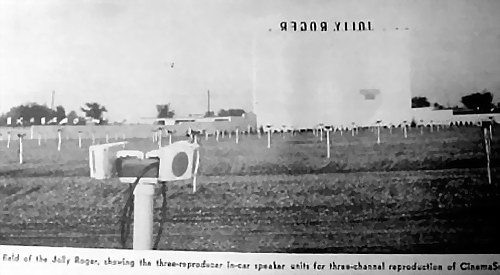
Audience-side of the screen and speakers.
Carrying out the theme of its name, the attraction board (or Marquee) of the Jolly Roger was shaped like the prow of a ship.. It was 95x34 feet and had a 60-foot pole to fly the jolly Roger flag. Three rows of lamps on a "Chaser Circuit" (To give the appearance of movement) bordered the glass panel that made up the board.

The marquee from the Jolly Roger, 1955
The Jolly Roger was Operated by Nicholas George Theatres Inc., it was closed in 1990. The drive-in had a capacity for 1,600 cars.
Aerial Photo from above. Prior to 2009.
A "Charter School" now resides on the south end of the property that the Drive-In once occupied.
The Drive-in Theater is a part of Endangered Americana that is missed by all who treasured the times that they had there.
Enjoy the Hunt...and beware of your surroundings, as always. :)