On the map below you will see our Solar System Series follows a rough line north to south along the Cambrian Mountains of Mid Wales and covers 40 miles using 1 mile to 1 astronomical unit, which itself equals 93 million miles. When finding the caches you will also notice we have chosen cache sizes relative to the size of the planets etc.

The picture below shows the relative size and positions of the objects in our series, which starts with Sol near Dylife (pronounced Du-leye-va) then travels in a southerly direction nearly 40 miles to end with Pluto near Llanwrda just south-west of Llandovery.

There are 15 caches in all, as we have included the first four Asteroids to be discovered and a famous Comet. We have also included Pluto, as most people have grown up learning that Pluto was a planet, though now demoted to dwarf planet status.

The name Sol is from Latin and is the route of such words as 'solar'. The Sun is our local star and is by far the largest object in our Solar System. Among other stars, it is of average mass, size, composition and brightness, but it's nearness, only 150 million kilometres from Earth, makes it appear large and bright.
The diameter of the Sun is 1,392,000km and is so large that the Earth could easily fit inside the Sun a million times. Light from the Sun takes only eight minutes to reach us, the next nearest star is Proxima Centauri, about 270,000 times farther away, and it takes four years to reach us!
Like most stars, the Sun gets it's energy from nuclear fusion, each second the Sun converts about five million tons of matter into energy. The energy heats the Sun's surface to a temperature of 5770 degrees kelvin, making the Sun's apparent colour yellow-white. The surface is actually not solid, though the gases there are thick enough to appear solid. In it's life so far it has used up half of it's available hydrogen fuel, which means that after another 4.6 billion years or so, the Sun will have become a Red Giant, a cooler but much larger incarnation of it's present self.
When deciding where to place our Solar System series we thought of using the Cambrian Mountain Ridge as a guideline to give Geocachers a scenic route and to give suitable cache sites with interest. We chose to start the series with Sol at it's northern end near the Star Inn in the old village of Dylife because of the connection... Sol being our nearest 'star'.
Mining at Dylife can be traced back as far as Roman times. Numerous companies have been established over the years, all with the purpose of mining the lead to turn a profit. The lead occurs in hydrothermal veins often in association with other minerals such as zinc, copper and silver. Mining at Dylife boomed during the mid-1800s and the mine quickly expanded to become one of the biggest lead producers in Europe.
 Dylife in the old days
At a time before the advent of electricity, in these isolated upland areas water power became the primary source of power for many mines. The erection of water wheels was commonplace 150 years ago and they were used for four main applications namely; pumping, winding, crushing and ore dressing.
In 1851 the biggest water wheel in mainland Britain was erected at the Dylife mines. Made largely of wood the Big Martha wheel measured 63ft diameter by 3 1/2ft wide. It is said the wheel worked for 50 years without a break. In the early 1900s when the mines closed the wheel was dismantled and shipped to Canada.
 Big Martha
Dylife was once home to a community of about 1000 people. Now little remains of the village, a few houses and a pub. However, the extensive spoil heaps hide numerous shaft, adits and other remains.
A few people went on living at Dylife after 1901. In 1921 there were 12 pupils on the school register, but in 1925 the school was closed. The last marriage at St David's church took place in 1915, and the last christening in 1926 and then the church was demolished in 1962.
 The old church yard
Two of the chapels at Dylife have been converted into houses and still exist. The other building to have survived is the Star Inn. It still provides refreshments, meals, and overnight accommodation.
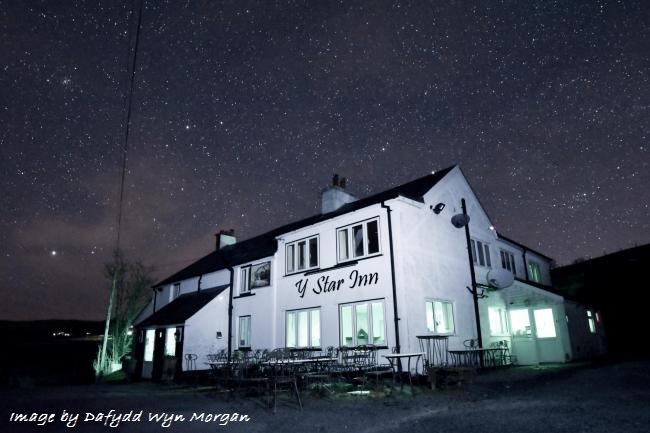 Y Star Inn under dark skies
We hope you enjoy our Welsh Solar System series...D&W
If you are interested in Astronomy here in the Dark Skies of the Cambrian Mountains then check out our Mid Wales Astronomy fb page ... www.facebook.com/midwalesastronomy and you are welcome to join us at Newtown Astronomy Society who have monthly meetings from September to June... www.facebook.com/groups/1412459148966189
For more information about the Cambrian Mountains please follow this link... https://www.thecambrianmountains.co.uk
For more information about Y Star Inn please see their website... https://www.starinndylife.co.uk
We have a Completion Certificate for those who complete our Solar System Series...so let us know when you do :D
Roll of Honour for Completion ...Our Special Congratulations go to...
FTC... Ants & Amanda (Ants tr7v8)
STC... Sadies Mob
TTC... crevell, wavydale, GO£ and L.L
4th... GraamdelaHyeres
5th... Lime Candy & TAG