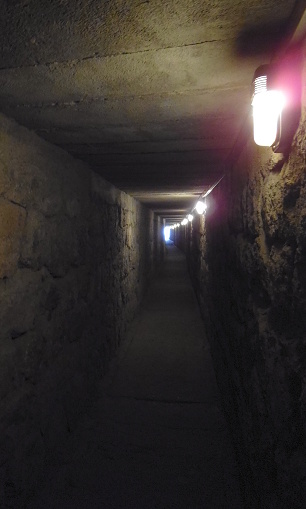
Tumulus Midas Mound
Near cache coordinates and opposite the "Gordion müzesi" (Museum of Gordium) is located Great Tumulus - the largest burial mound at Gordion, standing over 50 meters high today, with a diameter of circa 300 meters. Same as surrounding tumuli (tombs) it was build by the kings of Phrygia and it consist of artificial mounds constructed over burial chambers. There are about one hundred of them, covering both cremations and inhumations. The Great Tumulus was excavated in 1957 by Young's team, revealing the remains of the royal occupant, resting on purple and golden textiles in an open log coffin, surrounded by a vast array of magnificent objects. The burial goods included pottery and bronze vessels containing organic residues, bronze fibulae (ancient safety pins), leather belts with bronze attachments, and an extraordinary collection of carved and inlaid wooden furniture, exceptional for its state of preservation. The Tumulus MM funeral ceremony has been reconstructed, and scientists have determined that the guests at the banquet ate lamb or goat stew and drank a mixed fermented beverage. The burial is now dated to the second half of the eight century BCE, and while it is possible that this is the tomb of King Midas himself, it is now generally assumed to be that of his father Gordias.
Gordion - Yassıhöyük
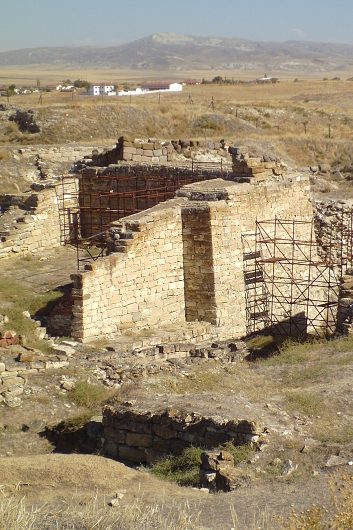
Circa 2 km (you can find coordinates in waypoints) from Midas Mound and local museum is located the capital city of ancient Phrygia called Gordion (EN: Gordium). The site was first excavated by German engineers Gustav and Alfred Körte in 1900 and then, with a much refined excavation technique, by the University of Pennsylvania Museum, under the direction of Rodney S. Young, between 1950 and 1973.
During the ninth and eighth centuries (BCE), the city grew into the capital of the Phryian kingdom that controlled Central Anatolia west of the river Halys (modern Kızılırmak) as far as region around Afyon. In the 8th century, the lower city and the area to the north of the citadel was surrounded by a circuit wall with regularly spaced towers.
There is ample evidence of widespread burning of the city mound of Gordion (Yassıhöyük), in a level referred to by Young as the destruction level. Archaeologists at first interpreted the destruction level as the remains of a Cimmerian attack, circa 700 BCE. The traces were later reinterpreted as dating to circa 800 BCE, largely on the basis of dendrochronology and radiocarbon analysis, although with reference to the types of
objects found in the burned level.
Information adopted from
Wikipedia, corrected and completed by Department of Archaeology, Bilkent University