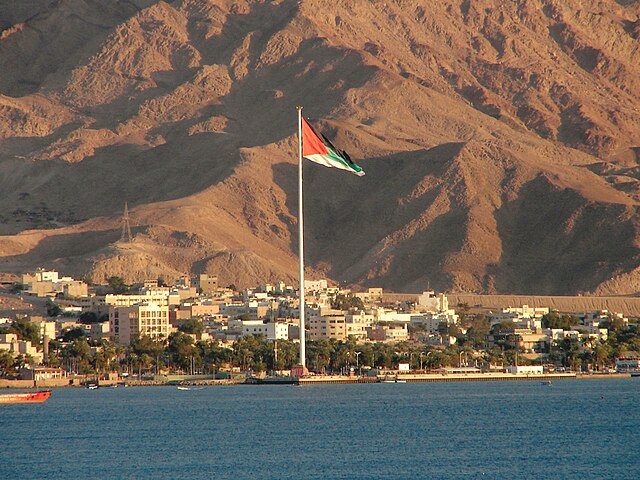
The flagpole with the flag of the Arab Revolt is set to mark the location of the Great Arab Revolt. The Ottomans held Aqaba and it was a defence against an invasion from the sea. They never thought to look towards the desert which was T.E. Lawrences startegic advantage and the Ottoman's ultimate fall.
The Aqaba Flagpole in Aqaba, Jordan is the fifth tallest free standing flagpole in the world at a height of 130 meters (430 ft) high. Many tourist incorrectly assume that the flag is that of the Palestinian people when it is actually the flag of the Arab Revolt (against the Ottomans). The flag can be seen from Egypt, Isarel/Palestine, and Saudi Arabia.
The horizontal colors stand for the Abbasid, Umayyad and Fatimid Caliphates. The red triangle refers to the Hashemite dynasty. The Hashemites were allies of the British in the conflict against the Ottoman Empire. After the war ended, the Hashemites achieved or were granted rule in the Hejaz region of Arabia, Jordan, formally known as the Hashemite Kingdom of Jordan, briefly in Greater Syria, and Iraq. The Hashemites are the ruling royal family of Jordan to this day.1
Click here to enjoy a quick snippet from Lawrence of Arabia and their defeat of Aqaba.
Waypoints:
R1 - Aqaba Castle, Mamluk Castle or Aqaba Fort (قلعة العقبة):

The castle is the scene of a great Arab victory in July 1916 when this heavily defended Turkish stronghold fell to a daring Arab camel charge. Lawrence of Arabia rode triumphantly from here to Cairo to report the good news to an astonished General Allenby. The port of Aqaba became a major supply base for the advancing Arab Revolt.
The castle was originally built by the Mamluk sultan Qansweh Al Ghuri in the 14 century. The fort is located next to the Aqaba Flagpole which carries the flag of the Arab revolt again the Ottomans. Adjacent to the fort is the Aqaba Archaeological Museum. The museum next to the fort was once the residence of Sharif Hussein.
*** Please note: The Castle is under renvoation for the year of 2013 and therefore is inaccessible ***
R2 - The Queen Noor Al Hussein Foudnation.

The Aqaba Center trains unemployed secondary school graduates and disadvantaged women in the production of marketable tourist items. Since its inception in 1986, the number of beneficiaries has exceeded 50,000, a majority of them women. Through its projects, the Aqaba Center addresses the economic, social and cultural needs of families in Aqaba.2
R3 - Aqaba Archaeological Museum -
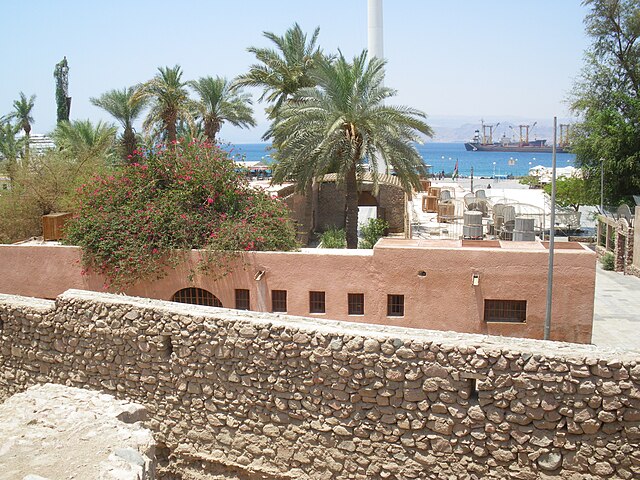
The Aqaba Region Archaeological Museum is located in the Aqaba house of Sherif Hussein Bin Ali next to the Aqaba Castle. The museum was opened to the public in 1990. Presently it houses an important collection from the Islamic site of Ayla, dated to the Rashidun, Umayyad, Abbasid and Fatimid periods, thus representing the Islamic periods from the mid-7th to the beginning of the 12th century AD. Among the exhibits is a Kufic inscription of "Ayat Al-Kursi" from the Holy Qur'an, which surmounted the eastern (Egypt) gate of the city, and a hoard of gold Fatimied dinars minted at Sajilmasa in Morocco.
Sources:
1http://en.wikipedia.org/wiki/Aqaba_Flagpole
2http://en.wikipedia.org/wiki/Aqaba_castle
3http://www.nooralhusseinfoundation.org/index.php?pager=end&task=view&type=content&pageid=60
4http://www.visitjordan.com/visitjordan_cms/MajorAttractions/Aqaba/HistoryCulture/tabid/150/Default.aspx