Larrabee State Park - Fragrance Lake Earthcache EarthCache
Larrabee State Park - Fragrance Lake Earthcache
Please note Use of geocaching.com services is subject to the terms and conditions
in our disclaimer.
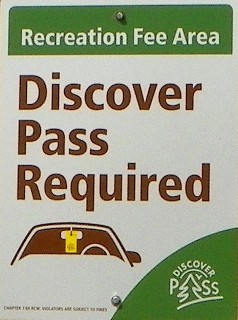 Take a hike to Fragrance Lake and study some of the geologic features along the way. The trail encircling Fragrance Lake allows hikers to walk below massive weathered sandstone cliffs and over footbridges through wooded areas of beautiful fir, hemlock, and cedar trees.
Click for a map of the Chuckanut Trail System
 GEOLOGY OF THE CHUCKANUT MOUNTAIN - FRAGRANCE LAKE AREA
Chuckanut Mountain is largely made up of a layer of sedimentation 20,000 feet thick, which has been topped and folded, accordion-style by subduction and other geologic forces. It’s one of the thickest layers of non-ocean sedimentary rock in the world.
The geology in the area has been shaped by various glacial deposits derived from the advance and retreat of the more than 5700 feet thick Cordilleran Ice Sheet (between about 12,000 and 18,000 years ago) and by subsequent sedimentation.
Great floods of meltwater washing over a barren landscape as part of the Cordilleran Ice Sheet invaded the Puget Lowland. The Fraser Glacier deposited a thick outwash of sand and gravel as the glacier advanced and retreated. The sandy outwash layers became overlain by a pebbly till. This represents the rock material deposited underneath the ice sheet.
GLACIAL TILL
The trail surface on which you are hiking the entire way to Fragrance Lake is glacial till. Till is unlayered and unsorted sediment deposited directly by a glacier. Till, a distinctive sediment, consists of rock fragments of all sizes mixed indiscriminately together. The Fragrance Lake trail glacial till is comprised of stones enclosed in a matrix of clay, silt, and sand. There are also some metamorphic cobbles along the trail, as well as sand eroded from Chuckanut bedrock. This mixture provides for a quality trail surface which is rarely muddy.
Glacial till on the trail surfaces to Fragrance Lake consists mostly of erratics, because they do not match any lowland bedrock. Many individuals commonly think of an erratic as a large boulder, however erratics may be small pebbles or cobbles as well. An erratic is a rock carried by a glacier far enough from its source to be deposited on a different rock type.

PLUTONIC ROCKS
Various sizes of plutonic rocks are plentiful in the area. The rocks were carried out of the Coast Mountains, are mostly black-and-white speckled, and have large crystals. Plutonic rock forms beneath the surface of the earth’s crust; and have large crystals which is an indicator of slow cooling. It is a non-volcanic, intrusive rock. A pluton is a mass of intrusive igneous rock, most commonly granite. Conversely, extrusive, volcanic rocks are fine-grained, extrusive rocks with small crystals due to the rapidity of cooling at the crust’s surface.

SANDSTONE CLIFFS
The only location where the Cascade Mountain Range reaches the salt waters of the Puget Sound are the Chuckanut Mountains; a part of the larger Chuckanut Formation which is geologically composed of sandstone, shale, conglomerate and mudstone.
Sandstone, a sedimentary rock, is formed by grains of sand being compressed by the pressure of the surface above where it lies. This pressure forces out air and water that exists between the sand grains. Over time, the pressure results in the grains of sand being fused together to form stone.
LOGGING REQUIREMENTS
To qualify for this earthcache, send an email providing answers to the following questions. You do not have to wait for a response to log this EarthCache online.
DO NOT include your answers in your online log.
1. Visit the listed waypoint to study a small plutonic rock near N 48° 39.410 W 122° 28.599 (click on image in gallery - UPDATED 2018). Describe the grains/colors/texture. What is a visible difference between a plutonic rock and a volcanic rock? (read the cache page).
2. To prove your visit, measure and provide the distance (in feet or meters) from the plutonic rock to the nearby bicycle barrier.
3. Go to the posted cache coordinates (below the sandstone cliffs), determine the approximate height of the sandstone cliffs above you (in feet or meters).
4. From the posted cache coordinates, walk entirely around Fragrance Lake; returning to the posted coords. Stay on the trail the entire way. Option #1 - Using your GPSr, measure the square acreage of the area including Fragrance Lake. Option #2 - Provide the hiking distance around the lake (staying on the trail) in miles or kilometers.

REFERENCES
1. Geology of Fragrance Lake Area, Dave Tucker, December 14, 2012, (http://nwgeology.wordpress.com).
2. Hiking Guide to Washington Geology, Bob Carson and Scott Babcock, 2000, ISBN 978-1-879628-37-3.
3. Roadside Geology of Washington, David D Alt and Donald W Hyndman, Nineteenth Printing, 2010, ISBN 0-87842-160-2.
4. Scenic Driving Washington by Steve Giordano, 1997. ISBN 1-56044-577-7.
5. Insider’s Guide: Bellingham, and Mt Baker, Mike McQuaide.
6. Hiking Whatcom County, Ken Wilcox, 5th Edition, 2006, ISBN 0-9617879-9-6.
 |
- This cache has an approved Permit to be placed at this location on property managed by the Washington State Parks and Recreation Commission. Visitors are responsible for acquainting themselves with policies and rules pertaining to State Park areas.
- By searching for the cache, visitors agree that they are responsible for their own actions, and acknowledge that neither the State of Washington nor the cache owner is responsible for any loss or injury that may occur in relation to such search.
- Report any incident, problem, or violation to State Parks staff.
|
Additional Hints
(No hints available.)
Treasures
You'll collect a digital Treasure from one of these collections when you find and log this geocache:

Loading Treasures