Arriving at the cache site you will be greeted by this sand outcrop with a small cliff, where wonderful examples of Aeolian crossbedding is evident, and a muffin like top where unique examples of weathering can be seen
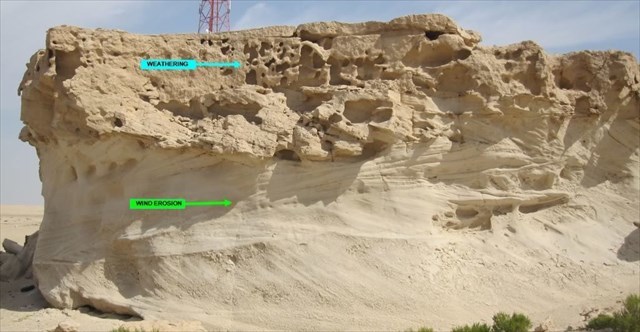
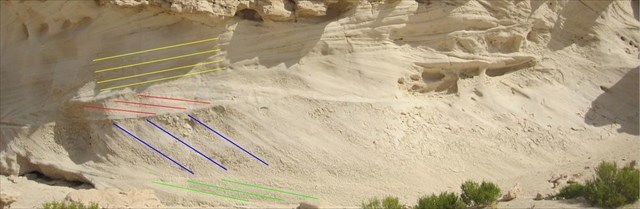
Aeolian is the term derived from the name of the Greek god, Æolus, the keeper of the winds. In an aeolian environment, cross beds often exhibit inverse grading due to their deposition by grain flows. Winds blow sediment along the ground until they start to accumulate. The side that the accumulation occurs on is called the windward side. As it continues to build, some sediment falls over the end. This side is called the leeward side. Grain flows occur when the windward side accumulates too much sediment, the angle of repose is reached and the sediment tumbles down. As more sediment piles on top the weight causes the underlying sediment to cement together and form cross beds.
Wind erosion is a serious environmental problem attracting the attention of many across the globe. It is a common phenomenon occurring mostly in flat, bare areas; dry, sandy soils; or anywhere the soil is loose, dry and finely granulated. Wind erosion damages land and natural vegetation by removing soil from one place and depositing it in another. It causes soil loss, dryness and deterioration of soil structure, nutrient and productivity losses and air pollution. Suspended dust and dirt is inevitably deposited over everything. It blows on and inside homes, covers roads and highways, and smothers crops. Sediment transport and deposition are significant factors in the geological changes which occur on the land around us and over long periods of time are important in the soil formation process.
Suspension, saltation, and surface creep are the three types of soil movement which occur during wind erosion. While soil can be blown away at virtually any height, the majority (over 93%) of soil movement takes place at or below one meter.
Suspension occurs when very fine dirt and dust particles are lifted into the wind. They can be thrown into the air through impact with other particles or by the wind itself. Once in the atmosphere, these particles can be carried very high and be transported over extremely long distances. Soil moved by suspension is the most spectacular and easiest to recognize of the three forms of movement.
Saltation - The major fraction of soil moved by the wind is through the process of saltation. In saltation, fine soil particles are lifted into the air by the wind and drift horizontally across the surface increasing in velocity as they go. Soil particles moved in this process of saltation can cause severe damage to the soil surface and vegetation. They travel approximately four times longer in distance than in height. When they strike the surface again they either rebound back into the air or knock other particles into the air.
Creep - The large particles which are too heavy to be lifted into the air are moved through a process called surface creep. In this process, the particles are rolled across the surface after coming into contact with the soil particles in saltation.
Weathering is the breaking down of rocks, soils and minerals as well as artificial materials through contact with the Earth's atmosphere, biota and waters. Weathering occurs in situ, or "with no movement", and thus should not be confused with erosion, which involves the movement of rocks and minerals by agents such as water, ice, snow, wind and gravity as the UAE experiences no ice and snow, the heavy mists and fogs come into play

Two important classifications of weathering processes exist – physical and chemical weathering; each sometimes involves a biological component. Mechanical or physical weathering involves the breakdown of rocks and soils through direct contact with atmospheric conditions, such as heat, water, ice and pressure. The second classification, chemical weathering, involves the direct effect of atmospheric chemicals or biologically produced chemicals (also known as biological weathering) in the breakdown of rocks, soils and minerals
The main learning aim for this cache is for you to learn how the wind changed the landscape and made the UAE what it is today.
In order to substantiate your visit and be able to claim this Earth Cache, a number of questions need to be answered and submitted to the cache owner, via e-mail.
1. Describe in your own words the surface texture difference between the areas affected by Wind Erosion and Weathering (Both hands and eyes are great for this)
2. Briefly discuss the differences of colours of the sand that can be seen between the top and the bottom sections of the outcrop and why do you think it occurred
3. What controls have you observed in the UAE to limit the effects of wind erosion?
4. Looking at the cross bed layers, why do you thing is there such a difference in the angles of bedding
5. Although not compulsory take a photo of you or your team at GZ or just an interesting feature seen close to GZ
NOTE: You may log your visit prior to approval, but e-mail submissions that do not meet the above criteria will be deleted
References:
http://pubs.usgs.gov/gip/deserts/eolian/
http://milford.nserl.purdue.edu/weppdocs/overview/wndersn
All photographs by Avanclan
