
A group of cachers have gathered together to place caches along The Hertfordshire Way; a 194 mile circular route along public rights-of-way within the County of Hertfordshire. Rather than caches at every 0.1 mile we have tried to put together interesting hides with cool Bonus Caches.
Leg 3 stretches from Willian to Codicote for 11.8 miles. As you walk the path collect the information you need to find the Bonus Cache at waypoints along the route. We advise that you bring sturdy boots for very muddy terrain and a high visibility vest with you because a couple of short sections require walking along the road.

Minsden Chapel
Cache Details
We were sad to see that the original cache on this site (GC1CZB8) had been archived, but knew that this leg of the Hertfordshire Way series would not be complete without celebrating this special landmark. In placing its successor, we’re very grateful to bill&ben for permission to reproduce the excellent and interesting text from their original cache page.
Minsden was mentioned in the Doomsday Book, the building being a chapel of ease to St Mary at Hitchin. The chapel served Minsden, Langley, Preston and even further afield. It was near St Albans Way and was a sanctuary for travellers and pilgrims en route to St Alban’s Abbey.
During the Reformation (from 1538) worship at Minsden chapel declined. The congregation was small and couldn’t afford a minister so every few months a clergyman rode to Minsden to conduct baptism, marriage and burial services.
In 1650, a report noted that the chapel had fallen into great decay, but added that it was fit to be made a parish church. Although a considerable amount of money was raised for repairs – a new roof was built - the custodians of the fund died and the money was lost. This reversal was quickly followed by a shattering decision that they should pay a rate for repairs to the church at Hitchin. In the face of overwhelming power and influence the people of Preston and Langley bowed to the inevitable and paid their dues under protest. In 1690 they sent a report to the archdeacon that their chapel was now totally ruinated, stripped, uncovered, decayed and demolished.
After this, Minsden chapel began to be plundered. Jeremiah Godfrey stole 400 pounds of lead in 1690. Stone and oak fittings from the chapel were carted to cottages for their repair and decoration. In 1700 Joseph Arnold of Langley was sued by John Heath, the chapel warden of Minsden, for appropriating the font for a sink at his home! Painted glass from the chapel was found at a pub in Hitchin and it was alleged that in 1840, when the church at Ippollitts was restored, the tracery work of the windows was stolen from Minsden. About this time, a Hitchin character known as “old Bowstock” would load his donkey cart with “clunch” at Minsden and travel to Hitchin market where it was sold in the shadow of St Mary's church.
Even the three bells of Minsden chapel were looted. In 1725, a probable witness to the removal of two of them, John Reason of St Pauls Walden, was returning home from Hitchin market and was near Hitch Wood when he was alarmed by the noise of men with horses and a fast-moving carriage. They were travelling towards Harpenden. Shortly afterwards, the bells were reported as missing. It was reported by Mr Cook of Little Almshoe that one of his barns was called “Bell Barn” as the third stolen bell had been hidden there one night.
Much of this pillage occurred when the chapel was still being used as a place of worship. The chapel warden, John Heath, was admonished because of his leanings towards the Baptists and Independents. Heath allowed an Independent Christian, Daniel Skingle, to use the chapel to preach to his flock. The congregation quickly swelled to around 300 souls, but Skingle and Heath were rebuked by the Church and were forced to make an abject confession of offences against God and the Church.
Skingle’s sermons were the last to be preached at Minsden, but marriages continued to be performed there. Despite the ruined shell of the building, there was a certain appeal in its rustic surroundings. It was hidden among trees and adorned with moss and ivy. Instead of being entered in the chapel register at Minsden, these later marriages were recorded in the parish register of St Mary. On 11 July 1738/9, the baker Enoch West married Mary Horn at the chapel. Beside their names “at Minsden chapel” was written for the last time. During the ceremony it was reported that a lump of masonry fell and dashed the service book from the curate’s hand. After this narrow escape the Bishop of Lincoln would not allow any other marriages at Minsden – a wedding might become a wake.
And so the chapel quietly crumbled. The Hitchin historian, Reginald Hine (1883-1949), leased it from the vicars of Hitchin in the 1920s and belatedly warned off trespassers and scavengers, threatening pursuit with “the utmost vigour of the law”. He wished to be buried there and promised that he would “endeavour in all ghostly ways to protect and haunt its hallowed walls”. The first part of his wish was granted, at least.
Information extracted from the excellent Preston Village website

You might meet these guys en route!
The cache itself can be reached and retrieved without entering the woodland. Please do not attempt this cache after dark.
Update
In 2022 Natural England funded major conservation repairs through the Countryside Stewardship Scheme. The area around the church has been cleared and repairs to stabilise the walls and arch have been completed to ensure the future of the chapel is secure.
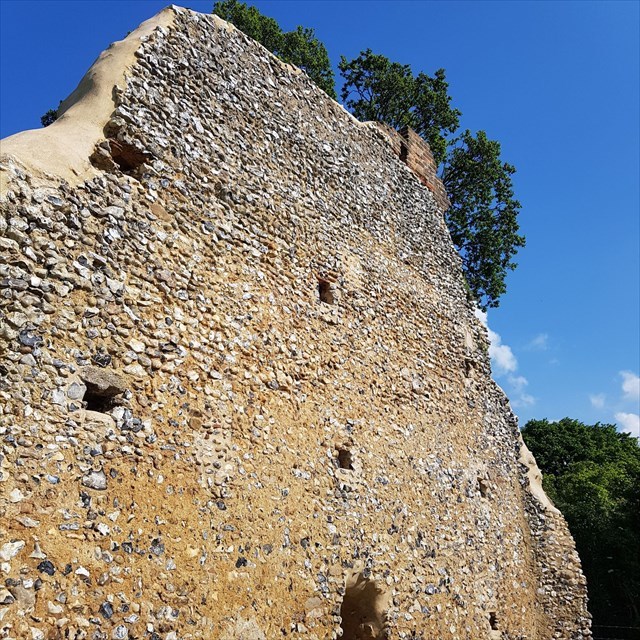
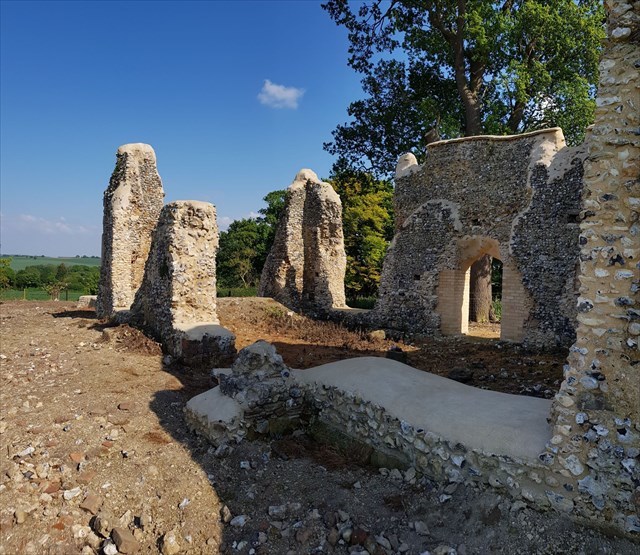
Minsden Chapel 2024
Bonus Waypoints
The following Bonus Cache waypoint can be found close to this cache or en route to the next cache.
BonusI - N51 54.071 W 000 15.659 - In what year were Subprionocyclus hitchinensis fossils first described from here? This gives you BonusI. Note: 27th November 2020 - the new board does not give a specific date. Bonus I=1927.
To the Next Cache
Continue on the Hertfordshire Way trail and head downhill towards the road. When you reach the road please cross carefully as the path on the other side is not directly opposite and there is a bend in the road hiding oncoming traffic. Proceed up the hill and pause to look into Hill End Chalk Pit, which is renowned for its fine fossils and is a very important geological site.
When you reach a T-junction with another path you may divert right, off the main trail, briefly to inspect it more closely by taking the small trail at N51 54.050 W000 15.664. Please make all attempts to preserve this important area. The Hertfordshire Way continues up the hill (left at the previously mentioned T-junction) and past a few houses. Then it follows a field boundary into a track lined with trees on each side.
Other Caches On The Way
All caches on, or close to, Leg 3 of the Hertfordshire Way can be found on this bookmark list.


Read more about the Historic Geocaches Campaign