Let’s follow LPT 26 –
Cycle of life
McKee Clan’s cache
Let’s follow LPT (Little Para Trail) is a series of caches along the trail for you to find. Please enjoy the walk or Ride as we have and happy hunting.
Due to the number of caches in carisbrook park and Howie bowie reserve we decided to start in salisbury and continue out to sea. Enjoy the walk or ride.
FTF – C STF – B TTF – A
Please follow the: 
I have chosen this area due to the frog calls you can hear at night here.
Don’t forget your ear muffs in winter.
Local point of interest
interest -

Frog Calls
The call or croak of a frog is unique to its species. Frogs create this sound by passing air through the larynx in the throat. In most calling frogs, the sound is amplified by one or more vocal sacs, membranes of skin under the throat or on the corner of the mouth, that distend during the amplification of the call. Some frog calls are so loud that they can be heard up to a mile away.
Frogs in the genera Heleioporus and Neobatrachus lack vocal sacs but can still produce a loud call. Their buccal cavity is enlarged and dome-shaped, acting as a resonance chamber that amplifies the sound. Species of frog that lack vocal sacs and that do not have a loud call tend to inhabit areas close to constantly noisy, flowing water. They need to use an alternative means to communicate. The coastal tailed frog (Ascaphus truei) lives in mountain streams in North America and does not vocalize.
The main reason for calling is to allow male frogs to attract a mate. Males may call individually or there may be a chorus of sound where numerous males have converged on breeding sites. Females of many frog species, such as the common tree frog (Polypedates leucomystax), reply to the male calls, which acts to reinforce reproductive activity in a breeding colony. Female frogs prefer males that produce sounds of greater intensity and lower frequency, attributes that stand out in a crowd. The rationale for this is thought to be that by demonstrating his prowess, the male shows his fitness to produce superior offspring.
A different call is emitted by a male frog or unreceptive female when mounted by another male. This is a distinct chirruping sound and is accompanied by a vibration of the body. Tree frogs and some non-aquatic species have a rain call that they make on the basis of humidity cues prior to a shower. Many species also have a territorial call that is used to drive away other males. All of these calls are emitted with the mouth of the frog closed. A distress call, emitted by some frogs when they are in danger, is produced with the mouth open resulting in a higher-pitched call. It is typically used when the frog has been grabbed by a predator and may serve to distract or disorientate the attacker so that it releases the frog.
Many species of frog have deep calls. The croak of the American bullfrog (Rana catesbiana) is sometimes written as "jug o' rum". The Pacific tree frog (Pseudacris regilla) produces the onomatopoeic "ribbit" often heard in films. Other renderings of frog calls into speech include "brekekekex koax koax", the call of the marsh frog (Pelophylax ridibundus) in The Frogs, an Ancient Greek comic drama by Aristophanes.
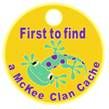
For the First to find there is a certificate and a unique FTF path tag. They are not swapped or given out so the first to find pathtag will be a unique item that no one else will have.