This site is site 2 on the Brown's Folly Geological Trail. An introduction to the geology on this reserve can be seen at EarthCache 'Brown's Folly - old adit mine' GC4CTH7. The EarthCache is here with the permission of The Reserves Manager, Avon Wildlife Trust.
Descend the rough steps into the site. You can see that the rocks are not horizontal here. The top of the layers (beds) are sloping (dip) downwards and the beds in the lower face get thinner towards the right.
These Jurassic rocks are the youngest seen on the reserve, but are still about 165 million years old. They are known as the Forest Marble although they are not marble at all. A true marble is a limestone which has suffered conditions of high temperature and/or high pressure during plate tectonic movement. The name Forest Marble was first used for this type of limestone in Wychwood Forest in Oxfordshire because it takes a good polish and it can be used as a decorative stone.
The rocks seen at this site are hard, brown and contain bands of shells and other fossils, some whole but often fragmented; they are sometimes oolitic. The rock splits fairly easily along the shell bands and has been used for building work such as field walls and farm buildings. Thin clay bands between limestone bands are common; one can be seen in the corner near the junction of the two faces.
Try to imagine what it would have been like to have been here when this rock was forming. You would have been in fairly shallow sea water with waves that were strong enough to break the shells of sea creatures. I am sure you have seen broken shells at high-tide mark on beaches today. The clay bands may indicate a slight shallowing of the sea and the formation of a lagoon. Oolitic limestones (like the rocks you may have seen if you found Site 1, the old adit mine) were forming further out to sea and that explains why some ooids have washed into this sediment to be cemented together with the shells into this rock.
This site appears to be the result of the rocks collapsing into a mine; such collapses can be seen at several places along the reserve. The beds in the lower face seem to have been little disturbed by the collapse, the variation in bed thickness and slope being the result of the way the sediment, from which the rock formed, was deposited. The deposition of sediments from flowing water is quite a complex process and often gives rise to rock layers or features in the rock, such as bands of broken shells, that are not horizontal. Such rocks are said to be cross bedded (or to show cross-bedding) and their formation (simplified) is illustrated below.
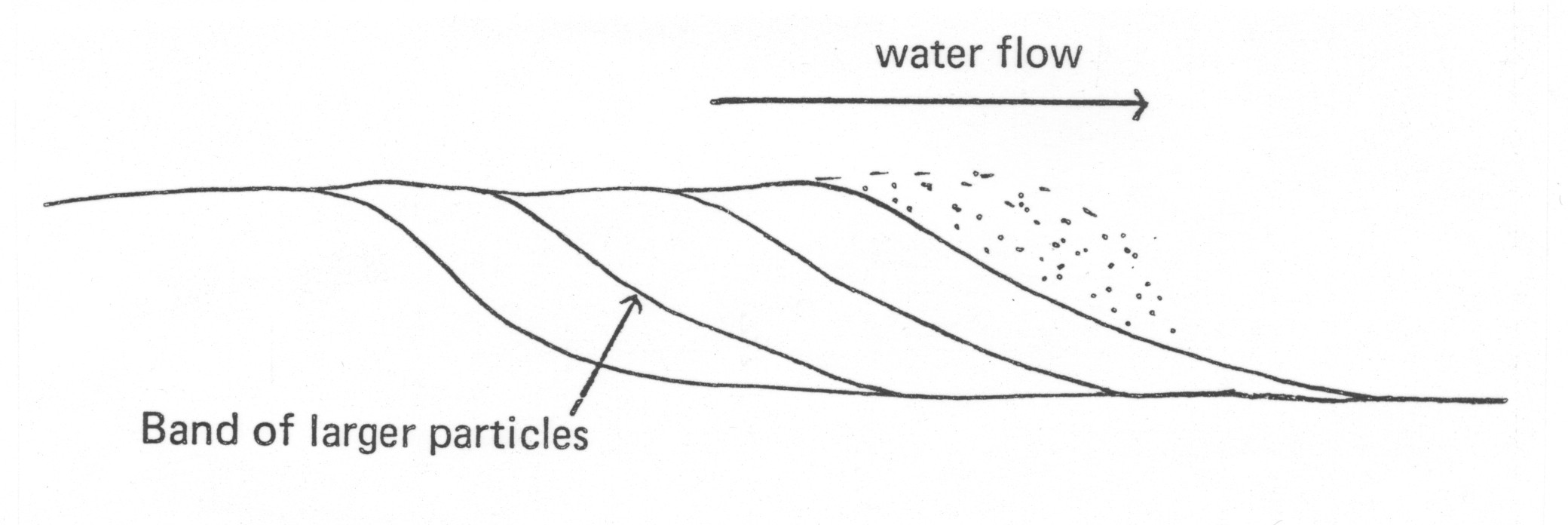
The sediment deposit moves downstream like a wave as sediment is deposited on the sloping face.
Periodically, larger particles that have collected at the top of the slope avalanche down forming distinct bands marking the slope.
Cross-bedded rocks can be seen at several places on the Reserve. The slope of the rocks in the higher face is probably due to quite recent movement (collapse) though some slopes may be the result of large-scale cross bedding.
What to do
1. Find a loose piece of rock, preferably one that is unweathered. Describe what you can see; a hand lens or magnifyer will help.
2. Do the beds of rock on both faces dip in the same direction? (Remember the faces are at right angles)
3. What has happened to the rocks in the corner between the two faces?
Email your answers to me, JurassicEdie