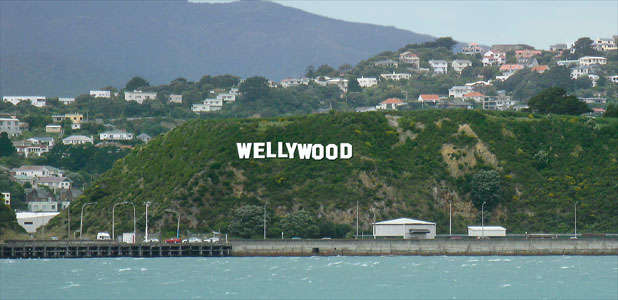
Welcome to WELLYWOOD, a series of caches designed to enlighten you and show you around some of the wonderful locations in 'the coolest little capital of the world'.
You will be required to do some 'pre-work' to complete and find some of these caches, while others will require you to do some exploring 'out in the field', and some will require a combination of both. Most caches can be found in the greater Wellington area, although there may be a few that are further afield. We hope you enjoy the series.
 Orongomai Marae
In Māori society, the marae is a place where culture can be celebrated, where the Māori language can be spoken, where intertribal obligations can be met, where customs can be explored and debated, where family occasions such as birthdays can be held, and where important ceremonies, such as welcoming visitors or farewelling the dead (tangihanga), can be performed. Like the related institutions of old Polynesia, the marae is a wāhi tapu, a 'sacred place' which carries great cultural meaning.
In Māori usage, the marae atea (often shortened to marae) is the open space in front of the wharenui or meeting house (literally "large building"). However, the termmarae is generally used to refer to the whole complex, including the buildings and the open space. This area is used for pōwhiri - welcome ceremonies featuring oratory. Some marae do not allow women to perform oratory there. The meeting house is the locale for important meetings, sleepovers, and craft and other cultural activities. The wharekai (dining hall) is used primarily for communal meals, but other activities may be carried out there. Many of the words associated with marae in tropical Polynesia are retained in the Māori context. For example, the word paepae refers to the bench where the speakers sit; this means it retains its sacred and ceremonial associations. Marae occur in various sizes, with some wharenui being a bit bigger than a double garage and some being larger than a town hall.
Legal status
A marae is a meeting place registered as a reserve under the Te Ture Whenua Māori Act 1993 ('The Māori Land Act'). Each marae has a group of trustees who are responsible for the operations of the marae. The Act governs the regulation of marae as reservations and sets out the responsibilities of the trustees in relation to the beneficiaries. Generally each marae has a charter which the trustees have negotiated with the beneficiaries of the marae. The charter details matters such as:
• the name of the marae, and a description of it;
• a list of the beneficiaries: usually iwi (tribes/nations), hapū (clans) or whānau (families); in some cases, the marae is dedicated to the common good of the people of New Zealand.
• the methods used to select trustees;
• general governing principles of the marae;
• the ways in which the trustees may be held accountable by the beneficiaries, and methods for conflict resolution;
• principles governing appointment and recognition of committees to administer the marae;
• procedures for amending the charter, and for ensuring adherence to its principles.
The New Zealand Māori Arts and Crafts Institute Act, 1963 was passed and the institute built to maintain the tradition of Whakairo. The NZMACI is responsible for the restoration and building of over 40 marae around New Zealand.
Tangihanga
Like in pre-European times, marae continue to be the location of many ceremonial events, including birthdays, weddings, and anniversaries. The most important event located at marae is the tangihanga. Tangihanga are the means by which the dead are farewelled and the surviving family members supported in Māori society. As indicated by Ka'ai and Higgins, "the importance of the tangihanga and its central place in marae custom is reflected in the fact that it takes precedence over any other gathering on the marae".
Traditional, church, and educational uses
Most iwi, hapū, and even many small settlements have their own marae. An example of such a small settlement with its own marae is at Hongoeka Bay, Plimmerton, the home of renowned writer Patricia Grace. Since the second half of the 20th century, Māori in urban areas have been establishing intertribal marae such as Maraeroa in eastern Porirua. For many Māori, the marae is just as important to them as their own homes.
Some New Zealand churches also operate marae of their own, in which all of the functions of a traditional marae are carried out. Churches operating marae include the Anglican, Presbyterian, and Catholic churches. In recent years, it has become common for educational institutions, including primary and secondary schools, technical colleges, and universities, to build marae for the use of the students and for the teaching of Māori culture. These marae may also serve as a venue for the performance of official ceremonies relating to the school. The marae of the University of Auckland, for instance, is used for graduation ceremonies of the Māori Department, as well as welcoming ceremonies for new staff of the University as a whole. Its primary function is to serve as a venue for the teaching of whaikōrero (oratory), Māori language and culture, and important ceremonies for distinguished guests of the University. Two spectacular secondary school marae are located in the Waikato at Te Awamutu College and Fairfield College. The latter was designed by a Māori architect with a detailed knowledge of carving and weaving. The wharenui features an intricately carved revolving pou as well as many other striking features. In addition to school activities it is used for other weddings.

Six years of work to build the wharewhakairo at Upper Hutt's Orongomai Marae and complete the many carvings culminated in a day of celebrations at its dedication last week. This photograph was taken during the combined thanksgiving service later in the morning. Standing in front of the wharewhakairo which has been named Kahukura is the local Maori cultural group Mawai-Hakona. With them (in white) is former chaplain to the Māori community in Sydney, Sir Kingi Ihaka (knighted the previous day) who officiated at the opening and the group in red to the right is the Wellington area Ratana Band. (Date taken: 30th May 1989)
To find this cache you'll need to find out the year the Marae opened. This will be ABCD. Cache can be found at 41 ab.cde 175 fg.hij
a = 0
b = C
c = D
d = D-A
e = A+C
f = a
g = A+h
h = B-D
i = C-D-A
j = D