This cache is part of a 1:133,700,000 scale model of the solar system. The dome on the Monroe County Courthouse in downtown Bloomington serves as a model of the sun.

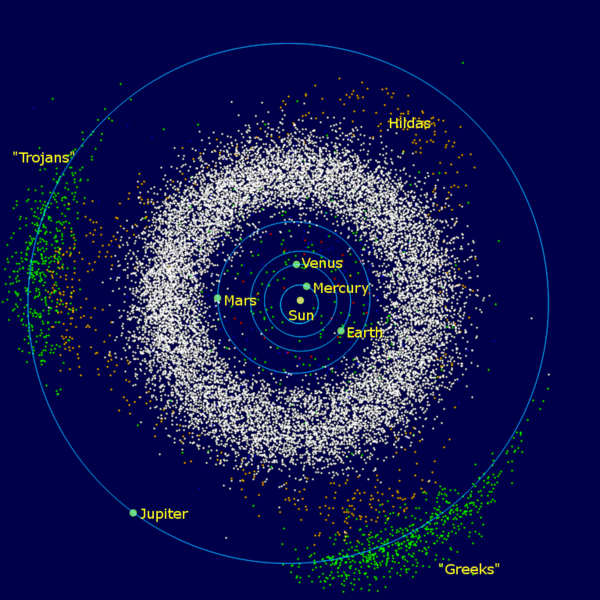
For the most part, all of the planets in our solar system orbit all by themselves their own little elliptical neighborhoods. Due to the gravitational force of the planet, most of the little rocks that might've been floating around nearby were long ago pulled down to the surface of the planet, trapped into becoming a moon, or swung out into a different orbit. (This is part of what makes a planet a planet and not just a dwarf planet (like Pluto, which isn't big enough to have cleaned out its neighborhood).) But there are these tiny little pockets where the gravity of the sun and a planet perfectly balance each other out, leaving a little point where an object can get dragged and shoved around in a perfect lock-step orbit with the planet, despite not actually being anywhere near the planet. These points are called Lagrangian points.

Hektor is the largest of Jupiter's Trojan asteroids, which all sit in Jupiter's L5 Lagrangian point, following behind Jupiter in its orbit. (The asteroids that precede Jupiter in its orbit, sitting in its L4 Lagrangian point are called Greek asteroids.) The asteroid is named after the Trojan hero Hektor, made famous by Homer's Iliad. Its orbit takes it from 762 million out to 800 million kilometers from the sun, so I've placed it about 3.8 miles from the courthouse. (This is actually a bit too far out, but proximity to other caches forced me to move it a bit.)
Hektor is one of the longest objects in the solar system. If it was any bigger, then its gravity would have pulled it into a more spherical shape. But it's small enough that it can maintain its width at 195 kilometers and its length at 370 kilometers. At this scale, that translates to roughly 1.5mm x 2.8mm. It might be be bilobate (meaning shaped like two balls stuck together), or it might actually be two separate asteroids that are just barely touching each other (or very nearly touching each other). Or it might just be an elongated spheroid. Until we get better pictures of it, it's impossible to tell.