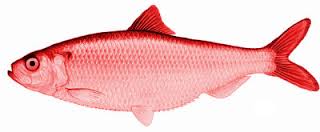
The idiom "red herring" is used to refer to something that misleads or distracts from the relevant or important issue. In a literal sense, there is no such fish as a "red herring"; it refers to a particularly strong kipper, a fish (typically a herring) that has been strongly cured in brine and/or heavily smoked. This process makes the fish particularly pungent smelling and, with strong enough brine, turns its flesh reddish. In its literal sense as a strongly cured kipper, the term can be dated to the mid-13th century, in the poem The Treatise by Walter of Bibbesworth: "He eteþ no ffyssh But heryng red."
Until very recently, the figurative sense of "red herring" was thought to originate from a supposed technique of training young scent hounds. There are variations of the story, but according to one version, the pungent red herring would be dragged along a trail until a puppy learned to follow the scent. Later, when the dog was being trained to follow the faint odour of a fox or a badger, the trainer would drag a red herring (whose strong scent confuses the animal) perpendicular to the animal's trail to confuse the dog. The dog eventually learned to follow the original scent rather than the stronger scent. An alternate etymology points to escaping convicts who used the pungent fish to throw off hounds in pursuit.
According to etymologist Michael Quinion, the idiom likely originates from an article published February 14th 1807 by radical journalist William Cobbett in his polemical Political Register. In a critique of the English press, which had mistakenly reported Napoleon's defeat, Cobbett recounted that he had once used a red herring to deflect hounds in pursuit of a hare, adding "It was a mere transitory effect of the political red-herring; for, on the Saturday, the scent became as cold as a stone." Quinion concludes: "This story, and [Cobbett's] extended repetition of it in 1833, was enough to get the figurative sense of red herring into the minds of his readers, unfortunately also with the false idea that it came from some real practice of huntsmen."
In case you haven't realized by now, I love the red herring. It is my second most favorite aspect of a good perplexing puzzle. My favorite is when a puzzle causes me to think in a new way or to view things with a new perspective. Most of my puzzles involve a red herring of some sort - just FYI in case you ever find yourself stumped with one.
To locate this cache, you need to locate the secret
code by solving GC4KGR5 and apply it above.
N 34° 54.443 W 080° 48.877
