Stay on trails and follow all rules and posted signs while within the Bennett Spring park area
If it’s open be sure to stop by the Bennett Spring Nature Center where you will see TONS of exhibits interpreting Missouri's springs and the natural environment surrounding Bennett Spring State Park.
Before stalagmites and stalactites caves are carved by forces of nature that are so powerful they can carve away solid rock. Don’t be mistaken Bennett Spring is a cave. This cave is “growing” or in its “Infancy”, in terms of geological time that is. Caves are mostly formed by water at first, some stay filled with water for longer periods of time than others. And yet still others are always filled with water. This is Missouri’s third largest spring, and produces, on average, a daily flow rate of 100 million gallons of water per day.
You are going to be focusing one two geological phenomenon’s that are currently occurring here; Erosion and karst topography.

Source: Photo
Karst topography
Karst topography is a geological formation shaped by the dissolution of a layer or layers of soluble bedrock usually carbonate rock such as limestone or dolomite. Subterranean drainage may limit surface water with few to no rivers or lakes. Many karst regions display distinctive surface features, with sinkholes being the most common. However, distinctive karst surface features may be completely absent where the soluble rock is mantled, such as by glacial debris or confined by one or more superimposed non-soluble rock strata. Some karst regions include thousands of caves, although evidence of caves large enough for human exploration is not a required characteristic of karst.
Types and formation
A cave or cavern is a hollow place in the ground, especially natural underground space large enough for a human to enter. Caves form naturally by the weathering of rock and often extend deep underground.
solution caves
Solutional caves are the most frequently occurring caves and such caves form in rock that is soluble, such as limestone, but can also form in other rocks, including chalk, dolomite, marble, salt, and gypsum. Rock is dissolved by natural acid in groundwater that seeps through bedding-planes, faults, joints and so on. Over geological epochs cracks expand to become caves and cave systems.
primary caves
Caves formed at the same time as the surrounding rock are called primary caves.
Lava tubes are formed through volcanic activity and are the most common primary caves. As lava flows downhill, its surface cools and solidifies. Hot liquid lava continues to flow under that crust, and if most of it flows out, a hollow tube remains. Examples of such caves can be found in the Canary Islands, Jeju-do, the basaltic plains of Eastern Idaho and other places. Kazumura Cave near Hilo, Hawaii is a remarkably long and deep lava tube; it is 65.6 km long (40.8 mi).

Source: Photo
Pirate and losing streams
Losing streams are common in regions of karst topography where the stream water may be completely captured by an underground cavern system, becoming a subterranean river.
A losing stream is the same thing as stream piracy. Stream piracy can also happen when the stream “sinks” into the ground and comes out of a spring. (USGS)
A good example of this is Goodwin Hollow at Missouri Highway 5 north of Lebanon in Laclede County.

Source: Photo
Erosion
Erosion is the process by which soil and rock are removed from the Earth's surface by natural processes such as wind or water flow, and then transported and deposited in other locations.
Types of Erosion:
Splash Erosion: Small soil particles are detached and sent airborne through the impact of raindrops on soil.
Sheet Erosion: Raindrops break apart the soil structure and it's moved down-slope by water that flows overland as a sheet rather than definitive channels. This occurs frequently during cloud bursts.
Rill Erosion: This process develops small, short-lived, concentrated flow paths. These paths create a sediment source and delivery system for hill-slope erosion. Areas where precipitation rates exceed soil infiltration rates are more prone to this type of erosion.
Gully Erosion: Water flows in narrow channels during or directly following heavy rains or melting snow. The gullies can erode to considerable depths.
Valley or Stream Erosion: Continual water flow alongside land (along a linear feature) creates this type of erosion. It extends downward, deepening a valley, and head-ward, extending the valley into the hillside. This occurs most frequently in times of flooding.
Bank Erosion: Over time, banks of rivers and streams are naturally worn down.
Freezing and thawing: Cold weather causes water trapped in tiny rock cracks to freeze and expand, breaking the rock into several pieces.
Wind erosion is a major geomorphological force, especially in arid and semi-arid regions. Wind erosion is of two primary varieties: deflation, where the wind picks up and carries away loose particles; and abrasion, where surfaces are worn down as they are struck by airborne particles carried by wind.
Mass movement is the downward and outward movement of rock and sediments on a sloped surface, mainly due to the force of gravity. Mass movement is an important part of the erosional process, and is often the first stage in the breakdown and transport of weathered materials in mountainous areas. It moves material from higher elevations to lower elevations where other eroding agents such as streams and glaciers can then pick up the material and move it to even lower elevations. Mass-movement processes are always occurring continuously on all slopes; some mass-movement processes act very slowly; others occur very suddenly, often with disastrous results.
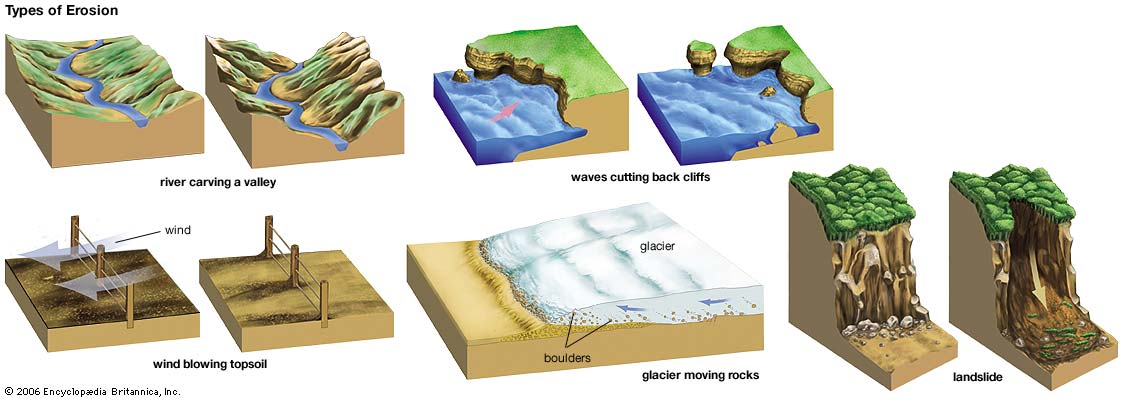
Source: (water)
Missouri rocks
Ordovician Period (505 to 441 million year old rocks)
Ordovician age rocks are largely carbonates and thin shales, along with three distinctive sandstone layers: Gunter, Roubidoux, and the St. Peter glass sand. More caves are found in Ordovician aged rocks than any other. Ordovician rocks in Missouri show common breaks in sedimentation. The erosional surfaces show that the Ordovician seas were shallower and less constant than others. Thicknesses of some layers vary greatly at different locations; this also shows considerable environmental variation. Gasconade dolomite is one of the most massive (and cavernous) units in the sequence, with caves regularly forming in the youngest Gasconade.

Source: Photo
How caves form
Cave formation begins when rainwater absorbs carbon dioxide as it falls through the atmosphere. Rain water must have carbon dioxide to become acidic. It must be acidic to chemically react to the limestone bedrock. Rainwater is absorbed by the soil into the ground.
As rainwater comes through the soil it absorbs more carbon dioxide that is being produced by plants that are dead. This changes the ground water to a weaker form of carbonic acid (H2O + CO2 = H2CO3). As it travels down through the ground it comes to solid rock. When the rock is limestone or dolomite caves can form.
The water reacts chemically with limestone and slowly a larger and larger space will form. This happens because the rocks are made of calcium carbonate (CaCO3). This is what you call chemical erosion.
As the space becomes larger and larger the water can flow through. As it flows it erodes. Physical erosion washes away rock and sand. This is what makes a cave larger and forms an underground stream. Finally over hundreds of thousands of years or even millions of years the cave is formed.

**Logging requirements**
DO NOT POST ANSWERS IN YOUR LOG.
Send the following answers to me via email.
- The text "GC4N2K3 Bennett Spring" on the first line
- What type of Rock is around the main part of this spring? (read the sign)
- Divers have explored and mapped the spring to a depth of about ___ and a horizontal distance of about ___ At this depth, narrowing of the cave passage to a ___ foot by ___ foot throat, and the high velocity of the water, halt further exploration.
- What is the diameter of the spring basin?
- As the posted sign says, this is a cave, so how big is it (answer in square miles)? You can tell this by finding what the recharge area of this spring is in Square miles
- How many known losing streams are cited as being part of this cave system?
| I have earned GSA's highest level: |
   |
Sources
- Rader, A.. N.p.. Web. 4 Sep 2013. <http://www.geography4kids.com/files/land_erosion.html>.
- water: erosion. Art. Britannica Online for Kids. Web. 4 Sept. 2013. <http://kids.britannica.com/elementary/art-88797>
- Easterbrook, Don J. Surface Processes and Landforms. 2nd ed. Upper Saddle River, N.J.: Prentice Hall, 1999. Print.
- Missouri State Parks, , ed. N.p.. Web. 7 Sep 2013. <http://mostateparks.com/park/bennett-spring-state-park>.
- MDC, , ed. N.p.. Web. 7 Sep 2013. <http://mdc.mo.gov/regions/southwest/bennett-spring-fish-hatchery>.
- USGS, . N.p.. Web. 7 Sep 2013. <http://ga.water.usgs.gov/edu/watercyclesprings.html>.
- DNR, , ed. N.p.. Web. 8 Sep 2013. <http://www.dnr.mo.gov/env/wrc/groundwater/education/provinces/salemplatprovince.htm>.