This cache is at the former Grand Rapids & Indiana railroad depot, on the White Pine Trail. The depot had been used as a restaurant in recent years, but currently stands vacant. This is muggle area, especially in nicer weather. Please be stealthy.
![http://www.michiganrailroads.com/RRHX/imagesRRHX/Stations/GR&IBigRapidsDepotPostcard[AlanLoftisColl].jpg](https://imgproxy.geocaching.com/2cfd564de55c0dd0309b97d53e50eee16e603916/687474703a2f2f7777772e6d6963686967616e7261696c726f6164732e636f6d2f525248582f696d61676573525248582f53746174696f6e732f475226494269675261706964734465706f74506f7374636172645b416c616e4c6f66746973436f6c6c5d2e6a7067 "Big Rapids Depot from the Alan Loftis Collection, RRHX")
GR&I Big Rapids Depot from the Alan Loftis Collection, courtesy RRHX
While there is some evidence near the city of Native Americans as much as thirteen thousand years ago, the first real settlers of the area were the Ottawa who camped on the banks of the Muskegon River each spring to gather maple sap. The first white settlers in what is now the City of Big Rapids were the brothers Zerah and George French and their families, in 1854 or 1855, depending on the source. The state authorized the organization of Mecosta County in 1859 and established Leonard (for the township) as the county seat. By 1869, the area had grown sufficiently for the town of Leonard to become the city of Big Rapids.
The first few decades of Leonard/Big Rapids existence were tied to the lumber boom. Early on, logs were moved primarily by floating them down the Muskegon River. The arrival of the railroads in the 1870s accelerated the boom and helped establish related industry in Big Rapids. The manufacture of furniture was established in the city.
A technical and trade school was established in 1884 by Nathan Ferris. The initial enrollment was 15. Within a couple of decades, enrollment was near 2000. Mr. Ferris became Governor in 1912 and a US Senator in 1922. Surviving several setbacks over the years, Ferris State University is now the leading employer in Big Rapids.
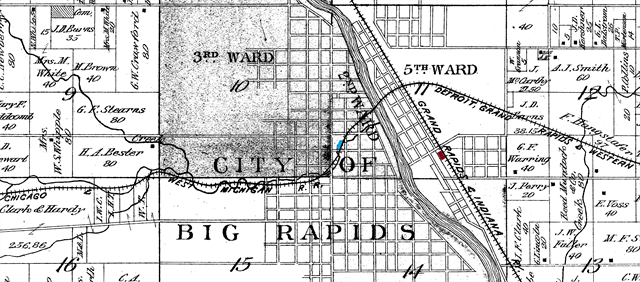
Three railroads came to Big Rapids in the decade starting in 1870. The first to arrive was the Grand Rapids and Indiana. The station is indicated in red on this 1900 plat.
The Grand Rapids and Indiana Railroad started life as a complicated conglomeration of paper companies incorporated in two different states over a two year span, partially due to current laws of incorporation. The first Grand Rapids and Indiana Railroad Company was incorporated in Indiana on January 26th, 1954. It’s Michigan sister company, the Grand Rapids and Southern Railroad Company was incorporated in Michigan on May 31st, 1855. Those two companies were consolidated on September 1st, 1855 into the second Grand Rapids and Indiana Railroad Company. The Grand Rapids and Fort Wayne Railroad Company was incorporated in Indiana on June 23rd, 1857. The Grand Rapids and Macinaw Railroad Company was incorporated in Michigan on June 8th, 1857. On July 30th, 1857, the second Grand Rapids and Indiana Railroad Company, the Grand Rapids and Fort Wayne Railroad Company, and the Grand Rapids and Macinaw Railroad Company were consolidated to form the third Grand Rapids and Indiana Railroad Company. The resulting paper shuffle languished for 10 more years before any construction began in Michigan. The GR&I and its subsidiaries were always under the control of the Pennsylvania Railroad.
Service finally began between Grand Rapids and Cedar Springs on Christmas Day, 1867. By the middle of 1869, the rails were down as far as Morley and into to Big Rapids and Paris by the fall of 1870. The line was also completed between Grand Rapids and Fort Wayne, Indiana. In 1871, the GR&I acquired the Cincinnati, Richmond and Fort Wayne Railroad Company, extending the GR&I to Cincinnati. The line was extending northward as well. By late 1872, it was completed between Walton to Traverse City as the Traverse City Railroad Company. By the end of 1873, the line reached Petoskey. In 1882, the line branched from Kegomic to Harbor Springs, as the Bay View, Little Traverse and Macinac. Also in 1882, the line reached from from Kegomic, to Macinaw City as the Grand Rapids, Indiana and Macinaw Railroad Company. At this point, the GR&I became the longest north-south line in the country. As such, it had a large role in the settlement of northern Michigan. In 1886, the railroad also built a subsidiary known as the Muskegon, Grand Rapids and Indiana to reach the port of Muskegon.
The primary business in the early years was timber and lumber. This shifted to tourism and the GR&I advertised itself as “The Fishing Line”. The GR&I, in partnership with the Michigan Central Railroad, and the Detroit and Cleveland Steamship Navigation Company, built and opened the Grand Hotel on Mackinac Island in 1887.
On January 1st, 1921, the GR&I was leased in perpetuity by the PRR and the company began to lose its identity, with equipment gradually repainted for the parent PRR. On December 1st, 1953, the PRR, through its holding company, Pendell, formally merged the GR&I into the PRR. On February 1st, 1968, the PRR and New York Central, both profitable companies, were combined to form the Penn Central. The two companies had been major competitors for decades and many issues including differences in corporate cultures and union contracts contributed to its rapid failure. On June 21st, 1970, the countries sixth largest company became its largest bankruptcy to date. The US Government developed a plan to consolidate the PC and six other railroads into the government owned Consolidated Rail Corporation, or Conrail. As part of this plan, many redundant lines were abandoned or sold, including much of what had been the GR&I. The Michigan Department of Transportation purchased portions of the line and sold or leased various parts to other companies.
Today, the line between Kalamazoo and Grand Rapids is owned by Norfolk Southern and is leased to the Grand Elk Railroad. The line between Grand Rapids and Cadillac has become the White Pine Trail. The line between Marne and Muskegon has become the Musketawa Trail. The line from Cadillac to Petoskey and Traverse City is operated by the Great Lakes Central. The line north of Petoskey has become the Petoskey to Macinaw Trail.
Sources:
RRHX: Big Rapids Depot.
Grand Rapids & Indiana Railroad
Historical Overview of the City of Big Rapids
Railroad History of Michigan
[agh]
