Roccie calcari sono secondo il dizionario rocce sedimentarie principalmente composte da carbonato di calcio. Rocce sedimentarie vengono creati dal deposito di materiali calcari.
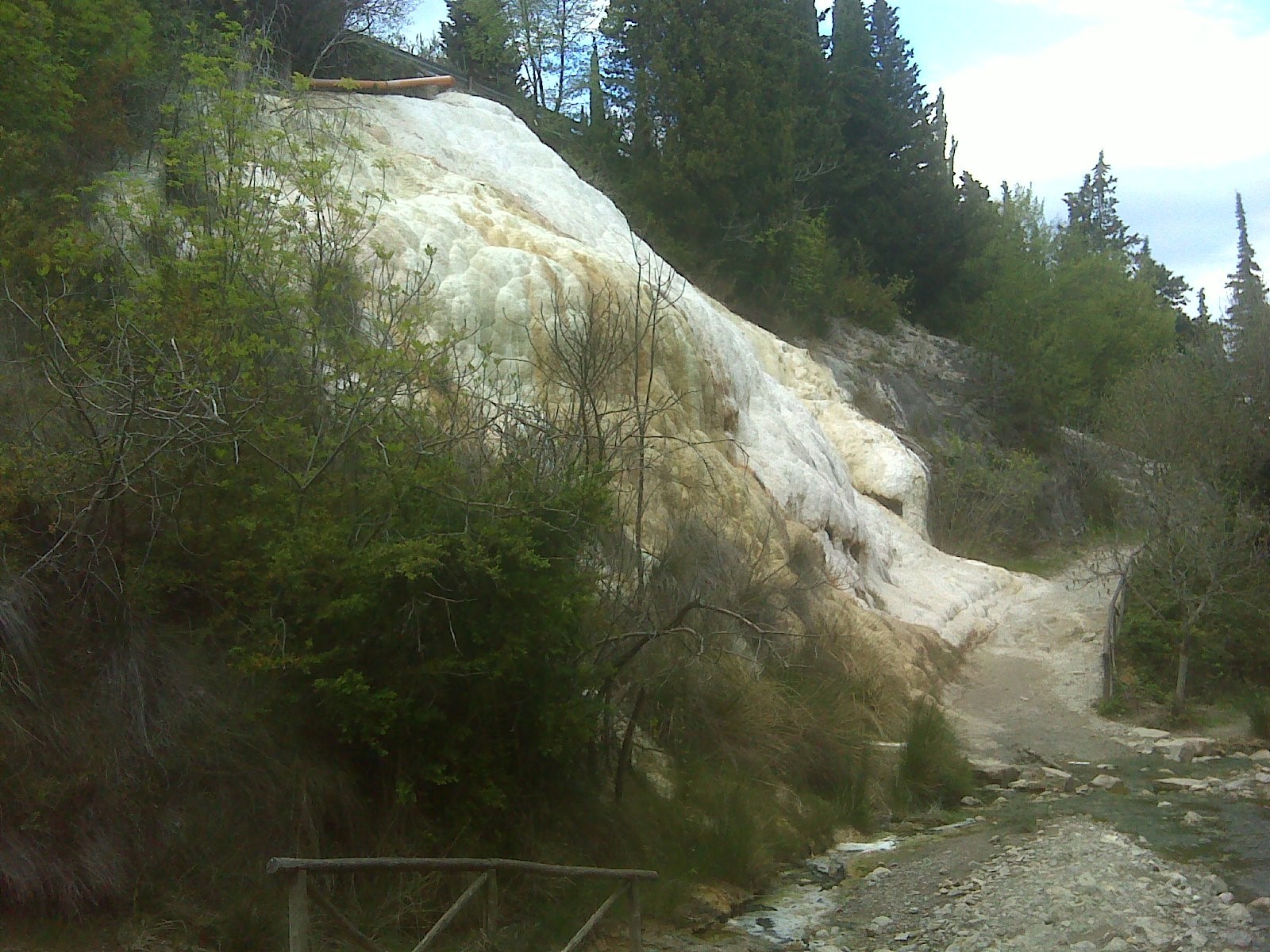
Particolarmente impressionante sono i depositi di calcare a Bagni San Filippo.
Sono chiamati "Fosso Bianco" dal loro colore bianco. I depositi sono stati formati dall'acqua di una molla, la cui alta contabilità di zolfo e Carbonato di calcio è responsabile per la colorazione.
Per sua forma la montagna viene anche chiamata «Balena Bianca». Nel piccolo bacino ai piedi della collina si può fare il bagno tutto l'anno. È stato usato come località balneare già ai tempi degli Etruschi.
Ci sono quattro domande da rispondere per registrare la cache. Rispondete alle domande solo via E-Mail, non via logtext. Si prega di attendere il rilascio del log.
(1) Qual`é la formula chimica per carbonato di calcio?
(2) L`odore ha il suo origine da?
(3) Tieni la tua mano nell'acqua. Che temperatura ha l'acqua? È fredda, calda o molto calda?
(4) In WP 1 (N 42° 55.692 ed E 011° 42.191) trovate un cartello dove c`è scritto: "BAGNI SAN FILIPPO (Fosso Bianco)" che numero vedete sotto il testo?
Volontario: Fate una foto di voi davanti il "Fosso Bianco" o in uno dei bacini.
English
Limestones are sedimentary rock consisting mainly of calcium carbonate, according to dictionary. Sedimentary rocks are caused by the deposition of materials.
Bagni San Filippo is particularly impressive limestone deposits. They are called "Fosso Bianco" because of their white colour. The deposits are formed by the water of a thermal spring, whose high account of sulphur and calzium carbonate for the coloring is responsible.
The mountain is also called "Balena Bianca" (white whale) because of its shape. In the small basins at the foot of the hill, you can swim all year round. The place has been used already at the time of the Etruscans as a seaside resort.
There are four tasks to perform to log the cache. Answer the questions by E-Mail, not in the logtext. Please wait for the release of the log.
(1) What is the chemical formula for calzium carbonate?
(2) How does it smell here?
(3) Hold your hand in the water. What temperature is the water? Is it cold, medium, warm or hot?
(4) On WP 1 (N 42° 55.692 and E 011° 42.191) you will find a sign with the text: "BAGNI SAN FILIPPO (Fosso Bianco)". Which number is under the text?
Voluntary: Make a photo from you in front of "Fosso Bianco" or in one of the pools.
Deutsch
Kalksteine sind, laut Lexikon, Sedimentgesteine, die überwiegend aus Calciumcarbonat bestehen. Sedimentgesteine entstehen durch die Ablagerung von Materialien.
Besonders eindrucksvolle Kalkablagerungen findet man in Bagni San Filippo. Sie werden wegen ihrer weißen Farbe „Fosso Bianco“ genannt. Die Ablagerungen werden durch das Wasser einer Thermalquelle gebildet, deren hoher Anteil von Schwefel und Calziumcarbonat für die Färbung verantwortlich ist.
Wegen seiner Form wird der Berg auch „Balena Bianca“ (weißer Wal) genannt. In den kleinen Becken am Fuß des Hügels, kann man ganzjährig baden. Der Ort wurde schon zur Zeit der Etrusker als Badeort genutzt.
Zum Loggen des Caches sind vier Aufgaben zu erfüllen. Beantworte die Fragen per E-Mail, nicht im Logtext. Bitte warte auf die Logfreigabe.
(1) Wie lautet die chemische Formel für Calziumcarbonat?
(2) Wonach riecht es hier?
(3) Halte deine Hand in das Wasser. Welche Temperatur hat das Wasser? Ist es kalt, lauwarm, warm oder heiß?
(4) An WP 1 (N 42° 55.692 und E 011° 42.191) findest du ein Schild mit dem Text: „BAGNI SAN FILIPPO (Fosso Bianco)“ Welche Zahl steht unter dem Text?
Freiwillig: Mache ein Foto von dir vor dem „Fosso Bianco“ oder in einem der Becken.
Novità 2023: L'ingresso è a pagamento (2 euro a persona).
New 2023: An entrance fee of €2 per person will now be charged.
Neu 2023: Nun wird eine Eintrittsgebühr in Höhe von 2 € pro Person erhoben.