Credit River - Shipwreck Series
Beaver
July 25, 1888
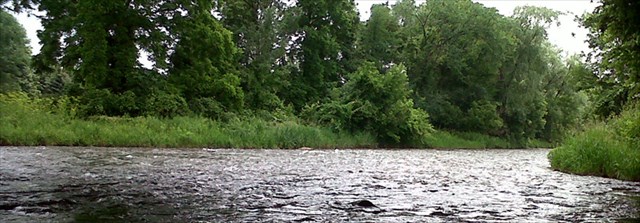
There are many shipwrecks around the world. Some very famous and others not so. Each however has it’s own story to tell. As you travel along the Credit River doing this series of caches, we have highlighted a number of these shipwrecks. During low water levels on these parts of the Credit River, you need to be careful in a canoe or kayak so as you don’t wind up in your own shipwreck. Besides the many large rocks along the way, there are also some other obstacles such as dams which should be avoided. All of the geocaches in this series have been placed by tubing, inflatable boat or on foot by walking in the water along the Credit River. Whichever way you choose to search for these caches, use caution and common sense.
More information about this series can be found here: Credit River - Shipwreck Series
Beaver was the first steamship to operate in the Pacific Northwest of North America. She made remote parts of the west coast of Canada accessible for maritime fur trading and was chartered by the Royal Navy for surveying the coastline of British Columbia. She served off the coast from 1836 until 1888, when she was wrecked.
Beaver was built in Blackwall, England of British oak, elm, greenheart and teak, and was copper fastened and sheathed. Her length was 101 feet (31 m), and the beam over her paddle boxes was 33 feet (10 m). She was launched at Blackwall Yard on 9 May 1835 and left London on 29 August under the command of Captain David Home, and with the company's barque, Columbia, built at the same time and commanded by Captain Darby. Beaver was outfitted as a brig for the passage out, paddles unshipped, and came out via Cape Horn under sail alone. After calling at the Juan Fernández Islands and Honolulu, she arrived off the Columbia River on 18 March 1836 and anchored off Fort Vancouver on 10 April. Here the paddles were shipped and boilers and engines connected.
A consortium that became the British Columbia Towing and Transportation Company in 1874 purchased her, and used her as a towboat until 25 July 1888. On that day an inebriated crew ran her aground on rocks at Prospect Point in Vancouver's Stanley Park. The wreck finally sank in July 1892 from the wake of the passing steamer Yosemite, but only after enterprising locals had stripped much of the wreck for souvenirs. The Vancouver Maritime Museum houses a collection of Beaver remnants including the boiler and two drive shafts for the paddle wheels, one raised in the 1960s and the other returned from a collection in Tacoma, along with the boiler. A plaque commemorates the site of the sinking. Divers surveyed the wreck in the 1960s. However, when the Underwater Archaeological Society of BC did so in the 1990s, they found she had mostly disintegrated due to rot and currents.