THE CACHE IS NOT AT THE POSTED COORDINATES
Going to the posted coordinates will take you to 88 Mart, formerly the location of
the Southwood Supper Club within a mall that used to be known as the Wedding Village.
You will not find the cache inside. However, it is nearby.

The Southwood Supperclub was likely the very last supper club in Winnipeg.
Historically, supper clubs became popular during the 1930s and 1940s as high-end evening dining and socializing destinations. Many establishments began as prohibition roadhouses and later became supper clubs when their "underground" operations were no longer illegal. Towards the end of the 20th century however, most supper clubs such as Southwood were simply restaurants that featured a casual and relaxed atmosphere, rather than the all-evening entertainment destinations of the past.
Before it's shuttering, the Southwood Supperclub billed itself as a special events facility specializing in weddings and other private events. The so-called Wedding Village had two separate banquet areas, a chapel plus a picture area that included an indoor fountain, and a crafts and card supply store, making the now defunct Wedding Village a one-stop shop for all of one's wedding needs.
Today, the Southwood Supperclub is known as 88 Mart. This market has a variety of excellent Oriental foods and products. Jinlin Chinese Restaurant is located here as well. These new establishments marked the end of The Last Supperclub in Winnipeg.
On the other hand, The Last Supper is a famous painting by Leonardo da Vinci that depicts the final meal that Jesus shared with his disciples before his crucifixion. It was painted towards the end of the 1490's and is located in Milan, Italy. The painting is massive, measuring approximately 15-feet by 29-feet and covers an entire end wall of the dining hall at the monastery of Santa Maria delle Grazie (N 45° 27.950 E 09° 10.267). The Last Supper was commissioned as part of the renovations to the church and its convent buildings.
The painting represents the scene of The Last Supper of Jesus with his disciples, as it is told in the Bible. da Vinci has depicted the consternation that occurred among the Twelve Disciples when Jesus announced that one of them would betray him. Each has a different reaction to the startling revelation.
It is believed da Vinci purposely included several references to the number 3 in the painting, representing the Christian belief in the Holy Trinity. For example: the Apostles are seated in groupings of three; there are three windows behind Jesus; and the shape of Jesus' figure resembles a triangle. Additional references may have originally been present but have since been lost as the painting faded over the years.

Within three years of it being painted, L'Ultima Cena was already deteriorating due to humidity (it was painted on an exterior wall) and because of the new paints and techniques da Vinci was experimenting with at the time. Within a mere twenty-two years the paint was flaking badly. And by year fifty-nine it was so deteriorated that the figures were unrecognizable. The painting has since been restored and repainted several times and has survived wars, bombings, vandalism, near-sighted contractors, criminals, faulty curtains, and other fiascos. Thanks to a major restoration project from 1978 to 1999, the painting has survived.
Interestingly, what is most recognizable as The Last Supper (above photo) is not da Vinci's painting at all. Instead, it is a reproduction made by Giovanni Pietro Rizzoli, an assistant of da Vinci. This duplicate was painted in 1520. It is a full-scale oil on canvas reproduction of da Vinci's work. It is currently in the collection of The Royal Academy of Arts in London. Another known copy (with some alterations to the background design) was painted by Cesare da Sesto and can be seen here.
Below is the current condition of da Vinci's original 520-year-old painting after several laborious restorations:
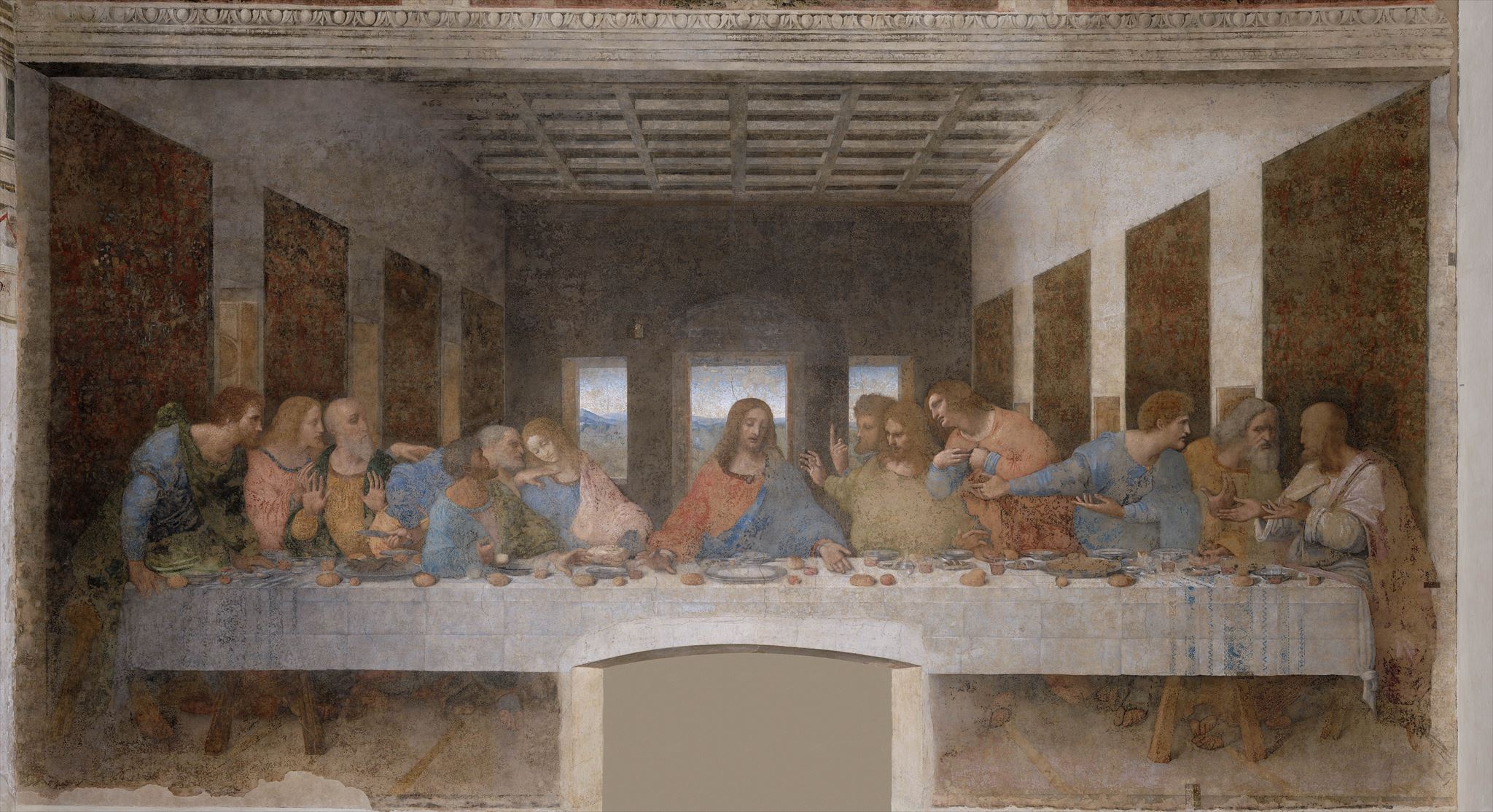
To find the cache, you will need to solve the following puzzle to obtain the final coordinates:
(Left-to-right according to the position of the apostles' heads)
N Judas Iscariot | James son of Zebedee ° Judas Iscariot | James son of Zebedee . Andrew | Andrew | Jesus
W James son of Zebedee | Jesus ° Matthew | James son of Zebedee . James son of Alphaeus | John | Andrew
You are looking for a winter-friendly, black magnetic container.
This is a high muggle area at all times. Please do not hang around GZ; instead, take the inside container and logsheet for a little walk before signing in.
For the purposes of this puzzle, numbers greater than 9 equal 0.
Detailed attributes listing: Winter-friendly, available 24/7, but it's in a very high muggle area at all hours of the day so please don't hang around GZ while signing the logsheet, no poison plants but you may encounter the occasional weed, no view whatsoever unless you want to check out the new rapid transit station nearby, plenty of parking available, public transit nearby, quick park 'n grab, restaurants and food nearby, dogs allowed.
Congratulations to Jean Déniche on the speedy FTF, and to Geo-Smart on the equally impressive 2TF!
This cache was hidden by a member of
the Manitoba Geocaching Association.
Join today; it's free!
Chmmyr uvag 1: Yrsg-gb-evtug nppbeqvat gb gur cbfvgvba bs gur ncbfgyrf. Chmmyr uvag 2: Sbe gur checbfrf bs guvf chmmyr, ahzoref terngre guna 9 rdhny 0. Chmmyr uvag 3: Abg "Gur Qn Ivapv Pbqr" inevnag. Uvag jura ng TM: Oynpx, zntargvp.