 El paso de la historia ha dejado huella en Segovia, y la ciudad vieja de Segovia es Patrimonio de la Humanidad. Todo su entorno merece la pena ser visitado y admirado.
La plaza está delimitada por el ábside de la catedral y por la nueva iglesia de San Miguel, la que sustituyó a la anterior del mismo nombre, que se derrumbó en 1532, ubicada en una dirección diferente a la que tuvo en origen, pues esta se encontraba en el centro de esta plaza. En ella esisten otros edificios emplemáticos como el teatro Juan Bravo y el Ayuntamiento de estilo Barroco.
Este geocache que vas a buscar es un multi muy sencillo que te ayudará a conocer algo más de esta plaza.

 The passage of history has left its mark on Segovia, and the old quarter of Segovia has been declared a World Heritage site. The entire surrounding area should not be missed.
The square is bounded by the apse of the cathedral and the new church of San Miguel, which replaced the preceding of the same name that collapsed in 1532, located at a different address than which it had at origin, because this had at the center of this square. Here exist other emblematic buildings like the theater Juan Bravo and the Council of Baroque style.
This geocache you will find is a very simple multi that will help you know more of this place.
QUIOSCO DE MÚSICA / BAND STAND
El quiosco de música fue diseñado en 1896 dentro de la tipología de arquitectura de hierro, tan de moda por aquel entonces en toda Europa. Su artífice fue el arquitecto Joaquín de Odriozola (1844-1913), que proyectó un templete en un lugar emblemático y céntrico, y que posee un zócalo elevado que sirve de almacén y vestuario para los músicos. Durante gran parte del siglo XX fue retirado en varias ocasiones y repuesto en su sitio de nuevo, hasta que en 1986 fue anclado definitivamente. Un día al año, durante la festividad de Santa Bárbara, el quiosco se transformaba en capilla.
X= NÚMERO DE LADOS QUE TIENE EL TEMPLETE DEL KIOSCO; "A = X + 1".

The band stand was designed in 1896 in the architectural typology of iron, so popular at that time in Europe. Its architect was the architect Joaquín Odriozola (1844-1913), who designed the pavilion in an emblematic and central place, and has a high plinth that serves as a storage and clothing for musicians. For much of the twentieth century was repeatedly removed and replacement in place again until 1986 was anchored permanently. One day a year, on the feast of Santa Barbara, the kiosk was transformed into a chapel.
X= NUMBER OF SIDES THAT HAS THE BAND STAND. "A = X + 1".
IGLESIA DE SAN MIGUEL / CHURCH OF SAN MIGUEL
La actual edificación, sustituyo al templo románico de la misma advocación, hundido en el año 1532, conserva la portada románica del antiguo templo y cuenta con una gran nave gótica, una cabecera plana, guardando las capillas entre contrafuertes y un altar mayor que tiene un retablo barroco realizado por José de Ferreras en 1672
El 13 de Diciembre de 1474 después de la muerte de su hermano Enrique IV fue proclamada reina de Castilla Isabel I, luego llamada Isabel la Católica, junto a la puerta de aquella iglesia románica. Como proclama una inscripción en su fachada principal. En ese momento su ubicación era distinta ya que estaba situada en medio de la actual Plaza Mayor.
En la iglesia se encuentra enterrado Andrés Laguna, médico y filólogo nacido en Segovia en 1499, que alcanzó prestigio internacional como médico personal del Papa Julio III y del Emperador Carlos I. El monumento funerario destaca por su decoración al fresco de figuras blancas sobre fondo negro.
Una de las capillas más importantes de esta iglesia es la capilla de nuestra Señora de la Paz.
En la portada están ubicados tres relieves románicos alrededor de la portada y corresponden a San Miguel, San Pablo y San Pedro. La escena donde aparece San Miguel es la más completa pues en ella aparece alanceando la cabeza del dragón que tiene bajo sus pies.
Y= NÚMERO DE SANTOS A AMBOS LADOS DE LA PORTADA ROMÁNICA PRINCIPAL DEL TEMPLO. "C = Y x 2" (MULTIPLICARLO POR DOS).
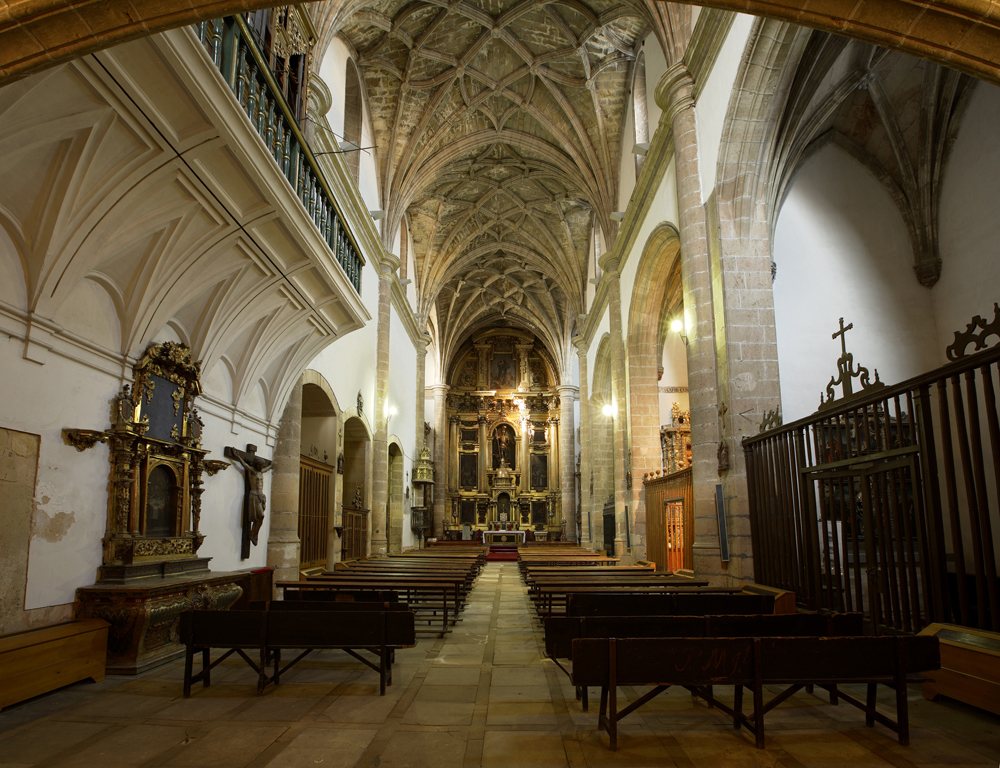
The current building replaced the Romanesque temple of the same dedication, sunk in 1532, preserves the Romanesque facade of ancient temple and has a Gothic nave, a flat head, keeping the chapels between buttresses and a high altar having a baroque altarpiece made by José de Ferreras in 1672
The December 13, 1474 after the death of his brother Enrique IV was proclaimed Queen Isabel I de Castilla, later called Isabel la Católica, by the door of the Romanesque church. Proclaims an inscription on its facade. At that time its location was different as it was in the middle of the current Plaza Mayor.
In the church is buried Andrés Laguna, physician and philologist born in 1499 in Segovia, who achieved international prestige as personal physician of Pope Julius III and the Emperador Carlos I. The monument notable for its fresco decoration of white figures on black background .
One of the most important shrines of this church is the Chapel of Our Lady of Peace.
On the cover are located three Romanesque reliefs around the cover and correspond to San Miguel, San Pablo and San Pedro. The scene where San Miguel appears is the most comprehensive because it appears spearing the dragon head at her feet.
Y= NUMBER OF SAINTS IN BOTH SIDES OF THE PRINCIPAL DOOR OF ROMANESQUE TEMPLE. "C = Y x 2".
TEATRO JUAN BRAVO / JUAN BRAVO THEATRE
El Teatro Juan Bravo es el teatro principal de la ciudad de Segovia. Inaugurado el 26 de octubre de 1918, se sitúa en la Plaza Mayor segoviana, en el mismo lugar que anteriormente habían ocupado el Teatro de La Zarzuela y el Cine Reina Victoria. Recibe su nombre del líder comunero local Juan Bravo.
El inmueble fue adquirido por la Diputación Provincial de Segovia en 1982, entidad que lo rehabilitó y abrió de nuevo al público en 1989.
E= NÚMERO MÁS REPETIDO DEL EL AÑO QUE APARECE EN LA FACHADA PRINCIPAL DEL TEATRO EN EL PUNTO MÁS ALTO.
F= BOTONES ABROCHADOS MENOS BOTONES DESABROCHADOS DE LA CHAQUETA DEL ESCRITOR QUE LLEVA UN EJEMPLAR DEL LIBRO CAMPOS DE CASTILLA.
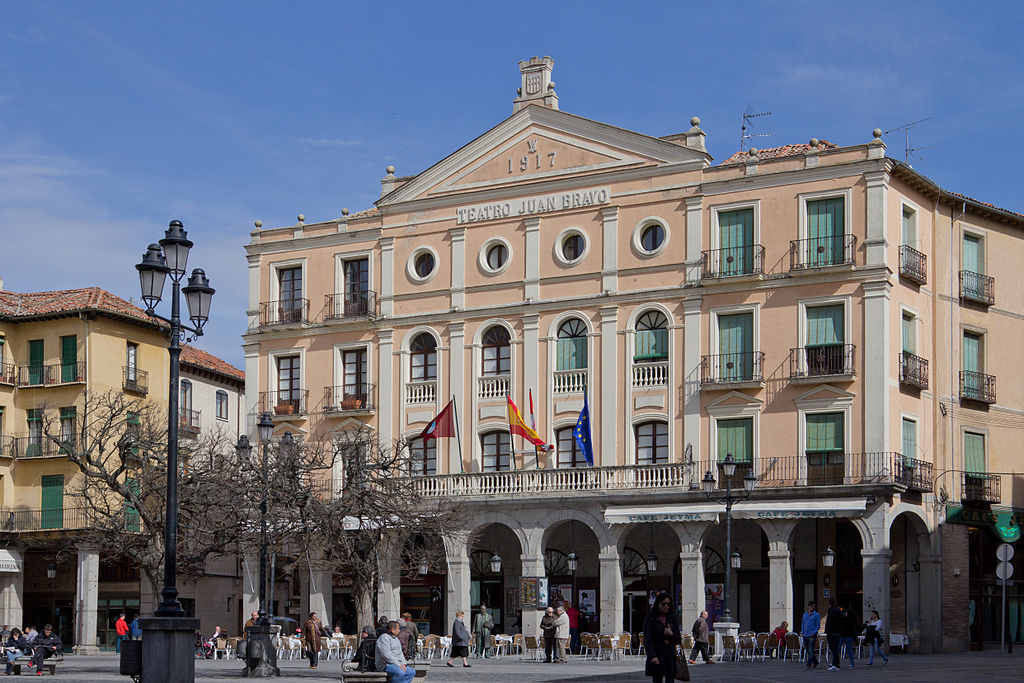
The Juan Bravo Theatre is the main theater of the city of Segovia. Opened on October 26, 1918, is located in the Plaza Mayor of Segovia, in the same place that had previously occupied the Teatro de la Zarzuela and Film Victoria. Named after the leading local villager Juan Bravo.
The property was acquired by the Provincial Government of Segovia in 1982, the entity that rehabilitated and reopened to the public in 1989.
E= NUMBER THAT APPEARS TWICE IN THE YEAR THAT APPEARS ON THE PRINCIPAL THEATRE FACADE IN HIGHEST POINT.
F= NUMBER OF BUCKLE ON BUTTONS LESS LOOSENED BUTTONS ON THE JACKET OF THE WRITER WHO CARRYING A COPY OF THE BOOK CAMPOS DE CASTILLA.
AYUNTAMIENTO / CITY HALL
El Ayuntamiento de Segovia se comenzó a construir en 1610 y, sorprendentemente, hasta entonces no contó la ciudad con una Casa Consistorial, habiendo utilizado antes el atrio de la Iglesia de San Miguel, o las Casas de la familia de los Arias Dávila, el primero para la celebración de sus sesiones, y las segundas para la presidencia de las distintas actividades que así lo requirieran de las realizadas en la Plaza Mayor. En 1619, las obras del Ayuntamiento estaban prácticamente terminadas, aunque aún quedaban el corredor y las gárgolas, diseñados en 1622 por Pedro de Brizuela y construido el primero por Francisco Álvarez.
En la fachada principal en la Plaza Mayor, podemos observar cómo en un edifico construido en época ya barroca aún se conservan elementos propios de la arquitectura escurialense, como pueden ser las dos torres con chapitel y la presencia de órdenes clásicos en la misma.
D= MITAD DE LAS COLUMNAS TOSCANAS DEL AYUNTAMIENTO EN EL CUERPO INFERIOR PORTICADO QUE SOSTIENEN EL BALCON EXISTENTE.

The City Council of Segovia construction began in 1610 and, surprisingly, until then the city did not have a town hall, having used before the court of the Church of San Miguel, or the palace houses Arias Davila, the first for the conclusion of their meetings, and the second for the presidency of the various activities which required it to those undertaken in the Plaza Mayor. In 1619, the City works were practically finished, but still had the hall and gargoyles, designed in 1622 by Pedro de Brizuela and built the first by Francisco Alvarez.
On the main front in the Plaza Mayor, we can see how in a building built in Baroque era and elements of architecture escurialense's past, such as the two towers with spiers and the presence of classic orders therein.
D= HALF OF THE TUSCAN COLUMNS IN THE CITY HALL ON THE LOWER BODY HOLDING THE PORTICATED BALCON.
CATEDRAL DE SANTA MARÍA / CATHEDRAL OF SANTA MARÍA
Fue la última catedral gótica que se construyó en España. Edificada en el punto más alto de la ciudad, la catedral de Segovia comenzó a edificarse en el año 1525, siendo rey Carlos V. Es de estilo gótico tardío y se levantó tras el incendio de la catedral vieja románica en el año 1520. Posee planta de tres naves, con capillas laterales y cabecera semicircular con girola. El templo, erigido siguiendo los planos de Juan Gil de Hontañón, posee tres entradas: en su fachada principal está la Puerta del Perdón, toda ella obra de Juan Guas; en la fachada sur está la Puerta de San Geroteo; y la Puerta de San Frutos. Posee 105 metros de largo por 50 de ancho y 33 metros de altura en la nave mayor. El retablo mayor está elaborado con mármol, jaspe y bronce. Fue consagrada en el año 1768.
B= NÚMERO DE FLORES PÉTREAS BAJO EL BALCÓN PRINCIPAL DEL PALACIO DEL MARQUES DEL ARCO, QUE SE ENCUENTRA FRENTE A LA ENTRADA LATERAL DE LA CATEDRAL.

It was the last Gothic cathedral built in Spain. Built at the highest point of the town, construction of the cathedral of Segovia began in the year 1525, during the reign of Carlos V. It is in the late Gothic style and was built after the fire in the old Romanesque cathedral in the year 1520. It has a ground plan with three naves, lateral chapels and a semicircular sanctuary with an ambulatory. The temple, erected according to the design of Juan Gil de Hontañón, possesses three entrances: the Puerta del Perdón, the work of Juan Guas, is on the main façade, while on the southern face we have the San Geroteo and San Frutos Doors. It measures 105 m by 50 m and stands 33 m high at the main nave. The main altarpiece is made of marble, jasper and bronze. It was consecrated in the year 1768.
B= NUMBER OF FLOWERS ON MAIN BALCONY IN THE PALACE OF MARQUES DEL ARCO IN FRONT OF THE CATHEDRAL DOOR.
EL CACHE
El cache se encuentra en las inmediaciones de la plaza, en un lugar poco transitado por los turistas que inundan la ciudad en determinadas épocas, pero con vecinos que pueden verte cogerlo desde sus casas, así que por favor ten cuidado para no ser descubierto.
The cache is located in the close to the square, in a place less traveled by tourists flood the city during certain times, but neighbors can see you take it from home, so please be careful not to be spotted.
N 40º 56. A B C
W 004º 07. D E F