Stockholm Metro Art
Stockholm's metro system is said to be the longest art installation in the world. The total length of the metro lines are 110 kilometre, and 90 of the 100 stations have art installations that varies between sculptures, mosaics, paintings, engravings and reliefs. Over 150 artists have been involved from the beginning in the 1950’s until today.
This mystery will take you into the Stockholm metro system and will therefore require a valid metro ticket. This can either be purchased via an Access card, credit card or a smart phone.
You will visit five central metro stations and their respective platform to find the answers to the questions below, then use the answers to create the “password” for the Certitude checker to get the final coordinates.
Hötorget
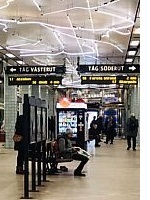 |
The art installation at Hötorget is the neon lights in the ceiling, it gives the station's tight 1950s architecture another dimension - a movement of light, by Gun Gordillo.
This movement consisting of 103 lines of light, extend over the entire center ceiling of the platform. The neon tubes are coated with different white colored pigments, which creates five white tones with varying color temperature. The neon tubes are arranged in layers and forms a three-dimensional shape. The white scale emphasizes the beautiful, bright, turquoise blue clinker on the walls and pillars. The different white light shapes are enhanced by reflections in the transparent glass sections at the exits, creating a feeling of infinity.
The station was opened as Kungsgatan in 1952 but was renamed to Hötorget in 1957. The art was inaugurated 1998 in connection with the station's renovation. |
| |
Question: There are black information signs about the art around the middle part of the platform, what is the last 10-letter word in the second paragraph? (Swedish descriptions)
Use the first letter as A. |
| |
|
Östermalmstorg
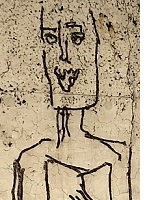 |
At Östermalmstorg the art installation are concrete carvings with themes of women's cause, peace and environmental movement. The wall decorations along the platform and were created 1961-65 by Siri Derkert. These are her best known public works.
The installation is two 145 meter long and 3.5 meter high panels of natural concrete, as well as some embellishments in the floors and other walls. The engravings in the concrete walls were created with sandblasting technique. The carvings are different characters, family scenes and portraits of famous politicians and cultural personalities. Among those are Simone de Beauvoir, Elin Wägner, Albert Einstein and Jean-Paul Sartre; as well as the musical note for “The Internationale” and “La Marseillaise”. |
| |
Question: There are black information signs about the art around the middle part of the platform, what is the last 6-letter word in the second paragraph? (Swedish descriptions)
Use the first two letters as BB. |
| |
|
Rådhuset
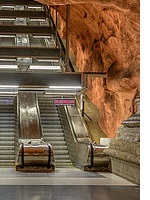 |
The installation at Rådhuset is filled with references from the history of Kungsholmen. The artist, Sigvard Olsson, made it look like an excavation of Kungsholmen.
At the exit towards Hantverkargatan there is a big foundation from a chimney that symbolize all the industries that once was found here at Kungsholmen and Klara Sjö. There are many large wooden boxes that were used as a measurement for hay, called a parm. One wall is filled with old baskets that were used at the old marketplaces here and elsewhere in Stockholm, the plastic bags for that time! Look closely around the platform and you will found other artifacts. |
| |
Question: Opposite the chimney are three large parm-boxes, they each have a number on the wall, add those numbers and the sum is the answer.
Use the sum as CC. |
| |
|
Stadion
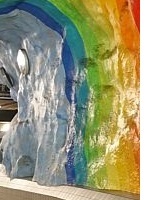 |
The inspiration for the art at Stadion is the poster for the Summer Olympics games of 1912. The games took place here at Stockholm Olympic Stadium between May 5 and July 22 in 1912. The station and the art is very colorful in bright rainbow colors and lots of blue. The Summer Olympics of 1912 is often referred to as the Sunshine games because of the good weather during the games.
The artists, Åke Pallarp and Enno Hallek, have made a lot of colorful installations at the station. At one end of the platform there are large M and S letters to guide the way to The Royal College of Music (Musikhögskolan) and The Stadium, behind the letter there's a replica of the 1912 Olympic poster. In the middle of the platform there’s a large rainbow on the ceiling and on the other end of the platform there are other colorful installations, among them a pointing hand inspired by a statue of Karl XII.
In 1973 the station was awarded with the Kasper Salin Prize, a prize awarded annually by the Swedish Association of Architect. |
| |
Question: On the wall near the rainbow are club badges, two of them with years on. Add the years, the 4-digit sum is the answer.
Use the sum as DDDD. |
| |
|
Kungsträdgården 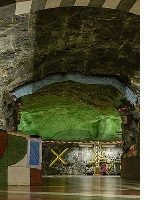 |
The purpose of the design in the station is to transform Kungsträdgården station into an underground garden. To tell the centuries long history of Kungsträdgården, The Kings Garden, as a park and cultural center of Stockholm.
Along the platform walls there are sculpture replicas from the old 16th-century palace of Makalös that was situated above the station, there are old and “modern” fossils in the floor to illustrate what we will leave behind from our time. At the exit towards Kungsträdgården there is an archaeological excavation site with columns and fragments that once belonged to the Swedish National Museums. There are also old gas lamps from Stockholm’s Gas plant at Torsgatan, and other remains from nearby buildings. |
| |
Question: At the exit towards Kungsträdgården, what is the white word in the green ceiling?
Use the first letter as E. |
Take the above answers to create the password ABBCCDDDDE . Enter that word into the Certitude checker. A correct answer will give you the final coordinates.

Du kan validera din pussellösning med certitude.