
What can you see at this Earthcache?
If real hot magma meet the cold water of the ocean, creates a special feature: pillow lava
Pillow lavas are lavas that contain characteristic pillow-shaped structures that are attributed to the extrusion of the lava under water, or subaqueous extrusion. Pillow lavas in volcanic rock are characterized by thick sequences of discontinuous pillow-shaped masses, commonly up to one metre in diameter. They mostly form the upper part of 'Layer 2' of normal oceanic crust and may form layers of thousands of meters thick. The presence of pillow lavas in the oldest preserved volcanic sequences on the planet, the Isua and Barberton greenstone belts, confirms the presence of large bodies of water on the Earth's surface early in the Archean. Pillow lavas are used generally to confirm subaqueous volcanism in metamorphic belts.
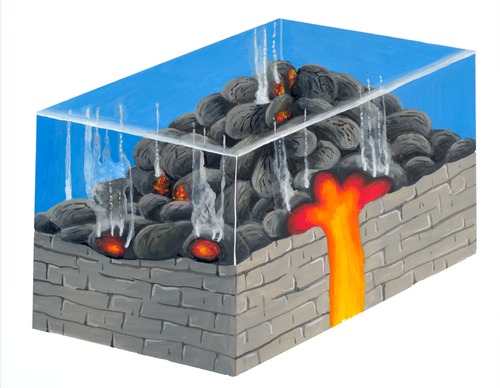
Pillow lavas are created when magma reaches the surface but, as there is a large difference in temperature between the lava and the water, the surface of the emergent tongue cools very quickly, forming a skin. The tongue continues to lengthen and inflate with more lava, forming a lobe, until the pressure of the magma becomes sufficient to rupture the skin and start the formation of a new eruption point nearer the vent. This process produces a series of interconnecting oblate shapes that are pillow-like in cross-section. The skin cools a lot faster than the inside of the pillow, so it is very fine grained, with a glassy texture. The magma inside the pillow cools more slowly, so is slightly coarser grained than the skin, but still classified as fine grained.
At the coordinates (hope they are okay) you can see some of these sort of magma. The pillows are a result of the hot magma and the cold ocean.

 To log the Earthcache send us an e-mail with the answers to the following questions before logging:
1. Examine the size of individual "pillows" to determine if the size of all the "pillows" are about the same. Send me a note with your observations and a guess as to why you the sizes are uniform or not.
2. Pillow lava rock formations are usually to be found on the bottom of the sea. How do you think it is possible for them to be in this mountains?
3. Optional make a Photo from you at the coordinates
You can log immediately. If there are any problems, we will send you a message.
Attention: The way to the cache is real hard. Use good shoes! Follow the path around the sandstone (this another attraction at this spot) into the small valley. If you reached a bank of stones you are at the right place.
Source:
Team_Mad_Cats,
Wikipedia
Carson, Robert J.; Pogue, Kevin R. (l996), Flood Basalts and Glacier Floods: Roadside Geology of Parts of Walla Walla, Franklin, and Columbia Counties, Washington, Washinton State Department of Natural Resources (Washington Division of Geology and Earth Resources Information Circular 90)