
 Access to the sea wall is along the sidewalk of Alii Drive. From the coordinates you can either sit on the wall and watch the waves crash up against it or even climb down to a small sand beach to a get a different perspective.
Sea walls are constructed to protect coastal property from erosion by waves and sea level rise. Sea walls are typically large vertical or near vertical concrete structures built along long stretches of shoreline designed to either adsorb the wave's energy or reflect the waves back out to sea. Sea walls that adsorb the wave energy are usually sloping, rough, and porous. Sea walls that are designed to reflect the wave energy are vertical or curved. These structures are effective at protecting the property landward of the sea wall, for a time and need periodic maintenance.
The typical 3-foot high sea wave hits the sea wall with approximately 10 kilowatts of energy per meter of shore line. That is comparable to the power of a small car at full speed. The energy of a 9-foot wave is 10 times that (100 kilowatts). If a 45-foot wave ever came into the bay the energy would be 250 times the 3-foot wave. Waves of that height can be formed by a storm with 70 mph winds. Thus sea walls must be built to withstand a constant pounding from a lot of energy.
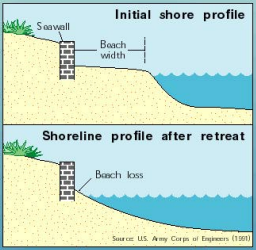 Sea walls immediately affect the beach profile. Sea walls are built where the coast line is eroding. Since the sea wall removes the source of sediment from the landward side of the beach, the waves erode the beach material instead. Additionally, the waves that reflect off the sea wall set up an interference pattern with the incoming waves creating waves that are larger and even more powerful. The result is that the beach is eroded and the foundations of the sea wall might begin to be eroded.
No matter how high the sea wall is constructed, there are storms where the waves over top the wall and build up behind the wall. As the water seeps back to the ocean through the ground and under the sea wall, the foundations of the wall are slowly eroded.
 To protect against seepage erosion and the reflected waves eroding the foundations of the sea wall, additional armoring at the sea wall base is required.
The likely of over topping increases as sea levels rise, the land subsidence, the intensity of the the storm surge, and tsunamis. The sea walls of the island Hawaii have to content with all three of these conditions. Sea levels have been rising and continue to rise. The mass of the Hawaiian volcanoes is pressing down on the lithosphere causing the entire island to sink. Hurricanes do affect the islands bringing storm surges with them.
 Numerous tsunami have affected the islands creating wave heights that greatly exceed normal wave heights. The most recent was in 2011 following the 9.0 Tohoku earthquake in Japan. Parts of the west coast of Hawaii experiences a 10 to 15 feet high tsunami. The seawall remained intact intact, but the lava rock was stripped away in large sections and the sidewalk behind the wall rubble. The wave over topped the wall and damaged numerous businesses. This picture from the Pacific Tsunami Museum shows some of the damage and the high water.
Logging requirements:
Send me a note with :
- The text "GC5C4VV Kailua-Kona Sea Wall" on the first line
- How many people are in your group
- Which kind of sea wall is this one, dissipative, reflective, or both? Describe why you chose that type?
- Describe the beach in front of the sea wall? How has the sea wall affected it?
- Does this sea wall have an issue with over topping? Provide you evidence. And if so how is it being dealt with?
- Is the sea wall protecting the property landward of the sea wall during normal conditions? How do you think it would fare during storm conditions or tsunami?
The following sources were used to generate this cache:
- http://www.seafriends.org.nz/oceano/beacheng.htm
- http://www.southwestcoastalgroup.org.uk/cc_defence_seawalls.html
- http://tsunami.org/8stories/narratives/18_kona_damage_2011.html