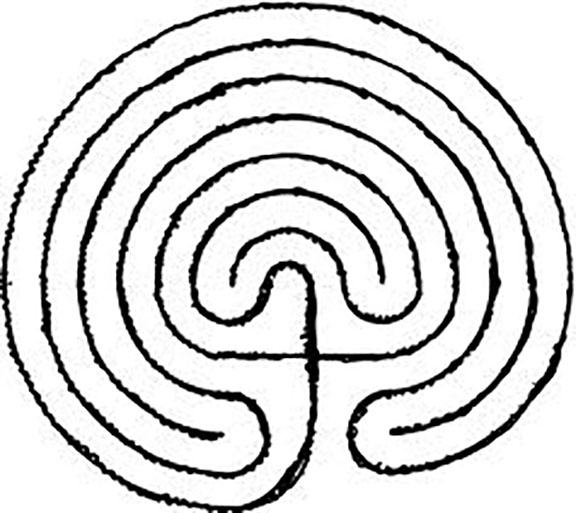
A labyrinth is not a maze, although this is a common misnomer. A maze is a path with one or more entrances, dead ends and not necessarily with a defined center. A labyrinth has only one way in and out and the purpose of it is to reach a center and to know your path all the time. The walker in a labyrinth should never be "lost". Quite the opposite, a labyrinth serves as a meditation tool. It can be a very spiritually uplifting experience, one that connects back many centuries with many thousands of other human beings through time who have found the labyrinth to be a source of power and healing.
Found in nearly every culture on earth, they are integral to Native American, Greek, Celtic and Mayan traditions. 2000 year old native pottery examples have been found containing the 7 circuit designs. The Hopi called the labyrinth the symbol of ‘mother earth’ and equated it with the Kiva, a room used by tribes of the Pueblo for religious rituals. Like Stonehenge and the Pyramids they are magical geometric forms that define sacred space.
This is a classical or seventh circuit labyrinth. Seven circuits refers to the seven paths that lead to the center or goal. This is an ancient design and is found in most cultures. It is sometimes dated back more than 4000 years. Also known as the Cretan Labyrinth it is associated with the myth of Theseus and the Minotaur. This design was even found on Cretan coins. Labyrinths, while not unique to any one religious belief, have most likely always been used in a spiritual manner. They can create a heightened awareness of the human condition and aid psychological and spiritual growth.
If you enjoy walking this labyrinth, others can be found here.
Directions for using the labyrinth:
- Stand in front of the entrance to the labyrinth. State your intention as clearly as possible. For example: I want a solution to my problem with ... It could be anything that is troubling you.
- Center yourself by taking a couple of deep breaths. This is important because doing this you instruct your subconscious and all other parts of yourself to pay attention to your sincere wish of solving your problem.
- Acknowledge your coming meditative or spiritual journey within the labyrinth. You may also say a short prayer or smudge yourself, depending on which faith you adhere to. Closing your eyes and reflecting or taking a simple bow are other nice ways to begin the process.
- Begin your walk. The first step sets the pace for your walk. It can be fast or slow. Choose your intention for the walk. Are you being spiritual, reflective, mindful, playful, creative or something else? If you're problem solving, your walk becomes a meditation when you surrender all your problems and just walk. Other parts of you now have a chance to process your request of a solution.
- Continue to walk. Keep your mind quiet, and still pestering thoughts each time they arise. Concentrate on the placement of one foot before the other and rhythmic, gentle and regular breathing.
- Pause on reaching the center. You may stop here for awhile, sit or lay down if you feel like it and meditate or reflect. The main thing is to let yourself surrender totally to your inner process. It feels so good to have all the time you need.
- Walk out. When you are ready, just walk out. Accept the insights and gifts you may have received. Adopting a sense of gratitude will always facilitate resolutions. Offer your thanks for what you have learned.