
Courte EarthCache près du Gymnase intercantonal de la Broye.
Un parc géologique a été créé et inauguré en novembre 2014, il est l'oeuvre d'un groupe de passionnés et a été financé par des soutiens de diverses institutions de la région.
Le but de ce parc et de cette cache est de faire découvrir et reconnaitre les différentes roches typiques de la géologie de la Suisse. Les EarthCaches ont souvent pour sujet l'une ou l'autre roche, ici, vous pourrez les toucher et les comparer !

Short EarthCache near the High School of Payerne.
A geological park was created and inaugurated in November 2014. It is the work of passionate people and was financially supported by diverse local institutions.
The aim of this park and of this cache is to make you discover and recognize the different typical rocks of the Swiss geology. EarthCaches often talk about one or another rock, here you will be able to touch and compare all of them !

Kurze EarthCache in der Nähe vom Gymnasium in Payerne.
Ein geologischer Park wurde im November 2014 erstellt. Es ist das Ergebnis harter Arbeit von einer passionierten Gruppe und war von verschiedenen regionalen Institutionen finanziell unterstützt.
Das Ziel dieses Geoparks und dieses Caches ist, die verschiedenen typischen Felsen der Schweizer Geologie zu entdecken. Dann werden sie diese Felsen erkennen können. EarthCaches sprechen oft über eine besondere Gestein oder eine andere, hier können Sie alle berühren und vergleichen!
La ville de Payerne est habituellement plus connue pour son Abbatiale du XIème siècle ainsi que pour son aérodrome militaire.
Cette cache va plutôt vous faire découvrir un autre quartier où se trouve la Blancherie ainsi que le Gymnase.
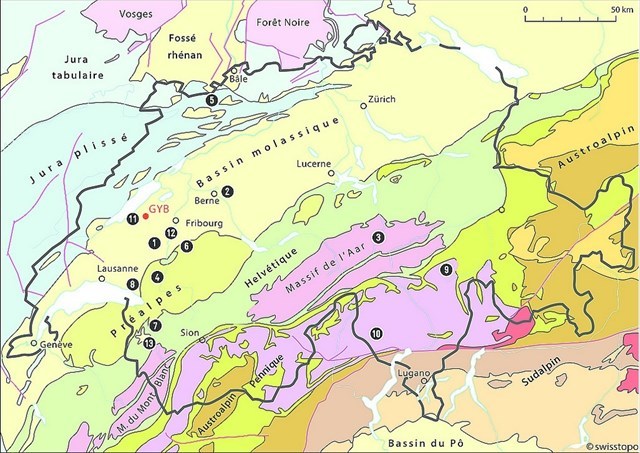
Aux coordonnées du listing, vous pourrez observer la grande diversité des roches de ce tout petit pays qu'est la Suisse. Sur une relativement petite surface, seulement 41 285 km2, 6 domaines géologiques sont rencontrés, à savoir: la chaîne calcaire du Jura, le bassin molassique, les Préalpes, les Alpes helvétiques, les Alpes penniques et le domaine austroalpin. Différents types de roches y sont rencontrés. 13 de ces roches provenant de différentes carrières suisses sont présentées dans le parc géologique. Chaque roche est munie d'un panneau décrivant sa provenance et sa période géologique. De plus amples informations sont disponibles au moyen de QR codes disposés sur les panneaux.
Voici ci-dessous, un résumé de ces 13 roches :
Les roches du parc géologique
| Roche et utilisations |
Formation et identification |
|
1 - Molasse bleue
Utilisations typiques : Fabrication de fourneaux
Occurrence : Plateau suisse / bassin molassique
|
Formation : Accumulation de débris issus de la formation des montagnes (ici les Alpes) dans les bassins périphériques. Ce grès calcaire s'est formé dans une mer peu profonde il y a 20 mio d'années.
Identification : Roches tendres, friables et perméables. La granulométrie de la molasse bleue est plus grossière que celle de la molasse jaune.
|
|
2 - Molasse jaune
Utilisations typiques : Construction de bâtiments
Occurrence : Plateau suisse / bassin molassique
|
Formation : Accumulation de débris issus de la formation des montagnes (ici les Alpes) dans les bassins périphériques. Ce grès calcaire s'est formé dans une mer peu profonde il y a 20 mio d'années.
Identification : Roches tendres, friables et perméables. Roche de teinte jaune à verdâtre en raison de deux minéraux accessoires riches en fer : la limonite et la glauconite.
|
|
3 - Granite
Utilisations typiques : Pavés, bornes, plans de travail de cuisine
Occurrence : Alpes, socle cristallin sous le Plateau suisse et le Jura
|
Formation : Roche magmatique formée il y a 300 mio d'années par refroidissement lent du magma à plusieurs kilomètres de profondeur.
Identification : Mélange de grands cristaux imbriqués les uns dans les autres. Aspect clair, tâcheté et massif.
|
|
4 - Calcaire des Préalpes
Utilisations typiques : Matériel de ballast
Occurrence : Préalpes
|
Formation : Accumulation de débris de coquillages et d'autres parties dures d'animaux marins. Formés il y a 150 mio d'années dans une mer assez profonde.
Identification : Calcaire de teinte grise à grains très fin. Réagit avec de la HCl et peut être rayé par un couteau. Présence de fossiles.
|
|
5 - Calcaire du Jura
Utilisations typiques : Pierre de construction, notamment les bassins de fontaines
Occurrence : Jura
|
Formation : Accumulation de débris de coquillages et d'autres parties durs d'animaux marins. Formés il y a 160 mio d'années dans une mer peu profonde.
Identification : Calcaire de couleur brun- jaune à grains très fin. Réagit avec de la HCl et peut être rayé par un couteau. Présence de fossiles.
|
|
6 - Flysch du Gurnigel
Utilisations typiques : Pavés, bords de trottoirs, escaliers
Occurrence : Préalpes fribourgeoises
|
Formation : Roche sédimentaire formée il y a 30 mio d'années par avalanches sous- marines de boues et de sables provenant de dépôts marins qui se forment en même temps que les montagnes.
Identification : Répétition d'un même motif, une strate de grès surmontée d'une strate de schistes argileux. Aspect feuilleté.
|
|
7 - Gypse
Utilisations typiques : Entre dans la fabrication du plâtre et du ciment
Occurence : Jura tabulaire et plissé, préalpes et Alpes
|
Formation : Roche sédimentaire formée il y a 220 mio d'années par précipitation de sulfate de calcium par évaporation d'eau de mer fermées à forte concentration saline.
Identification : Roche tendre de couleur gris- clair à blanche à gros grains. Elle se raye facilement à l'ongle à la différence des calcaires.
|
|
8 - Conglomérat
Utilisations typiques : ? aucune ?
Occurrence : En bordure des Alpes
|
Formation : Roche sédimentaire formée de débris provenant de la désagrégation des roches alpines par érosion transportés par les cours d'eau il y a 25 mio d'années puis liés entre eux par un ciment naturel.
Identification : Galets de différentes roches cimentés entre eux.
|
|
9 - Micaschiste
Utilisations typiques : Plaque de sol ou de façade, couverture de toit
Occurrence : Alpes, socle cristallin sous le Plateau suisse et le Jura
|
Formation : Roche métamorphique formée il y a 250 mio d'années par transformation de cristaux de micas sous l'effet de pression et température modeste.
Identification : Roche feuilletée et mal cohérente de couleur grise à l'aspect soyeux.
|
|
10 - Gneiss
Utilisations typiques : Pierre de bordure ou de mur, plaque de sol ou de façade, couverture de toit
Occurrence : Alpes, socle cristallin sous le Plateau suisse et le Jura
|
Formation : Roche métamorphique formée il y a plus de 250 mio d'années par transformation de cristaux de quartz, de micas et de feldspaths sous l'effet de pression et température élevée.
Identification : Roche très cohérente à texture enrubanée où alternent des lits clairs (quartz et feldspaths) et des lits sombres (micas, amphiboles)
|
|
11 - Grès coquillier
Utilisations typiques : Pierre de construction, plaque de façade, revêtement de chemin, dallage, escaliers
Occurence : Plateau suisse
|
Formation : Roche détritique constituée de coquille marines fossilisées cimentées par une masse gréseuse.
Identification : Roche très poreuse mais bien cimentée présentant une surface rugueuse
|
|
12 - Tuf
Utilisations typiques : Soubassement de maison, pont, dallage, escaliers
Occurrence: Plateau suisse et Jura
|
Formation : Roche sédimentaire formée il y a 10000 ans par précipitation du calcaire sur de la végétation aux débouchés de sources. Les végétaux pourrissent et il reste donc un vide à leur emplacement.
Identification : Roche poreuse de couleur blanche à gris-jaunâtre voire rougeâtre selon les impuretés
|
|
13 - Flysch d'Illiez
Utilisations typiques : Construction
Occurrence : Alpes
|
Formation : Roche sédimentaire formée il y a 30 mio d'années par avalanches sous- marines de boues et de sables provenant de dépôts marins qui se forment en même temps que les montagnes.
Identification : Répétition d'un même motif, une strate de grès surmontée d'une strate de schistes argileux. Aspect feuilleté.
|
Ce tableau va vous aider à répondre à nos questions ci-dessous... mais aussi et surtout tout au long de vos visites de la Suisse pour reconnaitre les différentes roches que vous croiserez !
Pour loguer un "found it" sur cette cache, il sera nécessaire de nous répondre par email aux questions suivantes :
- 1) Allez aux coordonnées du waypoint "Escalier" (N46°48.964 E6°56.425). Dans quelle roche présente dans le parc géologique est-ce que l'escalier de 17 marches est fabriqué ?
- 2) Allez aux coordonnées du waypoint "Pavés" (N46°48.911 E6°56.398). Dans quelle roche présente dans le parc géologique sont taillés les pavés ? Est-ce que ces pavés viennent de la même carrière que le bloc dans le parc ?
- 3) D'après vous, quelle roche du parc géologique disparaîtra en premier de ce lieu et pour quelles raisons ?
- 4) Allez vers le bloc de Granite, comment est cette pierre (apparence générale, couleur, taille des grains, etc.) ? Expliquez aussi la différence de couleur du sommet du bloc.
- En option - Vous pouvez accompagner votre log d'une photo de vous en compagnie de votre roche favorite (optionnel mais ça nous fait plaisir).
Merci de ne pas poster de photo avec l'escalier ou les pavés visibles.
Bonne visite et découverte de ces blocs.
PS : Le point parking est le parking normal du Gymnase. Ne l'utilisez que pour aller visiter le parc géologique et pas plus longtemps SVP.
The city of Payerne is usually well known for its eleventh-century Abbey as well as its military airport.
This cache will make you discover another area where the "Blancherie" and the High School are located.
At the listed coordinates, you can see the great diversity of rocks from this small country, Switzerland. On its relatively small territory, only 41 285 km2, there are no fewer than 6 geological domains: the calcareous Jura range, the Molasse basin, the Prealps, the Helvetic Alps, the Penninic Alps and the Austroalpine domain. Different types of rocks are encountered in these domains. 13 of these rocks coming from different Swiss quarries are presented in the geological park. Each boulder is accompanied by a sign describing its origin and its geological era. More information is available by use of a QR code printed on the signs.
A summary of these 13 rocks is presented here below:
The rocks from the geological park
| Rocks and their uses |
Formation and identification |
|
1 - Blue molasse (sandstone)
Typical uses : Furnaces manufacturing
Occurrence : Swiss Plateau / Molasse basin
|
Formation : Accumulation of deposit from mountain rising in a foreland basin. This calcareous sandstone was deposited in a shallow sea, 20 mio years ago.
Identification : Soft rock, loose and permeable. The particle size of the blue molasse is coarser than that of the yellow molasse.
|
|
2 - Yellow molasse (sandstone)
Typical uses : Building construction
Occurrence : Swiss Plateau / Molasse basin
|
Formation : Accumulation of deposit from mountain rising in a foreland basin. This calcareous sandstone was deposited in a shallow sea, there is 20 mio of years.
Identification : Soft rock, loose and permeable. Yellow to greenish rock because of two accessory minerals rich in iron: limonite and glauconite.
|
|
3 - Granite
Typical uses : Pavement, milestone, kitchenbench
Occurrence : Alps, crystalline basement under the Swiss Plateau and the Jura Mountains
|
Formation : Igneous rock formed 300 mio years ago by slow cooling of the magma at a depth of many kilometers .
Identification : Mixture of large crystals overlapping each other. Massive bright and spotted rock.
|
|
4 - Limestone from the Prealps
Typical uses : Track ballast
Occurrence : Prealps
|
Formation : Sedimentary rock formed 150 mio years ago by the accumulation of shells and other hard parts of marine animals in a shallow sea.
Identification : Rock of greyish color with very fine particle size. It reacts with HCI and can be striped by a knife. Presence of fossils.
|
|
5 - Limestone from the Jura Mountains
Typical uses : Building stone, particularly for fountain basins
Occurrence : Jura Mountains
|
Formation : Sedimentary rock formed 150 mio years ago by the accumulation of shells and other hard parts of marine animals in a shallow sea.
Identification : Rock of yellow-brown color with very fine particle size. It reacts with HCI and can be striped by a knife. Presence of fossils.
|
|
6 - Gurnigel Flysch
Typical uses : Pavement, stairs
Occurrence : Prealps
|
Formation : Sedimentary rock formed 30 mio years ago by deep marine deposits in foreland basin of a rising mountain.
Identification : Rock with repeated pattern of sandstone layer covered by a clayish schist layer. Laminated appearance.
|
|
7 - Gypsum
Typical uses : Constituent of plaster and cement
Occurrence : Jura Mountains, Prealps and Alps
|
Formation : Sedimentary rock formed 220 mio years ago by precipitation of calcium sulfate due to the evaporation of water with a high salt concentration in a closed sea.
Identification : White to grayish soft rock with coarse particle. Unlike sandstone, it can easily be scratched by a fingernail
|
|
8 - Conglomerate
Typical uses : -
Occurence : On the edge of the Alps
|
Formation : Sedimentary rock formed of geological detritus coming from the desegregation of alpine rocks transported by water courses and then cemented 25 mio years ago.
Identification : White to grayish soft rock with coarse particle. Unlike sandstone, it can easily be scratched by a fingernail.
|
|
9 - Mica schist
Typical uses : Floor or facade plate, roof cover
Occurrence : Alps, crystalline basement under the Swiss Plateau and the Jura Mountains
|
Formation : Metamorphic rock formed 250 mio years ago by the transformation of mica crystals under moderate pressure and temperature.
Identification : Laminated gray rock with silky aspect.
|
|
10 - Gneiss
Typical uses : Floor or facade plate, roof cover, curb stone
Occurrence : Alps, crystalline basement under the Swiss Plateau and the Jura Mountains
|
Formation : Metamorphic rock formed more than 250 mio years ago by the transformation of mica, quartz and feldspath crystals under high pressure and temperature.
Identification : Hard foliated rock characterized by an alternating pattern of darker (micas and amphibole) and lighter (quartz and feldspaths) colored bands.
|
|
11 - Shelly sandstone
Typical uses : Building stone, facade plate, pavement, stairs
Occurence : Swiss Plateau
|
Formation : Sedimentary rock formed of fossilized marine shells cemented by sandstone.
Identification : Porous rock, but well cemented, presenting a rough surface.
|
|
12 - Travertine
Typical uses : House foundation, bridge, pavement, stairs
Occurrence : Swiss Plateau and Jura Mountains
|
Formation : Sedimentary rock formed 10’000 years ago by limestone precipitation on vegetation at water spring outlets. The plants rot and die letting an empty place, thus creating the porosity.
Identification : White to yellow-gray or reddish (depending on the impurities) porous rock.
|
|
13 - Flysch from Illiez
Typical uses : Construction
Occurrence : Alps
|
Formation : Sedimentary rock formed 30 mio years ago by deep marine deposits in foreland basin of a rising mountain.
Identification : Rock with repeated pattern of sandstone layer covered by a clayish schist layer. Laminated appearance.
|
This table is going to help you answer our question listed below... but also and above all during your visits in Switzerland will help you recognize the different type of rocks that you will encounter!
To log a "found it" on this cache, you will need to send me an e-mail with the answers to the following questions:
- 1) Go to the coordinates of the waypoint "Escalier" (Stairs, N46°48.964 E6°56.425). Which rock material from the 13 rocks listed in the geological park are the 17 steps made of?
- 2) Go to the coordinates of the waypoint "Pavés" (Cobblestones, N46°48.911 E6°56.398).Which rock material from the 13 rocks listed in the geological park are the cobblestones made of? Do these cobblestones come from the same pit as the block in the park?
- 3) In your opinion, which rock from the geological park will disappear first and for which reasons?
- 4) Go to the granite block, please describe this stone (overall appearance, colour, grain size) and explain the difference of colour at the top of the block.
- As an option – You can join a picture of yourself with your favourite rock (that’s only optional, but we would be glad to get such picture).
Please do not post in your log any picture on which the stairs or the cobblestones would be visible.
Enjoy your visit and the discovery of these boulders.
P.S. : The parking waypoint is the official parking of the High School. Please use it only for visiting the geological park and not for a longer time. Thank you.
Die Stadt von Payerne ist gewöhnlich für seine Abtei aus dem elften Jahrhundert sowie für den Militärflughafen bekannt.
Dieser Cache wird Ihnen ein anderen Stadtviertel bekannt machen, in dem sich die "Blancherie" und der Gymnasium befinden.
Bei den genannten Koordinaten, können Sie die große Vielfalt der Gesteine aus diesem kleinen Land - die Schweiz - sehen. Auf einem relativ kleinen Bereich, nur 41 285 km2, gibt es nicht weniger als 6 geologischen Domänen: die kalkhaltigen Jura, die Molassebecken, die Voralpen, das Helvetikum, das Penninikum und das Ostalpin. Verschiedene Gesteinsarten sind dort vorhanden. 13 dieser Felsen aus verschiedenen Schweizer Steinbrüchen sind in der geologischen Park vorgestellt. Bei jedem Felsblock gibt es ein Schild, der die Herkunft und das geologische Zeitalter des Blockesbeschreibt. Weitere Informationen sind mittels einer QR-Code verfügbar.
Nachstehend finden Sie einen Überblick dieser 13 Gesteine:
Die Gesteine vom geologischen Park
|
Felsen und Verwendungen
|
Entstehung und Erkennungsmerkmale |
|
1 - Blaue Molasse
Typischen Verwendungen : Herstellung von Ofen
Vorkommen : Mittelland / Molassebecken
|
Entstehung : Sedimentgesteine gebildet durch die Ablagerung von Abtragungsmaterial aus steigenden Gebirgen in einem Vorlandbecken. Dieser Sandstein war vor 20 Mio Jahren in einem untiefen Meer gebildet.
Erkennungsmerkmale : Zärtlicher, wenig beständiger und durchlässiger Stein. Die Korngröße des blauen Molasses ist grösser als die des gelben Molasses.
|
|
2 - Gelb Molasse
Typischen Verwendungen : Errichtung von Gebäuden
Vorkommen : Mittelland / Molassebecken
|
Entstehung : Sedimentgesteine gebildet durch die Ablagerung von Abtragungsmaterial aus steigenden Gebirgen in einem Vorlandbecken. Dieser Sandstein war vor 20 Mio Jahren in einem untiefen Meer gebildet.
Erkennungsmerkmale : Zärtlicher, wenig beständiger und durchlässiger Stein. Gelb bis grünlich wegen zwei eisenreichen Begleitmineralien: Limonit und Glaukonit.
|
|
3 - Granit
Typischen Verwendungen : Pflastersteine, Meilenstein, Küchenbank
Vorkommen : Alpen, kristalliner Sockel unter Mittelland und Jura
|
Entstehung : Magmatische Gesteine gebildet vor 300 Mio Jahren durch die langsame Abkühlung von Magma auf eine Tiefe von mehreren Kilometern.
Erkennungsmerkmale : Mischung aus grossen miteinander verzahnten Kristallen. Helles, gesprenkeltes und massiges Aussehen.
|
|
4 - Kalkstein von Voralpen
Typischen Verwendungen : Ballastmaterial
Vorkommen : Voralpen
|
Entstehung : Sedimentgestein gebildet vor150 Mio Jahren durch Ablagerung von Organismen und Hartteilen in einem untiefen Meer.
Erkennungsmerkmale : Grauer Kalkstein mit sehr feinen Körnern. Reagiert mit HCI und kann mit einem Messer gekratzt werden. Vorhandensein von Fossilien.
|
|
5 - Kalkstein von Jura
Typischen Verwendungen : Baustein, zum Beispiel für Brunnenbecken
Vorkommen : Jura
|
Entstehung : Sedimentgestein gebildet vor 160 Mio Jahren durch Ablagerung von Organismen und in einem untiefen Meer.
Erkennungsmerkmale : Gelb-brauner Kalkstein mit sehr feinen Körnern. Reagiert mit HCI und kann mit einem Messer gekratzt werden. Vorhandensein von Fossilien.
|
|
6 - Flysch von Gurnigel
Typischen Verwendungen : Pflastersteine, Randstein, Treppen
Vorkommen : Freiburger Voralpen
|
Entstehung : Sedimentgestein gebildet vor 30 Mio Jahren durch die Ablagerung von Abtragungsmaterial aus steigenden Gebirgen in einem tiefen Meer.
Erkennungsmerkmale : Stein gebildet mit wiederholten Muster der Sandsteinschichte von lehmigen Schieferschichte bedeckt. Verbundes Aussehen.
|
|
7 - Gips
Typischen Verwendungen : Bauteil vom Zement und Beton
Vorkommen : Tafel- und Faltenjura, Voralpen und Alpen
|
Entstehung : Sedimentgestein gebildet vor 220 Mio Jahren durch Fällung von Calciumsulfat durch Verdunstung von Meereswasser mit hoher Salzkonzentration im geschlossenen Meer.
Erkennungsmerkmale : Weicher, weisser bis dunkelgrauer grobkörniger und gebänderter Stein. Im Gegensatz zu Kalkstein, es kann leicht mit dem Nagel zerkratzt werden.
|
|
8 - Konglomerat
Typischen Verwendungen : -
Vorkommen : Am Alpenrand
|
Entstehung : Sedimentgestein gebildet durch Erosion von Schutt aus dem Zerfall von Alpinen Felsen. Dieser Schutt wurde vor 25 Mio Jahren von Flüssen transportiert und dann durch eine natürliche Zement miteinanderverbunden.
Erkennungsmerkmale : Schutt aus verschiedenen Alpengesteinen (z.B. Granit, Kalkstein).
|
|
9 - Glimmerschifer
Typischen Verwendungen : Boden- und Fassadenplatten, Hausbedachungen
Vorkommen : Alpen, kristalliner Sockel unter Mittelland und Jura
|
Entstehung : Metamorphe Gesteine gebildet vor 250 Mio Jahren durch die Umwandlung von Glimmerkristallen unter der Wirkung von Druck und mäßiger Temperatur.
Erkennungsmerkmale : Grauer, blättriger Gestein mit seidigem Aussehen.
|
|
10 - Gneis
Typischen Verwendungen : Randsteine, Mauersteine, Boden- und Fassadenplatten, Hausbedachungen
Vorkommen : Alpen, kristalliner Sockel unter Mittelland und Jura
|
Entstehung : Metamorphe Gesteine gebildet vor mehr als 250 Mio Jahren durch die Umwandlung von Quarz, Glimmer und Feldspat Kristalle unter der Wirkung von hohen Druck und Temperaturen.
Erkennungsmerkmale : Fest blättriger Gestein gekennzeichnet durch abwechselnd dunkler (Glimmer und Amphibol) und leichter (Quarz und Feldspat) farbigen Bändern.
|
|
11 - Muschelsandstein
Typischen Verwendungen : Bausteine,
Fassadenplatten, Pflasterung, Treppe
Vorkommen : Mittelland
|
Entstehung : Detritischer Sedimentgestein von versteinerten Muscheln zusammen zementiert durch eine Sandsteinmasse.
Erkennungsmerkmale : Sehr poröser Gestein, sondern gut zementiert, mit einer rauen Oberfläche.
|
|
12 - Travertin
Typischen Verwendungen : Grundgestein, Brücke, Pflasterung, Treppe
Vorkommen : Mittelland und Jura
|
Entstehung : Sedimentgestein gebildet vor 10'000 Jahren durch die Ausfällung von Kalk auf die Vegetation aus Süsswasserquellen. Pflanzen verrotten und lassen ein Zwischenraum offen.
Erkennungsmerkmale : Poröser, weisser bis gelblich-grauer oder rötlicher Gestein (abhängig von den Verunreinigungen).
|
|
13 - Flysch von Illiez
Typischen Verwendungen : Baustein
Vorkommen : Alpen
|
Entstehung : Sedimentgestein gebildet vor 30 Mio Jahren durch die Ablagerung von Abtragungsmaterial von steigende Gebirgen in einem tiefen Meer.
Erkennungsmerkmale : Stein gebildet mit wiederholten Muster der Sandsteinschichte von lehmigen Schieferschichte bedeckt. Verbundes Aussehen.
|
Diese Tabelle wird Ihnen helfen, die folgende Fragen zu beantworten... Sondern auch und vor allem während Ihrem Besuch in der Schweiz, um die verschiedenen Steinarten zu erkennen!
Um einen "Found it" auf dieser Cache zu loggen, müssen Sie uns per E-Mail an die folgenden Fragen beantworten:
- 1) Gehen Sie zu den Waypoint "Escalier" Koordinaten (N46°48.964 E6°56.425). Ausewurden die 17 Treppenstufen hergestellt?
- 2) Gehen Sie zu den Waypoint "Pavés" (N46°48.911 E6°56.398). Aus welchem Felsen Gesteinmaterial von dem geologischen Park wurden die Steinpflaster geschnitten? Kommen diese Steinpflaster aus der gleiche Steinbruch wie die Felse von dem geologische Park?
- 3) Ihrer Meinung nach, welche Felse von dem geologische Park wird zuerst von dieser Platz verschwinden und warum?
- 4) Gehen Sie an der Granitblock und beschreiben diese Felse (allgemeines Aussehen, Farbe, Korngrösse, uzw.). Erklären Sie auch bitte, warum die Oberseite der Block aus eine verschiedene Farbe ist.
- Optional - Sie können Ihre Log mit einem Foto von Ihnen mit Ihrem Lieblings-Rock begleiten (fakultativ, aber es würde uns Spass machen).
Bitte posten Sie im Log kein Bilder mit den Treppen oder den Steinpflaster .
Wir wünschen Ihnen einen schönen Besuch und eine interessante Entdeckung dieser Felsblocken.
PS : Das Waypoint "Park" ist der offizielle Parkplatz des Gymnasiums. Bitte verwenden sie es nur für den Besuch der geologischen Park und nicht länger.
Source image : Office fédéral de topographie