Geologien i Bergensområdet består av fem tektoniske områder med sine spesielle egenskaper. Disse er Øygarden Gneis komplekset (GC5523G), Den lille Bergen buen (GC5523F), Den store Bergen buen (GC5M9F6) samt Ulriken Gneis komplekset (GC5K5EV) og Lindås nappen (GC5NAAR & GC5MXN3). Biskophavn Migmatiske Kompleks (BMC) er et prekambisk (±1400Ma) kompleks av migmatiske gneiser. BMC utgjør en del av Ulriken Gneiss komplekset som igjen utgjør en del av nappe systemet som utgjør Bergens buene.
Biskophavn Migmatiske Kompleks er en kompleks formasjon mht oppbygging i tid og rom. Denne earth cachen skal gi loggeren et lite innblikk i noen av de bergartene BMC er bygget opp av samt gi loggeren anledning til å reflektere hvordan den er bygd opp i tid og rom.
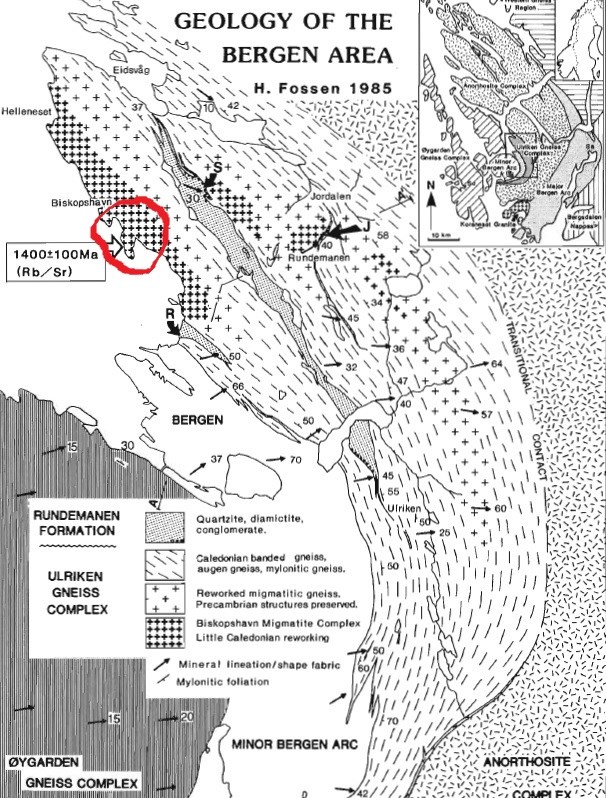 Geology of the Bergen Area, Fossen (1988)
Migmatitt er en kombinasjon av metamorfe og magmatiske bergarter dannet ved høyt trykk og høy temperatur dypt nede i jordskorpen. Migmatiter opptrer ofte som granittisk (GC5M9F6) eller gneissaktige lagdelte bergarter (GC5523G) som består av mørke slirer og bånd som i en lys grunnmasse. Denne observeres ved GZ og WP som en lys rødfarget bergart.
En granitt (GC5M9F6) er en bergart som har trengt opp fra dypet som en smeltemasse og størknet. Den består av mineralene kvarts, kali-feltspat (har ofte rød farge), se bildet over og plagioklas (har ofte hvit farge). Det siste er en feltspat-variant som inneholder natrium og kalsium. I tillegg har en granitt noen mørke mineraler som biotitt (glimmer) og hornblende. Når en granitt blir utsatt for tektoniske krefter i jordskorpa, slik som for eksempel under fjellkjedefoldninger, blir den omdannet til en gneis. Gneisen har da fortsatt granittisk sammensetning, men på grunn av deformasjonen blir den båndet eller sliret og får ofte masse lyse feltspat-årer som 'svetter' ut av granitten. Det er på grunn av disse strukturene i bergarten vi kaller det for en gneis.
Vi kan ved både GZ og WP1 observere grå til svarte innskutte gangbergarter av amfibolitter.
Amfibolitt er en middelskornet, mørk, metamorf bergart bestående av hornblende og plagioklas med mindre mengder kvarts. Amfibolitt er typisk svakt lagdelt og har en salt-pepper lignende farge. Dette utseende er utpreget for bergarten ved GZ. Amfibolitt dannes ved middels sterk regional metamorfose av ekstrusive (vulkanske) og intrusive basiske bergarter, slik som basalt og diabas.
Amfibolittene har igjen mindre årer av grovkornede pegmatiske materiale. VI kan også observere flotte pegmattiske kvartser (GC5KDZ0) ved foten av berget ved WP1.
 Amphibolite (dark) at GZ - photo: sveinivar
English version:
The geology in the Bergen area consists of five tectonic areas with their special properties. These are the Øygarden Gneis complex (GC5523G), The Minor Bergen Arc (GC5523F), The Major Bergen Arc (GC5M9F6), The Ulriken Gneis complex (GC5K5EV) and the Lindås nappe (GC5NAAR & GC5MXN3). The Biskophavn Migmatite Complex (BMC) is of Precambrian (±1400Ma) age and is a part of the Ulriken Gneiss complex which again is a part of the Bergen Arcs system.
The Biskophavn Migmatite Complex is a complicated formation wht construction in both time and space. This earth cache will give the logger insight in some of the rocks that the formation consists of. Further on, the logging task will require you to reflect on the sequence of formation of some of the rocks you will be introduced to.
Migmatite is a rock that is a mixture of metamorphic rock and igneous rock. It is created when a metamorphic rock such as gneiss (GC5523G) partially melts, and then that melt recrystallizes into an igneous rock, creating a mixture of the unmelted metamorphic part with the recrystallized igneous part. Migmatites often appears as gneissian foliated rocks with dark patterns in a lighter matrix. This is cleary visible at GZ and WP1 as a rock with a slightly pink colour.
A granite (GC5M9F6) is a igneous rock which is formed from hot, molten magma. Granite is a common type of felsic intrusive igneous rock which is granular and phaneritic (coarse grained) in texture. Granites can be predominantly white, pink, or gray in color, depending on their mineralogy. By definition, granite is an igneous rock with at least 20% quartz and up to 65% alkali feldspar by volume. Gneiss (GC5523G) is a common and widely distributed type of rock formed by high-grade regional metamorphic processes from pre-existing formations (for instance a granite) that were originally either igneous or sedimentary rocks. It is often foliated (composed of layers of sheet-like planar structures). The foliations are characterized by alternating darker and lighter colored bands, called "gneissic banding".
We can observe on our walk from GZ to WP dykes of amphibolites.
Amphibolite is a grouping of rocks composed mainly of amphibole and plagioclase feldspars, with little or no quartz. It is typically dark-coloured and heavy, with a weakly foliated or schistose (flaky) structure. The small flakes of black and white in the rock often give it a salt-and-pepper appearance. These properties are pronounced for the rock at GZ. Amphibolite is a metamorphic rock consisting mainly of the mineral amphibole which denotes a group of generally dark-colored, inosilicate minerals of which Hornblende is the main component of Amphibolite.
The amphibolites are themselves intruded by pegmatites net-veining the amphibolites. We can also observe some large beautiful pragmatic quartz (GC5KDZ0) at the foot of the rock at WP1.
______________________________________________________________________________
Oppgaven i denne earth cachen er å identifisere, karakterisere og måle de ulike bergartene som er beskrevet over ved å starte ved GZ og gå til WP1.
The logging requirements to this earth cache are to identify, characterize and measure the various rocks described above in a walk from GZ to WP.
Please email me any suggestions for improvements, corrections or additions to the text of this cache.
Send the answers by e-mail via the cache owner's profile page on Geocaching.com. You can log immediately after you have emailed me your answers.
Send svarene på spørsmålene via min email. Du kan logge straks etter at du emailet meg svarene på spørsmålene.
Logs without answers emailed to CO or with pending questions from CO will be deleted without any further notice.
Logger uten at jeg har mottatt svar på spørsmålene blir sletter uten forvarsel.
Spørsmål/Questions:
- Ved GZ kan du observer en gangbergart av type Amfibolitt. A) Hvordan vil du karakterisere overflaten til denne bergarten mht ruhet. B) Hvordan vil du karakterisere denne bergarten mht farge og lagdeling? C) Hvor bred er denne gangbergarten (i cm) i gjennomsnitt ved GZ ?. At GZ you can observe the dyke of Amphibolite A) How would you characterize the surface with respect to roughness/smoothness B) How would you characterize the colour with respect to foliation and colour variations ? C) What is the average width (in cm) of the dyke ?
- På veien fra GZ til WP vil de se en del av gneis, den rødlige bergarten. A) Hvordan vil du karakterisere overflaten mht ruhet B) Hva er estimert kornstørrelsen i mm ? On your walk from GZ towards WP you will find the gneissian (pink) rock. A) characterize the surface with respect to roughness/smoothness B) Estimate the size of the grains ?
- Ved WP kan du observer en annen amfibolitt. Du kan tydlig se årer av pegmattiter. A) Hvordan vil du karakterisere pegmatittene mht kornstørrelse B) Hva er typisk bredde i cm på disse pegmatittårene ? A WP you can observe a second dyke of Amphibolite. You can clearly see some vein patterns of pegmatites in the amphibolite. A) How would you characterize the grain size of the vein pattern. B) What is the average width in cm of these veins ?
- I hvilken sekvens antar du at bergartene Amfibolitten, Gneissen og de pegmatiske årene i amfibolitten ble dannet. Forklar antagelsen din. In what sequence do you estimate the rocks Amphibolite, the Gneissian rock and the pegmatic veins in the Amphibolite were created? Explain your answer.
- Se den flotte pegmatittiske kvartsen ved foten (rett over sanden) ved WP. Enjoy the beautiful pegmatite at the foot (just above the sand) of the rock at WP. Ta et bilde av deg, din GPS eller kvarts pegmatitten uten å rope svarene på spørsmålene over. Take a picture of your, your GPS or the pragmatic quartz without revealing any of the answers to the questions above.
Sources:
Haakan Fossen (1988) The Ulriken Gneiss Complex and the Rundemanen Formation: a basement-cover relationship in the Bergen Arc, West Norway. Nor. Geol.unders. Bull. 412 67-86.
Wikipedia