A BRIEF HISTORY OF THE LOCATION
Today's Rover Park is at the junction of two old cape estates, namely “Woodside” and “Firlands”. It was once a fertile farmland well watered from the Keurboom River. When you are standing at GZ reflect that this place was once farmland irrigated from the stream that is now trapped in a concrete canal a few meters away. From the 1933 map you can see that in times past an extension of Sandown Road crossed the Keurboom stream close to where you are standing.
“Woodside” was a freehold grant given to Andries Daniele Grove in February 1790. The first mention of a dwelling on “Woodside” was in 1796. In 1811 the property was owned by Isaac Stromboom, a ships chandler. Diagrams show a “wagenpad” leading to Woodside. Isaac grew fresh fruit and vegetables to supply his business in Simonstown.
The original freehold of “Firlands” was held in 1789 by Johannes Bletterman, eldest son of Hendrik Bletterman, an important official of the Cape who lived in Table Valley, Cape Town.
In 1901 the South African War was raging. Food shortages and poor sanitary and medical conditions resulted in very high death rates amongst Cape Town's refugee children. This led Mrs T E Marsh to conceive the idea of a children’s home. In his will, her father-in-law, Mr William Marsh, left half of his wealth for the “construction and maintenance of houses for orphaned and destitute children”. The Rev T E Marsh, his son, purchased the Woodside estate. The foundation stone of the Home was laid in 1902 and the first children arrived in what was to become the Marsh Memorial Home for Children in 1903. The Firlands estate was purchased by the Home in 1921.
To finance the operations of the Home portions of the Woodside and Firlands estates were sold at various times for freehold suburban development. The Sangrove subdivision of freehold properties and the Woodside life-rights retirement village being the most recent erosion to the extent of the original estates. The name Firlands is preserved in the name of a street close to the park and Woodside is preserved in the name of the neighbouring retirement village.
The Marsh Memorial Homes are known for their pioneering work in child care. Children live in groups under the care of social workers who endeavour to give them the experience of as near a normal family environment as possible. The concept of Family Preservation is used to address at source the problems that the children “at risk” have experienced. Marsh Memorial Homes seeks to assist families to overcome their problems so that their children may return to live with them at home.
Rover park is one of the few small patches of open space left on the banks of the Keurboom river that marks the eastern boundary of Rondebosch.
Enjoy it!
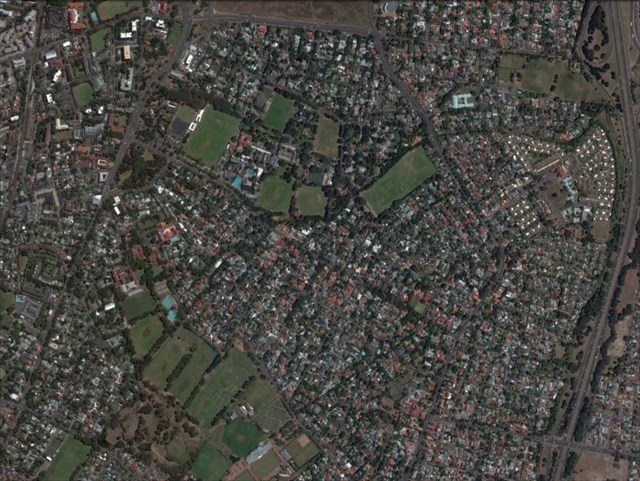
2015 Aerial Image of Rondebosch
Covering same area shown on 1933 Map