Welcome to the 2015 Cabell County GeoTrail: LOST HUNTINGTON, sponsored by the Cabell Huntington Convention and Visitors Bureau (CVB)
This trail is comprised of 10 caches.
Each site has a code word that you have to fill in on the LOST HUNTINGTON playcard which can be picked up at the Visitors Center.
Once these cards are turned in to the CVB and verified, you will be asked to fill out a very short information card and you will receive the 2015 custom made trackable geocoin. The contact information for the Cabell Huntington CVB is:
Address: 210 11th St, Huntington, WV 25701
Phone:(304) 525-7333 M-F 9 to 5 and Saturday 10-5. If you need to pickup a coin on Sunday, email cachencabell@gmail.com
HISTORY
This cache and listing will feature history at two Huntington locations, both within walking distance of each other.
COLLIS POTTER HUNTINGTON

Collis Potter Huntington (October 22, 1821 – August 13, 1900) was one of the Big Four of western railroading (along with Leland Stanford, Mark Hopkins, and Charles Crocker) who built the Central Pacific Railroad as part of the first U.S. transcontinental railroad. Huntington then helped lead and develop other major interstate lines such as the Southern Pacific Railroad and the Chesapeake & Ohio Railway (C&O), which he was recruited to help complete. The C&O, completed in 1873, fulfilled a long-held dream of Virginians of a rail link from the James River at Richmond to the Ohio River Valley. The new railroad facilities adjacent to the river there resulted in expansion of the former small town of Guyandotte, West Virginia into part of a new city which was named Huntington in his honor.
Collis Huntington was the son of William and Elizabeth (Vincent) Huntington; born October 22, 1821, in Harwinton, Connecticut. His family farmed and he grew up helping. In his early teens, he did farm chores and odd jobs for neighbors, too, saving his earnings. At age 16, he began traveling as a peddler. About this time, he visited rural Newport News Point in Warwick County, Virginia in his travels as a salesman. When he saw opportunity blooming in America's West, he set out for California, and established himself as a merchant in Sacramento at the start of the California Gold Rush. Huntington succeeded in his California business, too, and it was here that he teamed up with Mark Hopkins selling miners' supplies and other hardware.
His involvement in the Republican Party induced an interest in the railroad issue. In November 1860 Huntington attended a lecture on the subject. Afterward he invited the speaker to meet in private. The scheme laid out by Theodore Judah tantalized the storekeeper. Judah's survey enabled construction of a wagon road into Nevada Territory, on which Huntington could charge tolls. Better yet, the new Republican administration might reward the survey and subsequent lobbying efforts with the keys to the Pacific railroad. Huntington sensed a fantastic opportunity. If he was wrong, he'd still have the wagon road. There was little to lose. Huntington agreed to invest and brought in Hopkins, Leland Stanford, and Charles Crocker to do the same. From this initiative sprang the Central Pacific Railroad Company.
Of the four, he had a reputation for being the most ruthless in pursuing the railroad's business and the ouster of his partner, Stanford. Huntington negotiated with Grenville Dodge in Washington, D.C. They completed their agreement in April 1869, deciding to meet at Promontory Point, Utah. On May 10, 1869, at Promontory, the tracks of the Central Pacific Railroad joined with the tracks of the Union Pacific Railroad, and America had a transcontinental railroad. The joining was celebrated by the driving of the golden spike.
He married, first, on September 16, 1844, Elizabeth Stillman Stoddard, of Cornwall, Connecticut. She died in 1883. He remarried on July 12, 1884, Arabella D. Worsham. He died at his Camp Pine Knot, in the Adirondacks, August 13, 1900. He is interred in a grandiose private mausoleum at the Woodlawn Cemetery, Bronx, New York. He was the father of 9 and also adopted 2.
HUNTINGTON FIRE DEPARTMENT
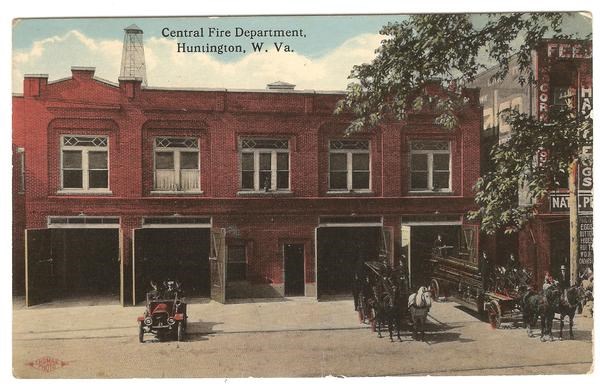
Huntington's Central Fire Station opened in the 700 block of 3rd Avenue in 1914, in an era when firefighters still galloped to fires behind pumpers and ladder wagons hauled by trained teams of spirited horses. The station would remain the Huntington Fire Department's headquarters for an incredible 58 years.
The picture postcard of Central Station reproduced with this article was postmarked in 1915. It shows only one piece of motorized fire equipment, a chief's car, most likely a Model T Ford. On display in front of the station with it are a pumper and a ladder wagon, both horse-drawn. Stubborn old-timers insisted that the new-fangled internal combustion engine would never replace a sturdy team of horses, but time proved them wrong. By the early 1920s, Central Station had put its horses out to pasture.
The station served the department well for decades but ultimately became sadly outmoded and, eventually, an embarrassment to the city. Long-time Fire Chief John Gallagher repeatedly urged its replacement but his pleas fell on deaf ears.
Finally, in 1972, the department moved out, relocating to the new Centennial Station, erected at 7th Avenue and 9th Street and named in honor of the city's 100th birthday. Later the old Central Station would be demolished, to be replaced by the Big Sandy Superstore Arena.
THE CACHE
At the posted coordinates, you will be looking at a prominent statue at CSX Headquarters, the former C&O Railway. THERE IS NO CONTAINER HERE. To find where you need to go next, you will need to go west 293 feet to the corner of 7th Avenue and 9th Street. Permission has be granted.
Special thanks to Clive and Juliana for hiding this cache.
