Proteins! They are a vast and diverse collection of molecular structures that do the bulk of the work in all living organisms. They can serve in signaling processes such as to trigger antibody production to boost our immune system or to break down glycogen to increase our blood sugar levels when needed. They can act as catalysts (enzymes) to allow all sorts of energetically unfavorable reactions to occur such as the metabolism of glucose to produce energy (ATP) and be used in the commercial large-scale production of high fructose corn syrup from corn starch. Other proteins serve structural or mechanical roles such as ones found in muscle and bone or the scaffolding of a cell. Proteins come in all shapes and sizes: large and small, globular and fibrous, water and membrane (fat) soluble. Besides all they’re differences, all proteins share 20 building blocks known as amino acids (AA) which form a linear polymer in a unique sequence to form each specific protein.

"Protein composite" by Thomas Splettstoesser (www.scistyle.com) - Own work (rendered with Cinema 4D). Licensed under CC BY-SA 3.0 via Wikimedia Commons.
So where do all these different proteins come from? Our DNA function stores the information needed for each protein (sort of a blueprint) in what are called genes. DNA is another type of polymer that is created by unique sequences composed of 4 base units (nucleotides: A-adenine, G-guanine, C-cytosine, T-thymine). DNA is found in a double helix arrangement where 2 different complementary strands are bound to each other with 2 specific bases bonding from one strand to the other (G-C and A-T). A DNA sequence is read from left to right (5’ to 3’). DNA is eventually converted to RNA and ultimately read (translated) on the ribosome and constructs the amino acid polymer (seen below with RNA threading through right to left of ribosome and protein slowly excreting linearly upwards)

"Protein translation" by Bensaccount at en.wikipedia. Licensed under CC BY 3.0 via Wikimedia Commons.
To determine the protein that will be produced from a given gene we must follow the universal rules laid out by the cellular machinery known as the Genetic code. This code states that every three sequential bases (termed a codon) codes for a specific amino acid (such as GTC would yield Valine or AGA gives Arginine).
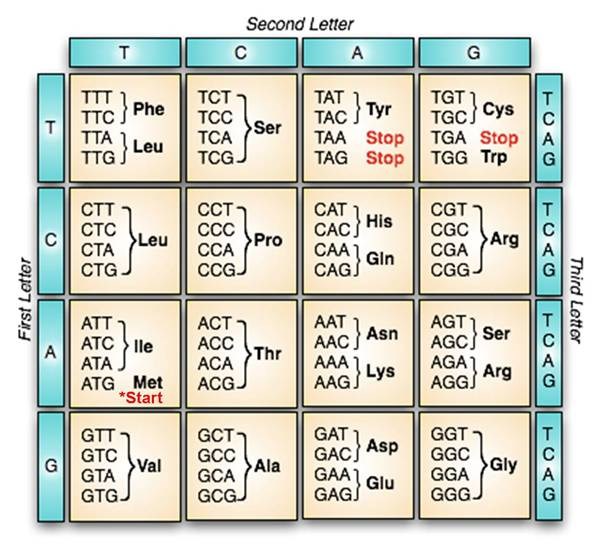
Many amino acids possess redundant codons since 64 codons (4^3) exist for 20 amino acids as well as START and STOP signals that tells the cell machinery when to start/stop making the protein. Protein translation doesn't begin until it comes across a START codon and it will stop when it reaches a STOP codon. This means that not all of the included codons will be a part of the final protein
I am going to give you a DNA sequence that codes for a 10 amino acid protein (decapeptide) that you will need to decipher using the genetic code.
I've also attached a reference table assigning numbers to each amino acids. Using this key, the sequence of the 10-residue peptide will fill in the empty coordinates to find the physical cache in that order:
N36° (#-1st AA) (#-2nd AA) . (#-3rd AA) (#-4th AA) (#-5th AA)
W94° (#-6th AA) (#-7th AA) . (#-8th AA) (#-9th AA) (#-10th AA)

The DNA strand for protein translation
TAT-ACC-TTT-TAC-AGG-AAA-CCA-ACG-ATG-TTA-TAC-TTT-CAA-GCT-TAT-GCA-GTG-CCC-TAG-GTT-CAG-CTG-GGG
Feel free to send me an email if you need additional hints on how to solve the puzzle or if you have difficulty finding the cache.

You can validate your puzzle solution with
certitude.