Totara
Common name: Totara
Botanical name: Podocarpus totara

The totara at GZ
Totara is a tall forest tree, growing as tall as 30 m with a trunk diameter up to 2 m. A visually similar species is Hall’s totara (P. hallii), which grows to 20 m tall with a trunk diameter up to 1.25 m. Both can be found in lowland forest up to 600 m altitude, but above 500 m P. totara normally gives way to P. hallii. They can be found in most podocarp forests in the North Island, Peel Forest in Canterbury and in Westland and Fiordland.
Totara was prized by Maori more highly than any other forest tree because of the qualities of its timber. The heartwood is very durable and Maori found the wood could be readily split and shaped with the stone tools that they used in pre-European times for waka, buildings and carving. The same properties made it valuable for the first European settlers for house and wharf piles.
Leaves
Adult leaves are 15 to 30 mms long and 3 to 4 mms wide; juvenile leaves are narrower, only 1 to 2 mms wide. On P. hallii the juvenile leaves are both longer (50 mms) and wider (4 to 5 mms). Juvenile totara leaves are quite sharply pointed at the tips, so that brushing past one with bare skin can irritate almost as much as brushing past gorse!
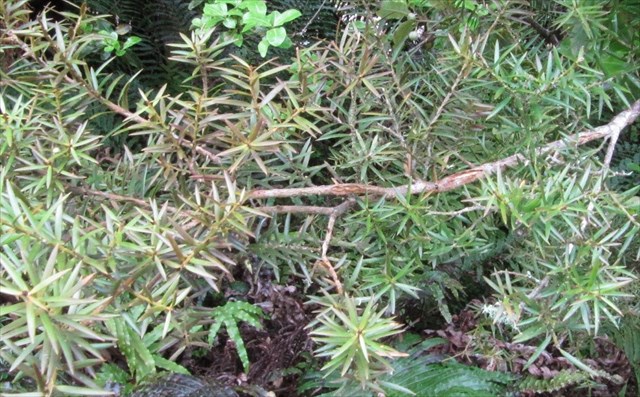
Juvenile foliage

Adult foliage
Cones and seeds
Totara bear male cones and female ovules on separate trees. Pollen is shed from the male cones in November to December. The ripe seed has a bright red swollen fleshy receptacle at its base.
Bark
The bark is vertically furrowed and grey-brown: for P. totara it is thick, stringy and usually deeply furrowed; for P. hallii it is thin, flaky and more paperlike, this being the most obvious difference between the two species.

P. totara bark
The Cache
The cache is a small dark glass Our Mate jar, big enough for small TBs or Geocoins only, and at time of placement contained a log sheet only. Please make sure you take your own pencil or pen to sign the log. Online logs that are not supported by an entry in the paper log will be deleted. Please make sure you rehide the cache carefully where found after signing the log as it is very close to the path and we don’t want it to be muggled. As the path is straight and carries numerous pedestrians at all times of the day and days of the week, some stealth and/or an extended wait may be required at GZ to find and replace the cache.
While you are in the vicinity of GZ you can see some other good specimens of totara as well as some other native trees that already have been featured in this series of caches. See if you can identify nearby Tawhairauriki, Ti Kouka and Kahikatea trees.