This cache can carefully be performed as a cache and Dash. However do take time to admire and touch the tactile rocks. Please email me your answers to claim this cache as a find.
Kentish Ragstone
Kentish ragstone is a hard grey limestone in Kent, England, drawn from the geological formation known as the Hythe Beds of the Lower Greensand. For centuries it has been quarried for use both locally and farther afield.
Geology
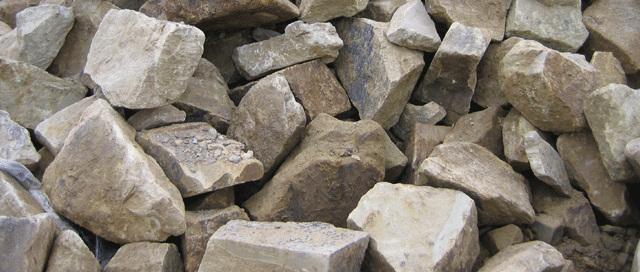
Ragstone occurs in a geological formation known in the Hythe Beds of the Lower Greensand, a layer of limestones running from Kent into Surrey which was laid down in the Cretaceous period. It outcrops in various places, notably at the cliffs of Hythe, Kent (whence it gets its name) and along the Greensand Ridge above the Weald of Kent. Ragstone occurs in bands between 15 cm and 60 cm thick, alternating with bands of a loose material called Hassock. These bands are of similar thickness and the difference in colour between them gives quarry faces a striped appearance. When the stone is extracted from the quarry, it appears to be of a grey green or blue grey colour but later weathers to an autumnal hue which, together with its hard-wearing properties, traditionally made it an attractive material for public building works.
From 1066, the Normans constructed a large number of public buildings using ragstone, such as Westminster Abbey and theTower of London, castles such as Rochester and Leeds, and churches such as All Saints and the Holy Cross churches in Maidstone. Other examples in Kent include the keep at Dover Castle, Westgate in Canterbury, Knole House, Ightham Mote, the Archbishop's Palace, Maidstone and Maidstone Prison.
Only two ragstone quarries are operational in Kent, the Hermitage Quarry in Barming and Blaise Farm near King's Hill, but there are plans to extend the former quarry into Oaken Wood, Ditton. Although the Hermitage Quarry continues to meet the traditional demand for building stone for use in modern buildings, this is on a reduced scale from the past. Modern demand is busy and diverse, however, with about 60 different products being required for use in the ready mix concrete, road building and engineering industries. Larger blocks of ragstone are also used in the construction of sea barriers against coastal erosion.
The Cache:
1. How long ago was the Cretacious period?
2. Describe the texture and colour of the rocks. Why is the colour different to when the stone is first quarried?
3. Over time what is the enemy of exposed quarried rocks?
4. How tall is the vertical rock and how long is the horizontal rock?
5. On the large rock there are some metal protrusions! Why do you think that they are there? How many are there?
6. Do you think that these rocks are naturally occurring where they are? Please justify your answer.
Optional:
7. Post a photo of yourself by one of the stones ensuring not to give away information to other people..