Belshaw's Quarry was once an industrial centre and source of employment for local people over many years. Quarrying operations stopped at the Quarry in the 1950's and it is now managed by the Northern Ireland Environment Agency and has been declared an Area of Special Scientific Interest. Mother nature is slowly reclaiming parts of the quarry and it is now home to wildflowers, bird life, common blue butterflies and dragonflies.
Enter the quarry via the gateway at N 54 32.193 W 006 06.143 being sure to read the information board located there to enable you to answer Question 1.
As you proceed into the Quarry, the first thing that you will notice are the two very different rock types, the white rock at the bottom (limestone) and the black rock at the top (basalt).
Belshaw's Quarry - Basalt (top) and Limestone (bottom)
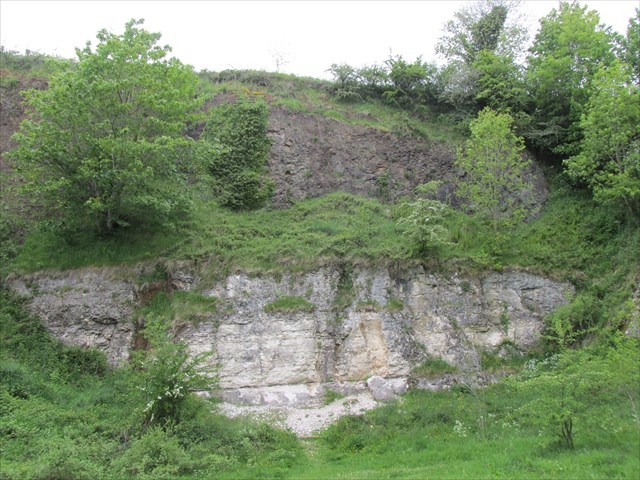
Let's deal with the Basalt first. Proceed to N 54 32.218 W 006 06.185:-
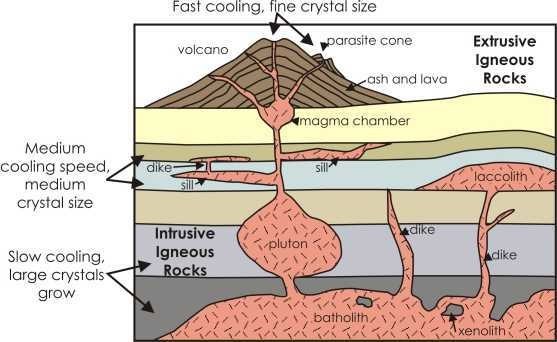
Here you will be standing in front of a quarry face made of black rock called basalt. Basalt was formed as a result of volcanic activity. Around 66 million years ago huge cracks opened in the Earth’s surface and molten rock (or magma) surged up from below. Once above ground, magma is known as lava, and as the lava flowed out the series of lava flows covered a huge area of land stretching from the Giant’s Causeway to just outside Belfast! The lava flows are arranged as horizontal layers which can be traced along the face of the quarry. It is estimated that the Antrim Basalt Plateau (the largest such plateau in Europe) was originally around 1km high reduced to it current thickness by over 60 million years of erosion.
If you look carefully you will notice a vertical sheet in the basalt that cuts through the horizontal layers. This is a feature known as a dyke and formed after the basalt. A dyke is a vertical crack into which molten rock has been injected. These vertical sheets may have been the magma feeders for surface lava flows or may not have reached the surface. Certainly molten material in the ‘crack’ did not reach the surface so it cooled and hardened beneath the ground and formed a vertical sheet of solid rock within the pre-existing basalt.
Formation of Basalt © NIEA (used with permission)
The dyke here is made up of a rock called dolerite which is very similar to basalt, making this feature difficult to spot! However being the kind Cache Owner that I am, a photo of the Dyke at Belshaw's Quarry is included below. Notice that the main joints in the dolerite dyke are horizontal whereas the cooling joints in the basalt lavas are generally vertical.
Belshaw's Quarry Dyke
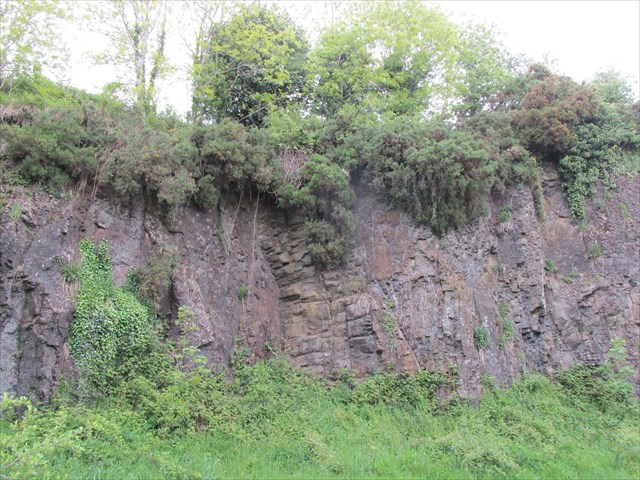
Be sure to study the dyke and adjoining basalt closely to enable to answer you to answer Question 2.
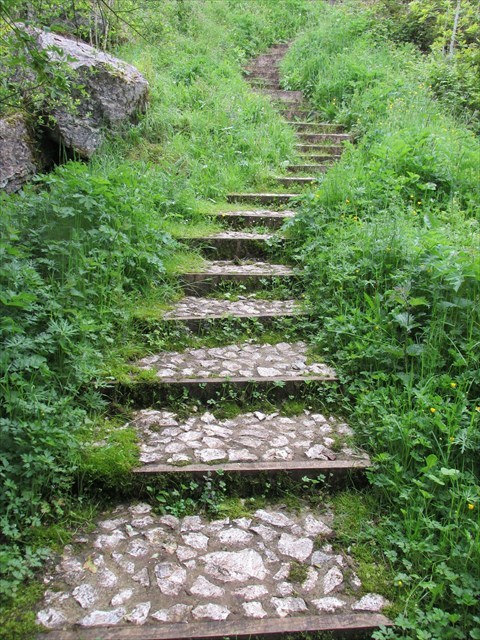
Now it's time to deal with the Limestone. Make your way down the limestone steps being sure to do a few calculations to enable you to answer Question 3.
Belshaw's Quarry - Limestone Steps
When you reach the bottom of the steps, you are now standing on the Quarry floor (base). This is made up of 150-250 million year old mudstone, formed in the Cretaceous Period when hot sandy deserts were successively flooded and dried out in the Triassic period. However we are going to focus on limestone so make your way to N 54 32.238 W 006 06.132.
Belshaw's Quarry - Limestone and Basalt faces
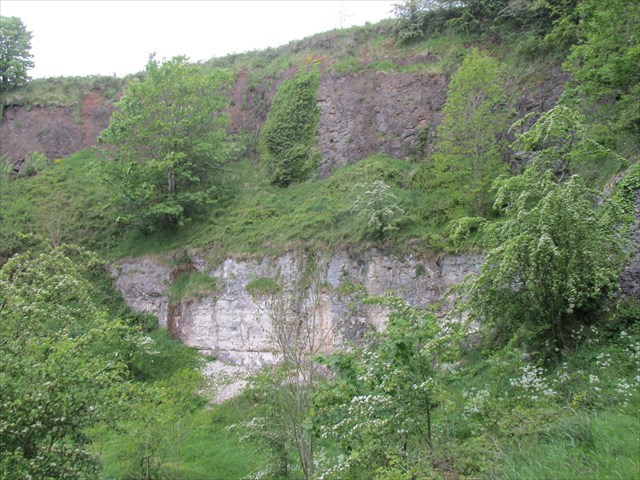
The white rock you see in front of you on the lower face is a very pure limestone (Ulster White Limestone) known as chalk that formed about 75 million years ago when this area was covered by a clear, tropical sea.
Rocks of this age come from the Cretaceous period – part of the Age of the Dinosaurs but rocks of this age in Ireland are formed from marine deposits and so no dinosaur fossils have been found. In the warm sea water, tiny sea plants called coccoliths swam about. When they died, their chalky shells settled on the bottom to form a deep deposit. Over the years, their chalky shells (sediment) was compressed to form solid rock and subsequent earth movements raised it. Limestone is formed in layers called bedding planes. In the chalk you might find the fossil remains of extinct squid-like sea creatures known as belemnites.
Photo of Belemnite Fossil In Limestone
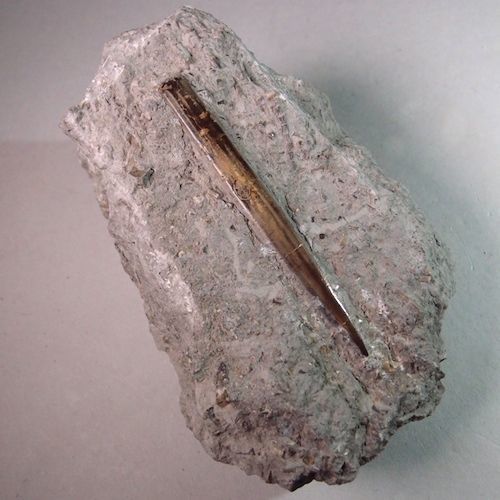
The limestone face is approximately 12 metres high and contains both young and old limestone beds. at the top and bottom of the face respectively. Limestone of this age is found widely in the Belfast Hills. It was of considerable commercial importance in the past used mainly in the production of agricultural lime for domestic use and export. Abandoned limestone quarries will often have an old lime kiln nearby. Limestone like the material at Belshaws is still quarried at a number of sites around Northern Ireland including Glenarm and Kilwaughter. Products include agricultural lime, ingredients in toothpaste and animal feeds as well as materials for the construction industry.
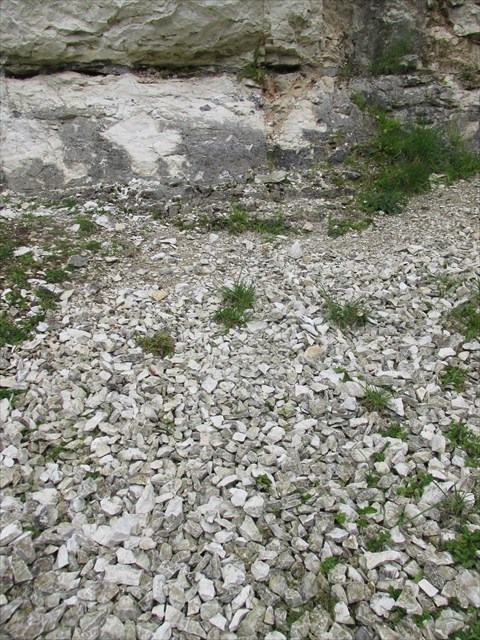
You will need to study the limestone face carefully to ascertain if it is a horizontal or vertical bed of limestone to enable you to answer Question 4 and examine one of the many limestone stones near the bottom of the face to enable you to describe their texture / colour etc to enable you to answer Question 5.
Belshaw's Quarry - Limestone Stones
To claim this as an Earth Cache find, you must find out the answers to the following questions:-
Question 1:- When you enter the quarry at N 54 32.193 W 006 06.143 you will find and information board. While this Earth Cache focuses on Basalt and Limestone which are the prominent features in the quarry, there are other types of stone to be found. Find out the name of the stone/rock which forms the base of the quarry.
Question 2:- At N 54 32.218 W 006 06.185 you will have a view of a dyke, a vertical fissure in the lavas filled with basalt. Although the dyke and the lavas are made of almost identical material, the dyke stands out because of its very different joint (crack) pattern. Visually compare the dyke to the basalt to the left of same (as you face it) and describe how the basalt differs from the dyke.
Question 3:- Also at N 54 32.218 W 006 06.185 you are standing on what would be known in quarry terms as the floor of the first face / top of the second face. Your task here is to estimate the height from the floor of the first face / top of the second face to the base of the quarry. You will need to proceed down the limestone steps to calculate this. It may be beneficial to assume that each step is 7" / 18cm high.
Question 4:- At N 54 32.238 W 006 06.132 you will find yourself standing close to the front of the limestone face. Carefully study the face and ascertain if the limestone bed is a horizontal or vertical bed and explain how you formed this conclusion.
Question 5:- Also at N 54 32.238 W 006 06.132 there are numerous small, limestone stones at the base of the limestone face. Describe one to me (i.e. colour / texture / hard or brittle etc.).
Question 6 (Optional):- Take a photograph with you and your GPSr with the limestone and basalt face in the background.
Please log your find after sending your e-mail containing the information requested above and if you've taken one, feel free to upload your optional photograph. Do not include any of the required information in your online log.
Additional Notes
Please ensure that your visit to Belshaw's Quarry is carried out in line with the Leave No Trace Principles. Take only memories, leave nothing but footprints.
Special Thanks
Published with the permission of The Northern Ireland Environment Agency.