Let us begin with an introduction to the wonderful world of the Rubik’s Cube :
· There are exactly 43,252,003,274,489,856,000 possible permutations of the cube. [http://ruwix.com/the-rubiks-cube/mathematics-of-the-rubiks-cube-permutation-group/]
· All of them can be solved in 20 moves or less. [http://kociemba.org/cube.htm]
· The current world record was set by Collin Burns, who solved a scrambled cube in 5.25 seconds. [https://www.youtube.com/watch?v=i8RBl7NmL8g]
Now before attempting this cache, I would recommend finding yourself a nice Rubik’s Cube (one that you haven’t rearranged all the stickers to say that you solved it). That’s an old trick don’t you think? Perhaps it is time for you to actually solve a cube!
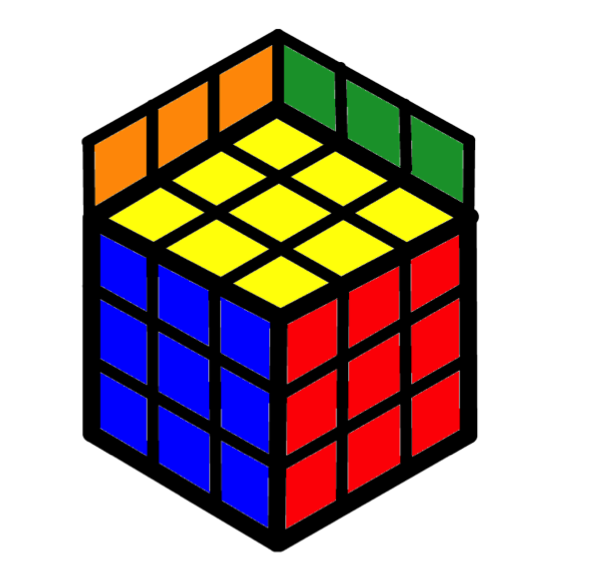
You should know two things before starting this challenge, first of all, the pictures I will be using throughout this puzzle are views of a standard cube, with the back of the top layers shown on top (orange and green). The following shows a cube in it’s solved state, next to four pictures showing an equivalent state. All light grey squares are assumed to be solved.
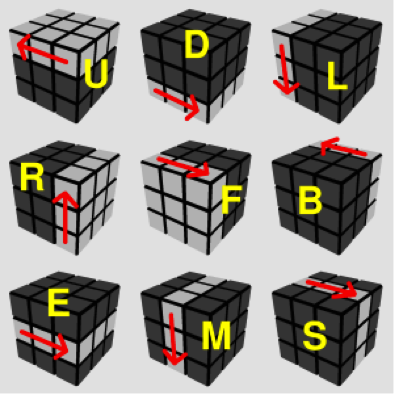
The second thing you need to know before taking on this puzzle, is how to move a Rubik’s cube. Below is a nice explanation of how a cube can be turned:
|
|
|
[http://grrroux.free.fr/method/Intro.html]
|
This notation is the most used notation in the cubing world. The six main face turns (U,D,L,R,F,B) all represent rotations of their respective faces (Up, Down, Left, Right, Front, Back). Shown in the picture are standard moves defined by a “clockwise rotation if you were looking directly towards that face”. A rotation in the other direction is generally shown using an apostrophe (“ ‘ “), or a “prime” in cubing lingo. There are therefore three moves that can be performed on one particular face.
1. A single rotation in the clockwise direction (ie. F,R,U…)
2. A double rotation in either direction (ie. F2,R2,U2…)
3. A single rotation counter-clockwise (ie. F’,R’,U’…)
a. Note, this could be considered equivalent to R3, three clockwise rotations
Note: Four rotations in either direction returns the face to its original position.
For purposes of this puzzle, turning the blue face will always be an ‘F’-type move, while turning the red face will always be a ‘R’-type move.
Now that you are an expert, it is time to test your knowledge. Your mission, should you choose to accept it, is to solve a partially scrambled cube with the help of a multiple-choice exam.
Your answers will determine the coordinates of the cache.
N 43.PQ.RST W 079.VW.XYZ
|
Q1 (P,Q)
|
Q2 (R,S)
|
Q3 (V,W)
|
Q4 (X,Y)
|
Q5 (T,Z)
|
|
A)
|
4,2
|
8,5
|
2,2
|
2,8
|
1,8
|
|
B)
|
4,1
|
8,3
|
2,2
|
2,9
|
6,9
|
|
C)
|
4,2
|
8,8
|
2,3
|
3,0
|
2,3
|
|
D)
|
4,1
|
7,9
|
2,3
|
3,1
|
9,0
|
Start with this cube:
|
|
|
[Solved State]
|
Apply the following transformation:
- F R U R’ U’ S R U R’ U’ S’ F’
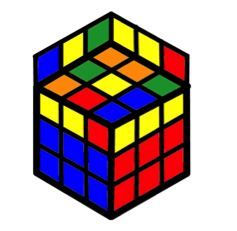
You should now have the following:
|
|
|
[Scrambled State]
|
You will now be asked to solve the cube in 5 steps, with each step getting you closer to the location of the cache.
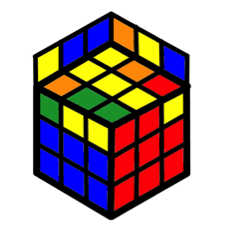
Q1 : Starting with the [Scrambled State], your target is to get to [State 1].
|
|
|
[State 1]
|
Which of the following algorithms achieves the desired permutation?
a) F R U R’ U’ R U R’ F'
b) R U R’ U R U2 R’ F R U F’ U’ F’
c) R U2 R2 F R F’ R U2 R’
d) R’ U’ F’ U F R
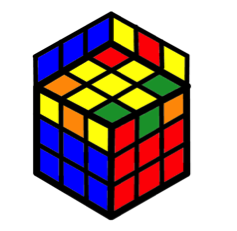
Q2 : Starting with the [State 1], your target is to get to [State 2].
|
|
|
[State 2]
|
Which of the following algorithms achieves the desired permutation?
a) F U R U’ R2 F’ R U R U’ R’
b) R U R’ U’ R’ F R F’
c) U R’ U’ R’ F R F’ U R
d) R B’ R’ U’ R U B U’ R’
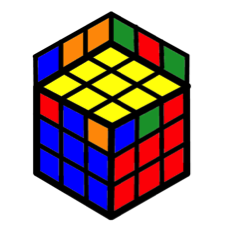
Q3 : Starting with the [State 2], your target is to get to [State 3].
|
|
|
[State 3]
|
Which of the following algorithms achieves the desired permutation?
a) F R U R’ U’ R U R’ U’ R U R’ U’ F’
b) F U2 R’ R’ F R F’ U2 R’ F R F’
c) U’ R U R’ U R U’ R’ U R U2 R’
d) R U R’ U R U2 R’
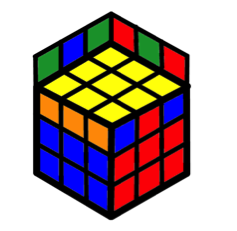
Q4 : Starting with the [State 3], your target is to get to [State 4].
|
|
|
[State 4]
|
Which of the following algorithms achieves the desired permutation?
a) R U R’ F’ R U R’ U’ R’ F R2 U’ R’ U’
b) R’ U2 R U2 R’ F R U R’ U’ R’ F’ R2 U’
c) F R U’ R U R U R’ F’ R U R’ U’ R’ F R F’
d) U' R U R’ U’ R’ F R2 U’ R’ U’ R U R’ F’
Q5 : Starting with the [State 4], your target is to get to [State Solved].
|
|
|
[State Solved]
|
Which of the following algorithms achieves the desired permutation?
a) R2 U R U R’ U’ R’ U’ R’ U R’
b) M2 U M2 U M’ U2 M2 U2 M’ U'
c) U2 R U’ R U R U R U’ R’ U’ R2 U'
d) U2 L U L U’ L U’ L U L’ U L2 U'