Watchet is famous for a number of reasons. The most well known is the link with the poem 'The Rime of the Ancient Mariner' by Samuel Taylor Coleridge. Secondly, the Folk song collector, Cecil Sharp, met and recorded the songs of a local Shantyman, Yankee Jack.
The harbour was used by the minerals trade and the paper mill until recent years and is now a marina with ship repairers on the harbourside.
The geology of the area includes both cliff and shoreline and is an area where it's possible to discover fossils as the area dates from the Mesozoic era.
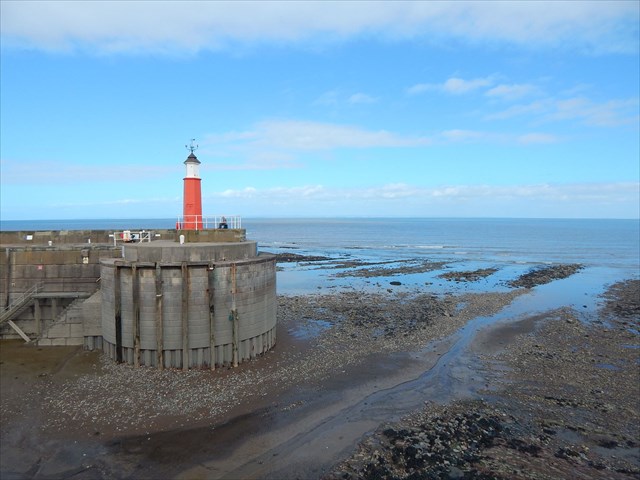
The Lighthouse on the harbour wall. Watchet.
The Mesozoic Era
Many hundreds of years ago the area would have looked quite different to what you can see today. The fossils of pre-historic creatures have been discovered in the rocks here, indicating the types of creatures which lived here and in the water.
Sedimentary rocks
Layers of sediment have created the striped effect which can be seen from the co-ordinates, along the foreshore and cliff.
Not far away, in next bay, can be seen the fault line where Triassic red marl sandstone is present. At some point, the land shifted and the older Triassic rock pushed its way through, moving the layers of sedimentary rocks to the angle that can be seen today and revealing the colours of the rock layers which had built up. The blue coloured rock is responsible for the name Watchet Blue.
Sand, made of silica and mud, made of clay minerals was layered over time and sediments were steadily buried over geologic time, packed together under pressure and low heat, not much more than 100°C. In these conditions the sediment is cemented into rock: sand became sandstone and clay became shale. If gravel or pebbles are part of the sediment, the rock that forms is conglomerate . If the rock is broken and recemented together it is called breccia . These layers of rock are called Strata
The cliffs and foreshore below you, show seaward-dipping Triassic marls and siltstones and are being rapidly worn away/eroded b weathering and action from the sea. A footpath on the clifftop leads eastwards to steps down to the foreshore where the East-West trending Doniford Bay Fault may be viewed. There are many cracks in the layers of rock in the cliff face between the steps and the harbour.
Further to the east the overlying Pleistocene valley gravels and brickearths descend to beach level and show cryoturbation (frost damaged) structures.
Forces of Nature
The Atlantic Ocean is responsible for some of the wear seen along this shoreline. However, The Bridgwater Bay tsunami or tidal surge of 1607 would have brought the cobbles to the beach.
Cliff retreat is a problem and, if you have time, do visit the Jubilee Geological Wall on the station platform plus Watchet Museum on the west side of the harbour. Low tide allows exploration of the Triassic marls, siltstones, shales, bone bed and Jurassic limestones. This is an unrestricted area for hunting for fossils and nearby shops will provide you with information and equipment if interested.
To be able to log this earth cache...
At the co-ordinates you should be able to see the different colours in the rock formations which today form the shoreline.
The best time to visit this earthcache is when the tide is out though it is possible to see what has happened to the rock as long as you have good light.Check tide times. Do NOT go at high tide.
When you are at the co-ordinates, look at the shoreline below and to the east of where you are standing.
Q1 You are looking at the layers of sedimentary rock... the exposed strata. What colours can be seen in the rock layers?
Q2 From the Co-Ordinates, estimate the angle from vertical that the rock along the shore has shifted from horizontal.
Q3 Describe why you think the rocks below the high tideline are smooth but those near to the cliff are not. (Hint: Look at the type of rocks you have here)
We hope you have enjoyed finding out a little more about this part of the coastline. Please email or message your answers to the questions before logging a find. A photo of yourself at the beach or of your GPSr would be great to see but is not a requirement of logging this cache. Unfortunately, if you log a find without messaging/emailing us the answers your log will be deleted.