In 1100 1010, the fifteenth episode of Star Trek: The Next Generation, the USS Enterprise puts in to spacedock for repairs by the Bynars, a technologically advanced race that communicates in base 2, or binary. The binary number system uses only the digits 0 and 1 to represent information.
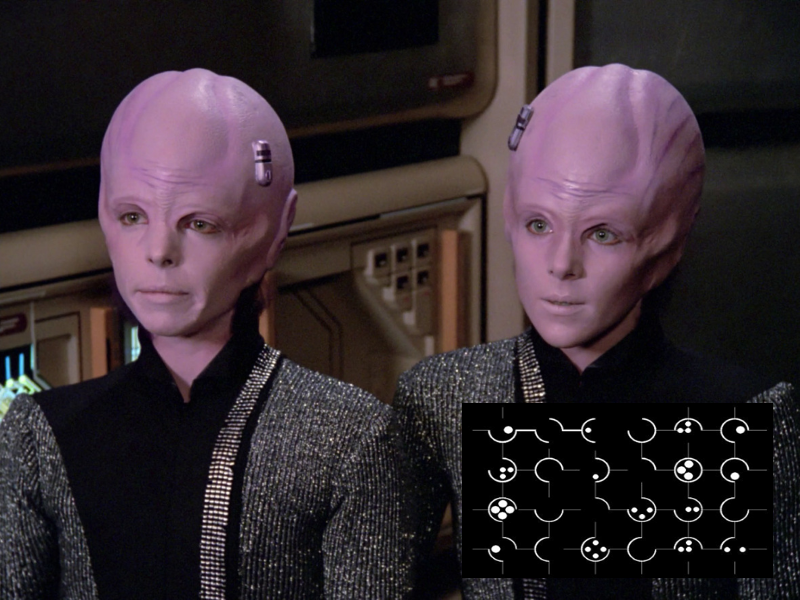 The Bynars and an example of their (presumably binary) language.
They perform the repairs but also temporarily take over the Enterprise main computer for their own purposes. To distract the then-beardless Commander Riker, they steer him in the direction of Minuet, a beautiful and sophisticated…program written in binary.
 You never forget your first holodeck love.
The use of two distinct tokens to achieve communications over long distances is one of the oldest patterns of communications. Even techniques as old as drumming and smoke signals often used two distinct signals to construct and transmit complex messages.

Samuel Morse, a portrait painter who lived and worked in 18th-century America, used a binary technique when he (and others) developed Morse Code, a system designed to transmit messages over the newly-invented single-wire telegraph and later used in radio. Morse Code uses combinations of “dots” and “dashes” (often spoken aloud as “dit” and “dah”) to represent letters and numbers.
.- “dit dah” is A
-… “dah dit dit dit” is B
-.-. “dah dit dah dit” is C
…and so on.

Why, yes, I did live long before radio or television and heard modern music perhaps a few times a year but was still culturally sophisticated enough to use the opening bars of Beethoven’s 5th Symphony for “V” in my code. I also painted this self-portrait of me, myself, and helped invent the telegraph. What have you accomplished?
Today every computer encodes information as binary integers. One early approach, called ASCII, was to use “bytes” consisting of eight binary digits to encode letters, numbers, and punctuation symbols. For convenience, those eight-bit binary numbers are often represented as two characters in base 16, or hexadecimal. In hexadecimal we need sixteen characters, so we the letters A-F as well as the digits 0-9.
0010 0001 binary = 21 hexadecimal represents the letter A
0010 0010 binary = 22 hexadecimal represents the letter B
…
0011 1010 binary = 3A hexadecimal represents the letter Z
…and so on
But early computer memory was limited in capacity and was extremely expensive
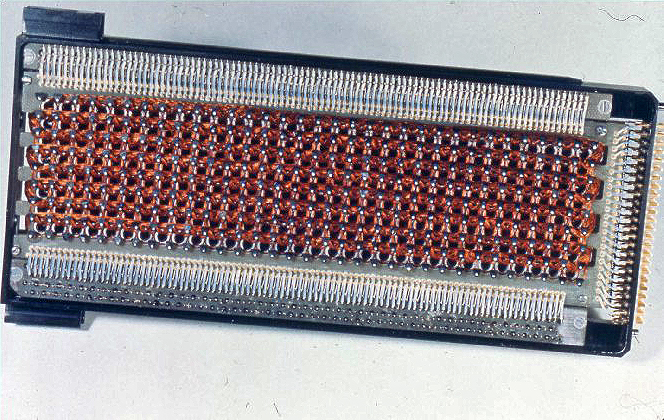 48K core-rope memory used in the Apollo Guidance Computer. Don’t ask what it cost.
So very early computer character schemes used six bits to encode characters, rather than eight. One such scheme, an early variant of ASCII called ECMA-1, encoded letters in six bits as
10 0001 A
10 0010 B
10 0011 C
…and so on
In modern terms, this meant that they could squeeze four characters into three bytes.
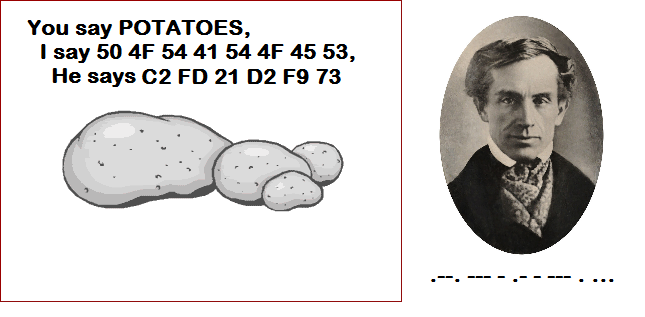
No matter how complex our data, it all boils down to binary and encoding schemes. The future belongs to those who understand binary and the various ways that binary is used to efficiently encode information.