
Welcome to the historic Cheesman Park Pavilion. This neoclassical structure was designed in 1889 and completed in 1902 in honor of Denver pioneer Walter Cheesman, whose family donated the funds for the structure. The pavilion is mainly comprised of Yule Marble, a very pure white marble quarried right here in Colorado and widely acclaimed for its quality and purity. Yule Marble has been used for many prominent buildings including Denver City and County Building, the Colorado National Bank building, the Denver Federal Reserve Bank, Union Station. It was also, notably, used in the construction of the Lincoln Memorial in Washington, D.C. and the Tomb of the Unknowns in Arlington, Virginia.
Yule Marble (Colorado's Official State Rock) is a marble of metamorphosed limestone found only in the Yule Creek Valley, in the West Elk Mountains of Colorado, 2.8 miles (4.5 km) southeast of the town of Marble, Colorado. First discovered in 1873, it is quarried today inside a mountain at 9,300 feet (2,800 m) above sea level, in contrast to most marble, which is quarried from an open pit and at much lower elevations.
The forces that created Yule Marble make it distinct from all other American marbles. It was formed by contact metamorphism, in which the mineralogy and texture of the body of rock was changed by exposure to the pressure and extreme temperature associated with a body of intruding magma. This is unlike Vermont marble and Georgia marble, which are the result of regional metamorphism, a process more associated with the orogeny and erosion of mountain ranges on a regional scale and tennessee marble which does not undergo metamorphism, so is not true marble, which is metamorphic.
The Yule Marble is a metamorphic facies of the regionally distributed Leadville Limestone of Mississippian age deposited 350 million to 324 million years ago. The Leadville within the Yule area was transformed by contact metamorphism that occurred during the latest Eocene and Oligocene epochs (34 million to 28 million years ago) associated with the intrusion and uplift of the nearby granitic Treasure Mountain Dome. The uplift of the Treasure Mountain Dome tilted the limestone away from the intrusion resulting in the marble bed dipping at an angle into the mountain. The marble unit along with older and younger adjacent units in the Yule Valley have a north-northwest strike paralleling the valley and variable dips of 35 to 50 degrees to the west-southwest. This local contact with the heat and pressure from the intrusion of hot granitic magma recrystallized the Leadville Limestone into a distinctive white marble. Although the Leadville Limestone covered hundreds of square miles and was the ore host at the Leadville mining district, the Yule Creek Valley is the only known location of marble in the region. When the magma cooled, it crystallized into granite.
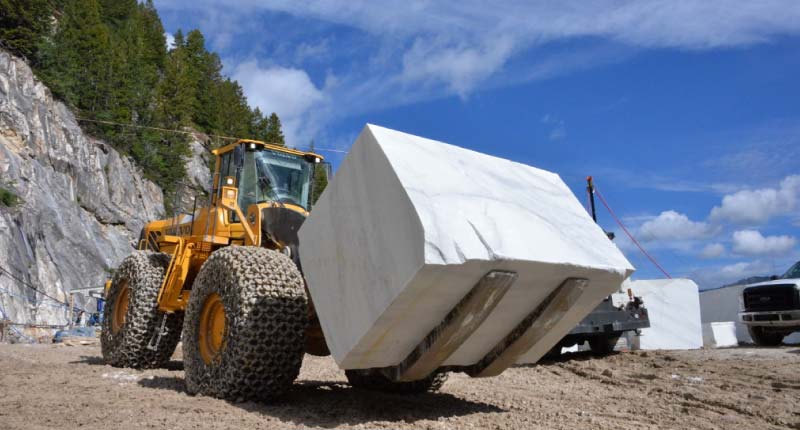
The localized geology created a marble that is 99.5% pure calcite, with a grain structure that gives a smooth texture, a homogeneous look, and a luminous surface. It is these qualities for which it was selected to clad the exterior of the Lincoln Memorial and a variety of buildings throughout the country, in spite of being more expensive than other marbles. The size of the deposits enables large blocks to be quarried, which is why the marble for the Tomb of the Unknowns, with its 56-long-ton (57 t) die block, was quarried from Yule Marble.
Yule Marble's quality comes at a high price due to the cost of quarrying in a high-altitude mountain environment. This challenge has caused the industry and the town of Marble to undergo many boom-and-bust periods since quarrying started in the mid-1880s, making the town emblematic of the economic fluctuations that beset a single-industry economy. Technology advancements in quarrying machinery and transportation have reduced, but not solved, the cost problem that afflicts the operation through the present.
To claim credit for this geocache, please e-mail me the following -
1. Is Yule Marble considered a soft or a hard rock? Do you think it would easily shatter?
2. Is the Yule Marble is fine-grained or coarse-grained?
3. Looking closely at a section of Yule Marble, what colors of minerals do you see, especially in the intrusions / veins?
4. Run your fingers along an uncurved length of Yule Marble. Is the marble perfectly smooth, or are there small dips and peaks? Measure (approximately) the size of a dip/peak if you find one.
5. As an optional extra take a picture of yourself and/or your GPSr with the Pavilion in the background and post it with your log.