A group of Muppets with Jim Henson in the middle.
The Muppets are a group of puppet characters known for an absurdist, burlesque and self-referential style of variety-sketch comedy. Created in 1955 by Jim Henson, they are the namesake for the Disney media franchise that encompasses films, television series, music recordings, print publications, and other media associated with The Muppet Show characters.
The Muppets were the stars of multiple television series and films, including; The Muppet Show (1976–1981), The Muppet Movie (1979), The Great Muppet Caper (1981) and The Muppets Take Manhattan (1984). After Henson's death in 1990, The Muppets continued their presence in television and cinema with Muppets Tonight (1996–1998), a series continuation of The Muppet Show, and three films, The Muppet Christmas Carol (1992), Muppet Treasure Island (1996), Muppets From Space (1999), the former two were co-produced with Disney, who sought to acquire the characters since the late 1980s. In 2004, The Walt Disney Company purchased the rights to The Muppets, and later formed The Muppets Studio, a division created specifically for managing The Muppets franchise.
Disney underwent an extensive re-branding of the franchise beginning in 2008, in anticipation of the seventh film; The Muppets. The film, written by Jason Segel and Nicholas Stoller and directed by James Bobin, was released by Walt Disney Pictures on November 23, 2011, and met with critical acclaim and commercial success. The eighth film, Muppets Most Wanted, was released in 2014.

Fozzie Bear (which is a common design for a Muppet)
is a character with a very wide mouth and large protruding eyes.
The puppets are often molded or carved out of various types of foam, and then covered with fleece, fur, or other felt-like material. Muppets may represent humans, anthropomorphic animals, realistic animals, robots, anthropomorphic objects, extraterrestrial creatures, mythical beings or other unidentified, newly imagined creatures, monsters, or abstract characters.
Muppets are distinguished from ventriloquist "dummies"/"puppets", which are typically animated only in the head and face, in that their arms or other features are also mobile and expressive. Muppets are typically made of softer materials. They are also presented as being independent of the puppeteer, who is usually not visible—hidden behind a set or outside of the camera frame. Using the camera frame as the "stage" was an innovation of the Muppets. Previously on television, there would typically be a stage hiding the performers, as if in a live presentation. Sometimes they are seen full-bodied. This is done by using invisible strings to move the characters' bodies and mouths, and then adding the voices later.
Muppets tend to develop, as writer Michael Davis put it, "organically", meaning that the puppeteers take time, often up to a year, slowly developing their characters and voices. Muppets are also, as Davis said, "test-driven, passed around from one Henson troupe member to another in the hope of finding the perfect human-Muppet match".
When interacting with Muppets, children tended to act as though the Muppets were living creatures, even when they could see the puppeteers.
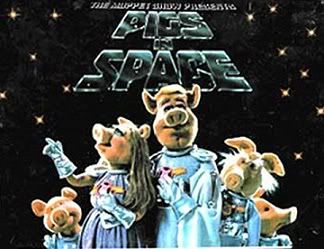
Pigs in Space is a recurring sketch from The Muppet Show, featuring the exploits of Captain Link Hogthrob, First Mate Piggy, and Dr. Julius Strangepork leading a crew of pigs aboard the Swinetrek. The sketch, in concept, is essentially a parody of Star Trek, Lost in Space, Battlestar Galactica, and other "TV space operas" of the 1960s and 70s.
Pigs in Space first appeared on The Muppet Show during the second season. The recurring sketch became a popular part of the series, appearing in 32 episodes over four seasons. During the sketch's first year, Pigs in Space began with an introduction featuring the crew's commanding roster. Each introduction, narrated by Jerry Nelson as the Announcer, used several different humorous adjectives to describe the characters by name. This was dropped starting with the third season.
Star Wars C3PO, R2D2, and Luke Skywalker on the Starship Swinetrek
The popularity of Pigs in Space won the sketch a spot on the second Muppet Show cast album released in 1978. The script for the skit used in episode 205 was re-recorded in the studio by the performers. That same year, the events of the sketch from episode 209 were translated to the pages of The Muppet Show Book, as illustrated by Tudor Banus.
The height of pop-culture awareness for the crew of the Swinetrek occurred in 1981. As part of NASA's morning wake-up call tradition, by which the crew of the space shuttle are awakened with stirring music, familiar song lyrics, or comedy routines in order to boost morale and encourage camaraderie between the astronauts and their mission control colleagues, the crew of the Space Shuttle Columbia were greeted by Pigs in Space on two consecutive mornings. Specially recorded by the Muppet performers for this occasion, two separate comedy routines were heard, one on the morning of November 13, and another on November 14, where it followed a rendition of "Columbia, Gem of the Ocean" by a flight directorate band.
The Swinetrek
Outside of The Muppet Show, animated Pigs in Space segments were featured on Little Muppet Monsters. Later, on Muppets Tonight, the sketch was revived as Pigs in Space: Deep Dish Nine (The Next Generation of Pigs in Space), a parody of the many Star Trek spinoffs, including Star Trek: The Next Generation and Star Trek: Deep Space Nine.
Pigs in Space continued to be a recurring theater sketch in The Muppet Show Comic Book by Roger Langridge.
Since the 1950's when Jim Henson created the Muppets, they have been a welcome addition into our culture and will be for many years to come with new creations and characters being created in the style and the same affections as Jim Henson originally gave to his "inanimate" creations.
orthnay ourfay wotay wotay
ourfay hreetay hreetay inenay estway
erozay ighteay hreetay neoay
inenay wotay wotay evensay