Hannibals trail (Katschberg)
Hannibal's crossing of the Alps
Hannibal Barca (247 – between 183 and 181 BC) was a Carthaginian general. During the second Punic War in Italy (218–204 BC) Hannibal made his famous attempt to cross the Alps with an entire army with approximately 38.000 infantry, 8.000 cavalry, and 38 elephants.
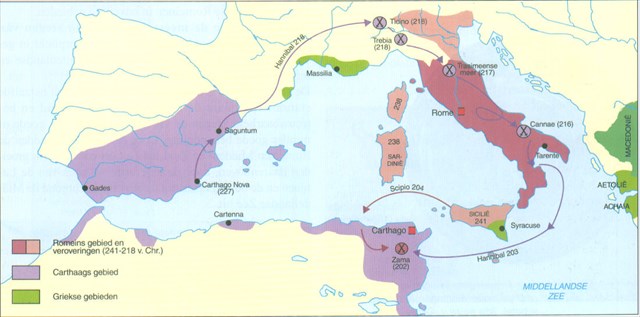
Rome versus Carthago
The journey was originally planned by Hannibal's brother-in-law Hasdrubal the Fair, who became a Carthaginian general in Iberia in 229 BC. He maintained this post for eight years until 221 BC. Soon the Romans became aware of an alliance between Carthage and the Celts of the Po River valley in Northern Italy. The Celts were amassing forces to invade farther south in Italy, presumably with Carthaginian backing. Therefore, the Romans pre-emptively invaded the Po region in 225 BC. By 220 BC, the Romans had annexed the area as Gallia Cisalpina. Hasdrubal was assassinated around the same time (221 BC), bringing Hannibal to the fore. It seems that the Romans lulled themselves into a false sense of security, having dealt with the threat of a Gallo-Carthaginian invasion, and perhaps knowing that the Carthaginian commander had been killed.

Hannibal’s route of invasion
Hannibal departed New Carthage in what is now south-east Spain in late spring of 218 BC. He fought his way through the northern tribes to the foothills of the Pyrenees, subduing the tribes through clever mountain tactics and stubborn fighting. He left a detachment of 20,000 troops to garrison the newly conquered region. At the Pyrenees, he released 11,000 Iberian troops who showed reluctance to leave their homeland. Hannibal reportedly entered Gaul with 40,000 foot soldiers and 12,000 horsemen.
Hannibal recognized that he still needed to cross the Pyrenees, the Alps, and many significant rivers. Additionally, he would have to contend with opposition from the Gauls, whose territory he passed through. Starting in the spring of 218 BC, he crossed the Pyrenees and reached the River Rhône, by conciliating the Gaulish chiefs along his passage, before the Romans could take any measures to bar his advance, arriving at the Rhône in September. Hannibal's army numbered 38,000 infantry, 8,000 cavalry, and 38 elephants, almost none of which would survive the harsh conditions of the Alps.

Army in the snow
Hannibal and his men crossing the Alps.
Hannibal outmanoeuvred the natives who had tried to prevent his crossing, then evaded a Roman force marching from the Mediterranean coast by turning inland up the valley of the Rhône. His exact route over the Alps has been the source of scholarly dispute ever since. (Polybius, the surviving ancient account closest in time to Hannibal's campaign, reports that the route was already debated.) The most influential modern theories favour either a march up the valley of the Drôme and a crossing of the main range to the south of the modern highway over the Col de Montgenèvre or a march farther north up the valleys of the Isère and Arc crossing the main range near the present Col de Mont Cenis or the Little St Bernard Pass. Recent numismatic evidence suggests that Hannibal's army may have passed within sight of the Matterhorn.

Possible routes
By Livius's account, the crossing was accomplished in the face of huge difficulties. These Hannibal surmounted with ingenuity, such as when he used vinegar and fire to break through a rockfall. According to Polybius, he arrived in Italy accompanied by 20,000 foot soldiers, 4,000 horsemen, and only a few elephants. The fired rockfall event is mentioned only by Livius; Polybius is mute on the subject and there is no evidence of carbonized rock at the only two-tier rockfall in the Western Alps, located below the Col de la Traversette. If Polybius is correct in his figure for the number of troops that he commanded after the crossing of the Rhône, this would suggest that he had lost almost half of his force. Historians have questioned the reliability of the figures for the number of troops that he had when he left Hispania. From the start, he seems to have calculated that he would have to operate without aid from Hispania.

A modern day attempt
Hannibal's vision of military affairs was derived partly from the teaching of his Greek tutors and partly from experience gained alongside his father, and it stretched over most of the Hellenistic World of his time. Indeed, the breadth of his vision gave rise to his grand strategy of conquering Rome by opening a northern front and subduing allied city-states on the peninsula, rather than by attacking Rome directly. Historical events which led to the defeat of Carthage during the First Punic War when his father commanded the Carthaginian Army also led Hannibal to plan the invasion of Italy by land across the Alps.
The task was daunting, to say the least. It involved the mobilization of between 60,000 and 100,000 troops and the training of a war-elephant corps, all of which had to be provisioned along the way. The alpine invasion of Italy was a military operation that would shake the Mediterranean World of 218 BC with repercussions for more than two decades. And people are talking about it today …

Surviving the alps
The cache
Hannibal had to make accurate bearings to plan his crossing. Let’s see if you can do the same…
Waypoint 1.
Here you will find one of the elephants that was involved in the crossing. As you can see it fell down in the snow (or in the earth, regarding of the season you are visiting Katschberg). Make a bearing from the head of the elephant: (approximately) 180 degrees south. About 60 meters further south you will find one the instruments that was used to communicate with the huge force during the crossing.
Waypoint 2.
As mentioned earlier here you will find here one the instruments that was used to communicate with the huge force during the crossing. It also stayed behind. Make a bearing from the mouthpiece of this instrument: 245 degrees southwest . About 78 meters further southwest you will find a group of trees. Here you will find the cache. To find the cache you will probably have to cross through deep snow, like Hannibal did. But regarding to the season the snow might be gone which will make it much easier. Look for a small green waterproof cylinder. Write your name in the logbook to proof you managed to cross this alp … Put the cache back the way you found it (or better, if it obviously wasn’t put back the way it was intended to be). Take care.
Though it can be quiet here, there are also moments there are muggles around. So use stealth when needed…
Happy caching!
Marrakesj
