
 This location brings you near a short (5 to 7 foot high) cliff/gully. Be careful moving around the area and do not add to the erosion.
Pedology is the study of soils. This study includes the formation, morphology, and classification of soils. Here we will look at the morphology of soil.
While there are many definitions of soil, soil can be considered a natural body consisting of layers (horizons) of mineral and/or organic constituents which differ from the parent materials in their morphological, physical, chemical, and mineralogical properties and their biological characteristics
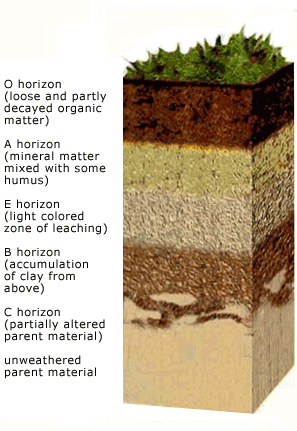 The soil horizons typically can be easily identified by their color and physical characteristics. There are other differences such as pore size and chemical composition, but they can't be examined without laboratory testing. The horizons are based on the dominant soil forming process occurring in that layer. There are six Master Horizons or major classifications of soil horizons.
These are:
- O – decomposing plant material.
- A – organic material mixed with minerals.
- E – sand and silt particles that are resistant to decomposition. Typically lighter than the A horizon. Eluviation (the loss of silicate clay, iron and/or aluminum, predominates)
- B – accumulation of silicate clay, iron, aluminum, carbonates, and or gypsum
- C – has not been much affected by soil formation, may look like the bedrock
- R – Unweathered Bedrock.
Additional lowercase letters and numbers are given to further describe variations within a Master Horizon. The following link profides a simplified version of the how the horizons could be futher described. http://www.petrik.com/PUBLIC/library/misc/aw5_s_layers.htm or http://www.pedosphere.ca/resources/sg_usa/mhorizons.cfm.
The thickness, presence or absence of layers, and characteristics of each horizon together make up a soil profile.
The ocean waves maintain a small cliff exposing a soil profile. There is no need to do any digging yourself to expose the profile.
Logging questions:
- The text "GC6DPMT Soil Horizons at Leo Carillo" on the first line.
- How many people are in your group
- A description of the soil profile exposed in the cliff face, including the estimated thicknesses of each horizon. (note: you may not see all the horizons)
The above information was compiled from the following sources:
- http://www.uvm.edu/place/analyze/soil_horizons.html
- http://www.ncat.edu/~lik/wetland/SoilHor.htm