
 The San Ardo oil field was discovered in 1947. Oil reservoir is found in the Aurignac and Lombardi Sands of the Monterey Formation. These sands were deposited on a shallow marine shelf during the Miocene. Now they have been buried between 2,000 and 2,500 feet below the surface.
A very gentle doubly plunging anticline trending northwest-southeast provides the structural trap. An anticline looks like a sheet of papers folded into an arch. Doubly plunging means that top part of the arch angles down into the earth on both sides making what looks like an elongated dome. This anticline likely formed sometime between the Plio- and Pleistocene age.
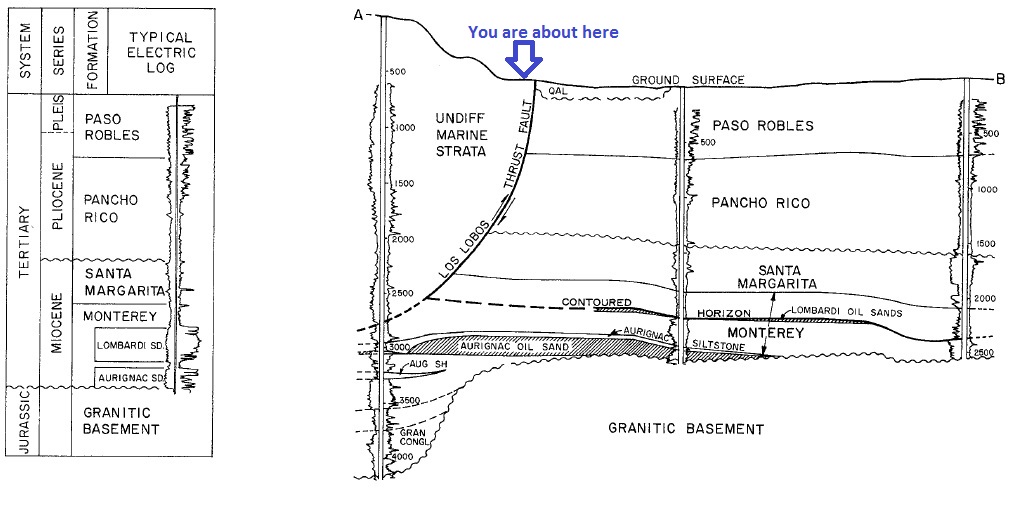 Changes in the sediment characteristics also trap the oil. To the west, north, and south, the grain size of the Aurignac and Lombardi Sands decreases into less permeable material. This change in sediment size that prevents the oil from continuing to migrate is the sedimentary trap. None of this geology can be seen from the surface.
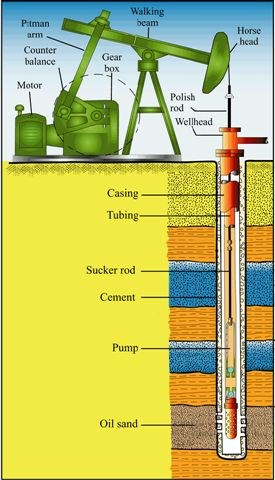 The only surface features are the many oil pump jacks extracting oil. The pump jacks move a sucker rod up and down in the oil well. The up and down motion alternately sucks in a mixture of oil and water (called an emulsion) from the reservoir into the casing and pulls that mixture up in the casing. The operation of one of the main designs is shown in this video https://www.youtube.com/watch?v=SFJFiyXTOa0. At the surface, the oil and water mixture is pumped to a holding tank to be processed. The amount of oil and water extracted on each cycle is dependent upon the diameter of the casing and the length of each stroke.
Logging requirements:
Send me a note with:
- The text "GC6DPN9 San Ardo Oil Field" on the first line
- The number of people in your group (put in the log as well).
- Calculate how much oil is extracted from one of the moving oil jacks per minute. Assume that each stroke of the jack extracts 0.5 gallon and 10% of the emulsion is usable oil.
- Using the above calculation, estimate how much oil is being extracted from the field per day. Use the following formula:
(Answer from above)x(60 minutes)x(24 hours)x(estimate of the number of jacks operating)
The following sources were used to generate this cache:
- All Pumped Up Oilfield Technology. 3/19/2016. http://aoghs.org/technology/oilwellpump/
- Nicholaus Driscoll and Winston Seiler. Introduction To The San Ardo Field. April 29, 2014 Tuesday 2:00 P.M. Pacific Section AAPG, SPE and SEPM Joint Technical Conference, Bakersfield, California
- William C. Kempner. Undated. The San Ardo Field 3-D Seismic Survey: Design, Acquisition, and Preliminary Results. ChevronTexaco, Bakersfield, CA
- California Department of Conservation Division of Oil, Gas, and Geothermal Resources. 1992. CALIFORNIA OIL & GAS FIELDS Volume II – Southern, Central Coastal, and Offshore California Oil and Gas Fields (CD-1) Contour maps, cross sections, and data sheets for California’s oil and gas fields